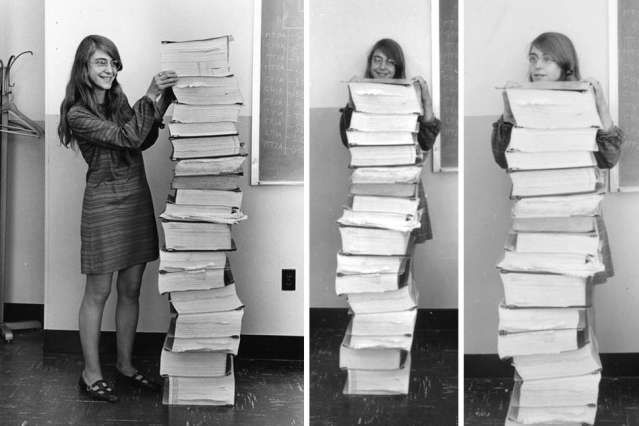
A picture of Margaret Hamilton, programmer for the Apollo space program, standing next to not one single microsoft error message or bluetooth problem.
-
@mhoye I use the first pic to teach the difference between the purpose of a caption and alt text, with a guerilla casual mention of how much we owe Hamilton and similar minimized women.
-
@sarajw @lerxst @mhoye here's a decent article on the subject (despite being on the guardian) https://www.theguardian.com/careers/2017/aug/10/how-the-tech-industry-wrote-women-out-of-history
-
@sarajw @lerxst @mhoye here's a decent article on the subject (despite being on the guardian) https://www.theguardian.com/careers/2017/aug/10/how-the-tech-industry-wrote-women-out-of-history
-
@eons yeeep:
"But by the 1970s, there was a change in mindset and women were no longer welcome in the workplace: the government and industry had grown wise to just how powerful computers were and wanted to integrate their use at a management level. “But they weren’t going to put women workers – seen as low level drones – in charge of computers,” explains Hicks. Women were systematically phased out and replaced by men who were paid more and had better job titles."
-
@eons yeeep:
"But by the 1970s, there was a change in mindset and women were no longer welcome in the workplace: the government and industry had grown wise to just how powerful computers were and wanted to integrate their use at a management level. “But they weren’t going to put women workers – seen as low level drones – in charge of computers,” explains Hicks. Women were systematically phased out and replaced by men who were paid more and had better job titles."
Also:
If women had continued to be a major force in computing, instead of being sidelined, the way the tech industry looks today would have been very different, she argues. “If women had been a more important part of the high tech industry all along, would so many platforms and apps have the same problems with rampant sexism and misogyny both in their workplaces and their products? Most likely not.”
-
@janxdevil @sarajw @mhoye I don't recall any of these women being mentioned in my courses at UMich. But I knew Grace Hopper coined "computer bug" (but it was an actual bug, a moth, that fried itself on a circuit). Probably just picked up in outside reading. I learned about Kay from reading about ENIAC, because the EECS department had a slice of it (1/10th) on display. I learned about Margaret because... a colleague of mine at the UM Computing Center looked like her. https://websites.umich.edu/~umvm/MIDAC/midac_eniac.html
@janxdevil @sarajw @mhoye oh, this book sounds interesting! https://eniacprogrammers.org/
-
In 2017 Margaret Hamilton was inducted into the Computer History Museum's Hall of Fellows. On that occasion I was privileged to accompany her on a private, docent-guided tour of the Museum's public display.
She looked about the same as she does in these pictures from the 1960s, albeit a little grayer; a bright, diminutive grandma.
But she was very humble and human. At one point we rounded a corner into the Apollo section. Prominently in the front of the exhibit was a reproduction of your left-hand photo. Upon seeing it, Margaret stopped and exclaimed, "Oh my gosh! Is that me?"
As Margaret explained it to me, NASA wanted the lunar lander's actual landing to be 100% automated with no manual override. She disagreed, and insisted on implementing an override. NASA didn't like the idea but Margaret just went ahead and wrote it.
Of course, on Apollo 11's final approach, the lander was headed for a field of giant boulders. Neil Armstrong used Margaret's code to override the computer and manually divert to the actual, safer, landing point.
-
A picture of Margaret Hamilton, programmer for the Apollo space program, standing next to not one single microsoft error message or bluetooth problem.
@mhoye just look at her now
-
@mhoye just look at her now
@Kierkegaanks wtf is this
-
@Kierkegaanks wtf is this
@mhoye as per alt text, microsoft uses copilot to write code now and their latest update was so thoroughly borked by some margin they had to revoke it at once for lacking necessary files
-
A picture of Margaret Hamilton, programmer for the Apollo space program, standing next to not one single microsoft error message or bluetooth problem.
i can see mackenzie davis playing her in the biopic.
-
A picture of Margaret Hamilton, programmer for the Apollo space program, standing next to not one single microsoft error message or bluetooth problem.
@mhoye 1201
-
On a more serious note, I didn't realize that Hamilton coined the term "software engineer".
Blame!
It is the cure,
cure anything
Throw the rudder down, throw the rudder down -
In 2017 Margaret Hamilton was inducted into the Computer History Museum's Hall of Fellows. On that occasion I was privileged to accompany her on a private, docent-guided tour of the Museum's public display.
She looked about the same as she does in these pictures from the 1960s, albeit a little grayer; a bright, diminutive grandma.
But she was very humble and human. At one point we rounded a corner into the Apollo section. Prominently in the front of the exhibit was a reproduction of your left-hand photo. Upon seeing it, Margaret stopped and exclaimed, "Oh my gosh! Is that me?"
@mralancooper @mhoye The kid and I are big fans…
-
A picture of Margaret Hamilton, programmer for the Apollo space program, standing next to not one single microsoft error message or bluetooth problem.
@mhoye zero HN posters can imagine writing that much code without AI
-
As Margaret explained it to me, NASA wanted the lunar lander's actual landing to be 100% automated with no manual override. She disagreed, and insisted on implementing an override. NASA didn't like the idea but Margaret just went ahead and wrote it.
Of course, on Apollo 11's final approach, the lander was headed for a field of giant boulders. Neil Armstrong used Margaret's code to override the computer and manually divert to the actual, safer, landing point.
@mralancooper @mhoye what a legend.
As I have written before:
Margaret E Hamilton
Her name is Margaret E Hamilton
She wrote 400,000 lines of code
Without one bug, without one bug -
In 2017 Margaret Hamilton was inducted into the Computer History Museum's Hall of Fellows. On that occasion I was privileged to accompany her on a private, docent-guided tour of the Museum's public display.
She looked about the same as she does in these pictures from the 1960s, albeit a little grayer; a bright, diminutive grandma.
But she was very humble and human. At one point we rounded a corner into the Apollo section. Prominently in the front of the exhibit was a reproduction of your left-hand photo. Upon seeing it, Margaret stopped and exclaimed, "Oh my gosh! Is that me?"
@mralancooper @mhoye she’s a genuine legend, what an amazing opportunity!

this may be of interest…

-
As Margaret explained it to me, NASA wanted the lunar lander's actual landing to be 100% automated with no manual override. She disagreed, and insisted on implementing an override. NASA didn't like the idea but Margaret just went ahead and wrote it.
Of course, on Apollo 11's final approach, the lander was headed for a field of giant boulders. Neil Armstrong used Margaret's code to override the computer and manually divert to the actual, safer, landing point.
@mralancooper @mhoye There’s a great history of the debate in a book “Digital Apollo.” I would love to have heard her story!
-
As Margaret explained it to me, NASA wanted the lunar lander's actual landing to be 100% automated with no manual override. She disagreed, and insisted on implementing an override. NASA didn't like the idea but Margaret just went ahead and wrote it.
Of course, on Apollo 11's final approach, the lander was headed for a field of giant boulders. Neil Armstrong used Margaret's code to override the computer and manually divert to the actual, safer, landing point.
@mralancooper @inthehands @mhoye what a great story!
-
@mralancooper @mhoye There’s a great history of the debate in a book “Digital Apollo.” I would love to have heard her story!
@adamshostack @mhoye Thanks for the pointer. I just ordered the book.