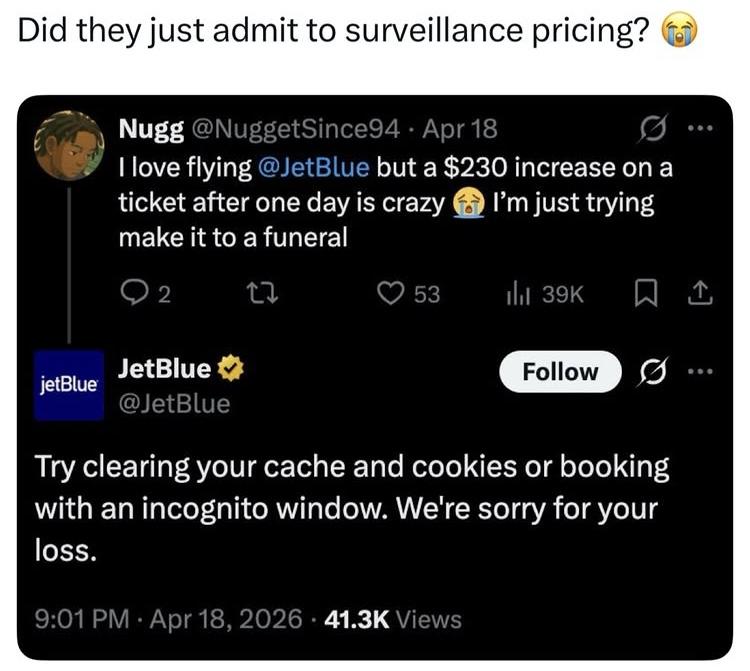
An FYI to folk booking tickets online: if you notice price jumps between the first time you look and when you are ready to book, delete cache and empty cookies.
-
An FYI to folk booking tickets online: if you notice price jumps between the first time you look and when you are ready to book, delete cache and empty cookies. The airline deleted their post a short time later because someone was being too helpful.
@CStamp hope the social media intern that replied that is safe
-
An FYI to folk booking tickets online: if you notice price jumps between the first time you look and when you are ready to book, delete cache and empty cookies. The airline deleted their post a short time later because someone was being too helpful.
@CStamp better tip: turn JS, caching and cookies off so you don't get fucked.
-
An FYI to folk booking tickets online: if you notice price jumps between the first time you look and when you are ready to book, delete cache and empty cookies. The airline deleted their post a short time later because someone was being too helpful.
@CStamp Thanks for the tip!
-
@kkarhan @CStamp @Bundesverband idk about Germany, in Spain it happens. Try to search several times for the same flight, its price should go up. If you try tell me because it would be interesting to know if it depends on the country
@luckychronic @kkarhan @CStamp @Bundesverband you can exploit this too - about 10 min before I need to go I start checking bolt and uber and then stop and give algorithm some time to give me the best price;)
-
I think we're using two meanings of the word 'markets'.
That's certainly true in markets as physical things where people have stalls and other people come to bargain.
It's not true in markets as economists view them. A functional market (in the economics sense) requires that the buyer have complete information (which is why they usually require explicit intervention to actually work and why anyone who claims a deregulated market will solve things is normally asking permission to rip people off). In such a market, if seller A is offering a product at a high price to buyer B and a low price to buyer C, this is an opportunity for arbitrage. Buyer C can buy and then sell to buyer B at a cost somewhere between the two. Run this for multiple iterations and the price that A will sell to both B and C will converge.
And that's a desirable feature of a market. Seller A will eventually end up with a price that maximises their revenue while meeting the demand of both B and C. B and C will both get the goods at a fair price.
The problem here is that there's significant information asymmetry. If I go into a shop and see a price label, I know that this is the price that they sell to everyone. If I go to a web site, I don't know whether I'm seeing the price for me or the price for everyone. The seller can buy a lot of information about me from brokers and can adjust their prices as they wish. And that means that this isn't a functioning market unless you introduce regulation to prevent this kind of manipulation.
@david_chisnall @coba @CStamp Sure, you talk about markets that are functional, desirable and creating a fair price.
It's more a normative model that economists described in the past two centuries, especially applicable to financial markets, dealing in goods that are abstract from the real world, financial instruments.
When real markets don't fit to the model some people demand that the state intervenes. But that's a question of power. -
I think we're using two meanings of the word 'markets'.
That's certainly true in markets as physical things where people have stalls and other people come to bargain.
It's not true in markets as economists view them. A functional market (in the economics sense) requires that the buyer have complete information (which is why they usually require explicit intervention to actually work and why anyone who claims a deregulated market will solve things is normally asking permission to rip people off). In such a market, if seller A is offering a product at a high price to buyer B and a low price to buyer C, this is an opportunity for arbitrage. Buyer C can buy and then sell to buyer B at a cost somewhere between the two. Run this for multiple iterations and the price that A will sell to both B and C will converge.
And that's a desirable feature of a market. Seller A will eventually end up with a price that maximises their revenue while meeting the demand of both B and C. B and C will both get the goods at a fair price.
The problem here is that there's significant information asymmetry. If I go into a shop and see a price label, I know that this is the price that they sell to everyone. If I go to a web site, I don't know whether I'm seeing the price for me or the price for everyone. The seller can buy a lot of information about me from brokers and can adjust their prices as they wish. And that means that this isn't a functioning market unless you introduce regulation to prevent this kind of manipulation.
@david_chisnall
I know what you mean, but it's really not that economists do not view or analyse markets such as I was describing them. They would explain to you, that there is a demand curve that goes down with higher prices and a supply curve that goes up with increasing prices. The market price is at the intersection of the two. This is how e.g. the price of stock is found at the stock market. -
@david_chisnall
I know what you mean, but it's really not that economists do not view or analyse markets such as I was describing them. They would explain to you, that there is a demand curve that goes down with higher prices and a supply curve that goes up with increasing prices. The market price is at the intersection of the two. This is how e.g. the price of stock is found at the stock market.@david_chisnall
Furthermore, I do not agree that price discrimination is bad per se ("predatory").E.g. if you have only 10 seats left for a certain train connection, the uniform price per seat might be 150 EUR. For the train company it may be financially beneficial to sell 8 tickets at 150 and to keep two tickets unsold.
But they might have fulfilled more people's transportation needs by selling the remaining two tickets to someone who would afford only 100 EUR.
-
@david_chisnall
Furthermore, I do not agree that price discrimination is bad per se ("predatory").E.g. if you have only 10 seats left for a certain train connection, the uniform price per seat might be 150 EUR. For the train company it may be financially beneficial to sell 8 tickets at 150 and to keep two tickets unsold.
But they might have fulfilled more people's transportation needs by selling the remaining two tickets to someone who would afford only 100 EUR.
@utrenkner @david_chisnall @coba @CStamp In reality, the "uniform price" from the example (150€) would be changed by coupons, discounts, bonus programs, premium versions ("1st class"), bundles and so on, differentiating the price as well as the product.
Hard to argue why that must conform to a model for financial markets instead, where needs are only present in form of searches for investment opportunities. -
@filipslusarski @CStamp what is wrong about having a fixed price for a flight?
@yoshimura @CStamp Higher demand means tickets can be sold even with the higher price.
-
@utrenkner @david_chisnall @coba @CStamp In reality, the "uniform price" from the example (150€) would be changed by coupons, discounts, bonus programs, premium versions ("1st class"), bundles and so on, differentiating the price as well as the product.
Hard to argue why that must conform to a model for financial markets instead, where needs are only present in form of searches for investment opportunities.@Kraemer_HB
Coupons, bonus programs etc. are not directly connected to my "willingness to pay".@coba mentioned "apple used to be more expensive because people buying apple products have more money." And this is how I understood this discussion: Should the company be allowed to differentiate the price based on the (perceived) willingness to pay of an individual.
-
An FYI to folk booking tickets online: if you notice price jumps between the first time you look and when you are ready to book, delete cache and empty cookies. The airline deleted their post a short time later because someone was being too helpful.
@CStamp Yes the airlines have been doing this for some time now. I use DuckDuckGo as my browser and search for cheapest flights through Kayak or similar, then book my flight on the airline's website.
-
@Kraemer_HB
Coupons, bonus programs etc. are not directly connected to my "willingness to pay".@coba mentioned "apple used to be more expensive because people buying apple products have more money." And this is how I understood this discussion: Should the company be allowed to differentiate the price based on the (perceived) willingness to pay of an individual.
@utrenkner @david_chisnall @coba @CStamp What a company perceives in searches for a train or flight connection seems to be a need for transportation.
Consumers feel ripped of if their need drives prices higher.
They pay only if they are willing to.
I argue that markets and prices are not as transparent as in ideal models. Neither are needs, the need for transportation is embedded in a fuzzy conglomerate of other needs it is weighed against.
The need for an Apple is not the need for a PC. -
-
@luckychronic @CStamp Where?
Cuz if it hapoens in #Germany I'm shure #ConsumerProtection like @Bundesverband would love to know...
@kkarhan @luckychronic @CStamp @Bundesverband It's definitely happening in Germany, try booking Ryanair or KLM/Air-France
-
@kkarhan @CStamp @Bundesverband idk about Germany, in Spain it happens. Try to search several times for the same flight, its price should go up. If you try tell me because it would be interesting to know if it depends on the country
@luckychronic @kkarhan @CStamp FWIW, I've never seen this happen when booking from Austria. I mean, sure, airline pricing is confusing. But there is a certain number of seats at each price, and people will buy them. And the available seats for each price tend to get recalculated/re-allocated once a week. But outside of that, the prices quoted for the same itinerary won't change. (Close to the flight date with few seats left it can of course sell out quickly.)
-
@luckychronic @kkarhan @CStamp FWIW, I've never seen this happen when booking from Austria. I mean, sure, airline pricing is confusing. But there is a certain number of seats at each price, and people will buy them. And the available seats for each price tend to get recalculated/re-allocated once a week. But outside of that, the prices quoted for the same itinerary won't change. (Close to the flight date with few seats left it can of course sell out quickly.)
@luckychronic @kkarhan @CStamp The prices also don't change when logged into the airline website vs not, or on different devices. My wife (not logged in) will sometimes find a specific flight at a particular price on the iPad, and I can log in with my account on the desktop and get the same price for the same itinerary.
One thing that can mess it up: search for price for 1 person, then actually try to book for N>1 pax. (If # tickets at that price is <N, you all pay the next price level.) -
@CStamp Try not flying.
-
An FYI to folk booking tickets online: if you notice price jumps between the first time you look and when you are ready to book, delete cache and empty cookies. The airline deleted their post a short time later because someone was being too helpful.
Just a reminder of something I think about every time I se a Trivago ad. Why do hotels offer the same rooms at different prices on different websites. Why do customers put up with it. And shouldn't the lowest price be on the hotel's website which would encourage customers to go there first.
-
@luckychronic @kkarhan @CStamp The prices also don't change when logged into the airline website vs not, or on different devices. My wife (not logged in) will sometimes find a specific flight at a particular price on the iPad, and I can log in with my account on the desktop and get the same price for the same itinerary.
One thing that can mess it up: search for price for 1 person, then actually try to book for N>1 pax. (If # tickets at that price is <N, you all pay the next price level.)@luckychronic @kkarhan @CStamp I guess I should qualify that we tend to fly with Lufthansa Group (LH, Austrian, Swiss) or if we have to, Ryanair, because they happen to fly relevant routes and minimise flight km for our location. We've also recently booked flights with various Asian airlines (inc budget) & didn't notice anything weird going on with their prices either.
-
@CStamp I haven't tested this but I hear if you book the same flight from a different country/area it could change price also. That sounds confusing but say you want a flight from Dallas to NY. If you book while in Dallas you will get one price but if you use a VPN to connect from say Colombia and try to book the same flight you could get a lower price.
As I said, I didn't test it but airline fees are stupid and inconsistent.