I've cleaned up my Raspberry Pi selfhosting setup a bit.
-
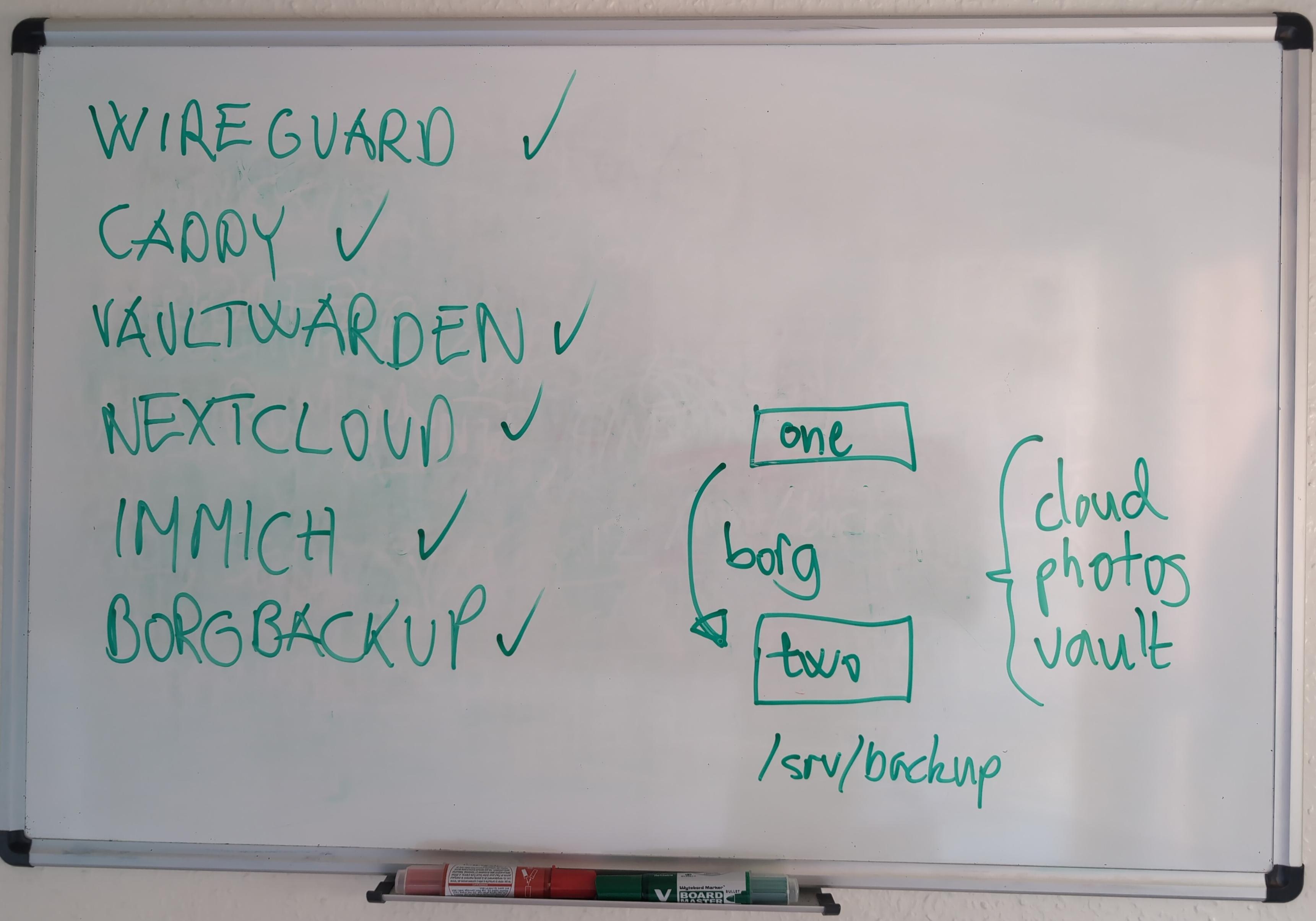
I've cleaned up my Raspberry Pi selfhosting setup a bit. I'm using two, each in an Argon ONE V5 case with a 1TB NVME drive, running Raspberry Pi OS.
'one' is serving Nextcloud All-in-one, Immich and Vaultwarden via a Caddy reverse-proxy. All using Docker containers, Caddy as a custom build with my domain DNS provider added.
'two' is used as remote borg backup destination for 'one', and later a few monitoring tools.
All three sites are using a wildcard certificate for my domain, and I connect via WireGuard (on the router) when away from home.
Path of least resistance:
I've tried Podman, AlmaLinux, and running a manual install of Nextcloud on Ubuntu. This setup follows recommended installations methods, and gives me fewer things to worry about.
#selfhosting #raspberrypi #nextcloud #immich #vaultwarden #caddy #wireguard
-
I've cleaned up my Raspberry Pi selfhosting setup a bit. I'm using two, each in an Argon ONE V5 case with a 1TB NVME drive, running Raspberry Pi OS.
'one' is serving Nextcloud All-in-one, Immich and Vaultwarden via a Caddy reverse-proxy. All using Docker containers, Caddy as a custom build with my domain DNS provider added.
'two' is used as remote borg backup destination for 'one', and later a few monitoring tools.
All three sites are using a wildcard certificate for my domain, and I connect via WireGuard (on the router) when away from home.
Path of least resistance:
I've tried Podman, AlmaLinux, and running a manual install of Nextcloud on Ubuntu. This setup follows recommended installations methods, and gives me fewer things to worry about.
#selfhosting #raspberrypi #nextcloud #immich #vaultwarden #caddy #wireguard
@mjack I have did a similar one,but using OmniOS (on x86-64), Haproxy, and zrepl.
-
I've cleaned up my Raspberry Pi selfhosting setup a bit. I'm using two, each in an Argon ONE V5 case with a 1TB NVME drive, running Raspberry Pi OS.
'one' is serving Nextcloud All-in-one, Immich and Vaultwarden via a Caddy reverse-proxy. All using Docker containers, Caddy as a custom build with my domain DNS provider added.
'two' is used as remote borg backup destination for 'one', and later a few monitoring tools.
All three sites are using a wildcard certificate for my domain, and I connect via WireGuard (on the router) when away from home.
Path of least resistance:
I've tried Podman, AlmaLinux, and running a manual install of Nextcloud on Ubuntu. This setup follows recommended installations methods, and gives me fewer things to worry about.
#selfhosting #raspberrypi #nextcloud #immich #vaultwarden #caddy #wireguard
That's a tidy stack to run off a single Pi. How did Immich's first library scan land on the NVMe? The thumbnail + smart-search indexing pass is the one I always brace for.
-
That's a tidy stack to run off a single Pi. How did Immich's first library scan land on the NVMe? The thumbnail + smart-search indexing pass is the one I always brace for.
Yeah, I noticed that when using podman: load at about 5 (with 4 cores) for more than 30 minutes. In the end I did a hard reboot (unplug power, apply power). I didn't notice it with the docker setup, but maybe I wasn't paying attention when it happened.
-
I've cleaned up my Raspberry Pi selfhosting setup a bit. I'm using two, each in an Argon ONE V5 case with a 1TB NVME drive, running Raspberry Pi OS.
'one' is serving Nextcloud All-in-one, Immich and Vaultwarden via a Caddy reverse-proxy. All using Docker containers, Caddy as a custom build with my domain DNS provider added.
'two' is used as remote borg backup destination for 'one', and later a few monitoring tools.
All three sites are using a wildcard certificate for my domain, and I connect via WireGuard (on the router) when away from home.
Path of least resistance:
I've tried Podman, AlmaLinux, and running a manual install of Nextcloud on Ubuntu. This setup follows recommended installations methods, and gives me fewer things to worry about.
#selfhosting #raspberrypi #nextcloud #immich #vaultwarden #caddy #wireguard
Are you using 'two' just to hold backups?
Or you can switch to point to 'two' and continue serving the services when 'one' is down?I have a setup with 4 x Pi5. And any of them holds the same. They replicate from 'current primary'. They are also in 4 diff locations (lets say my 4 homes
 )
)
And I can switch from one to another when primary is down. -
Are you using 'two' just to hold backups?
Or you can switch to point to 'two' and continue serving the services when 'one' is down?I have a setup with 4 x Pi5. And any of them holds the same. They replicate from 'current primary'. They are also in 4 diff locations (lets say my 4 homes
)
And I can switch from one to another when primary is down.Right now 'two' is only used for backups, but I know about swarm mode, and might explore it later.
I'm used to a similar setup from Proxmox, where you can use a (maybe less beafy) node to take over when doing maintenance.
My main concern right now is simplicity. Except for vim and borgbackup, 'two' is just the basic OS.