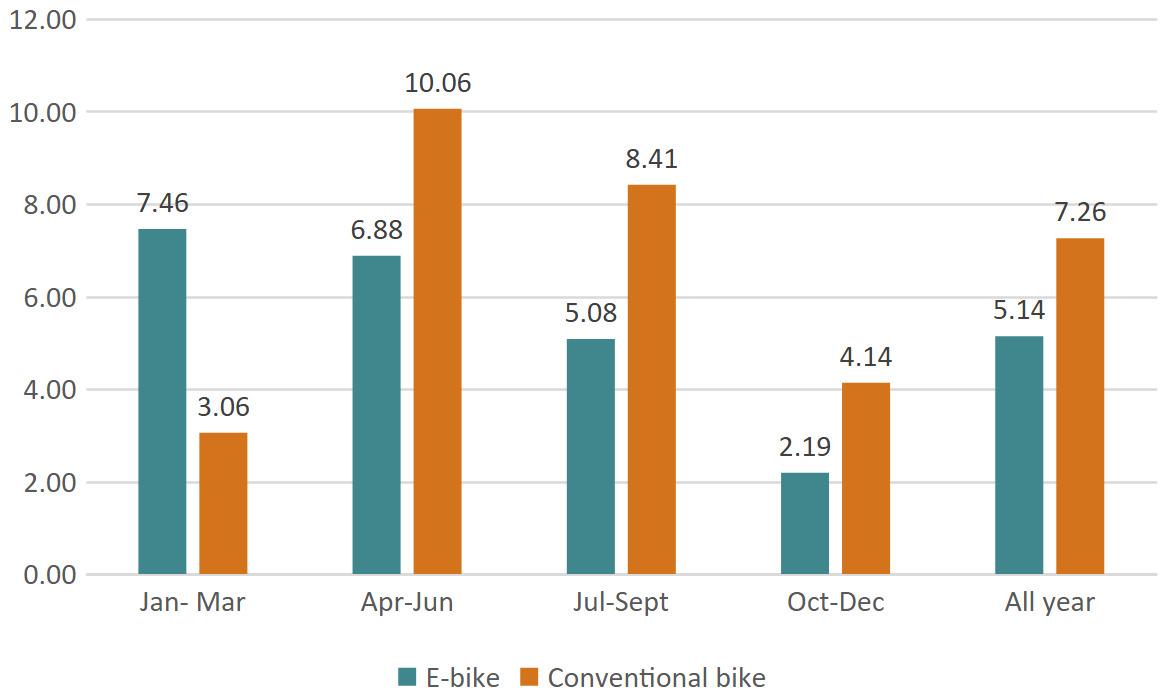
A finding that e-bike injury risk in Oslo, Norway is *lower* than conventional bike risk after adjusting for distance traveled.
-
A finding that e-bike injury risk in Oslo, Norway is *lower* than conventional bike risk after adjusting for distance traveled.
Caveat for North American readers: e-bikes in the EU are speed-limited to 25 km/h.
https://findingspress.org/article/157852-relative-injury-risk-of-e-bikes-and-conventional-bicycles
-
A finding that e-bike injury risk in Oslo, Norway is *lower* than conventional bike risk after adjusting for distance traveled.
Caveat for North American readers: e-bikes in the EU are speed-limited to 25 km/h.
https://findingspress.org/article/157852-relative-injury-risk-of-e-bikes-and-conventional-bicycles
These rates are an order of magnitude higher than injury rates for driving in Canada, by comparison (0.3 injuries or fatalities per million km in 2023).
But I would argue that per distance is not the right comparison for cars vs. bikes, and something more like rate per trip would be better.
Canadians drive something like 15,000 km per year on average. Bike commuters' average trip is 20 minutes, so even if you biked to work every weekday, you would still be under 4000 km biked for the year.
-
A finding that e-bike injury risk in Oslo, Norway is *lower* than conventional bike risk after adjusting for distance traveled.
Caveat for North American readers: e-bikes in the EU are speed-limited to 25 km/h.
https://findingspress.org/article/157852-relative-injury-risk-of-e-bikes-and-conventional-bicycles
@mbonsma Wow, that's wild. I can think of so many confounding factors (eg, people on ebikes using them for transportation and sticking to bike-friendly routes vs people on acoustic bikes being more adventurous and going on less safe routes. Or people with ebikes being wealthier and being able to afford to live in safer, more bike-friendly parts of town versus acoustic bike owners being poorer. Or or or..). But either way, still completely unexpected!
-
A finding that e-bike injury risk in Oslo, Norway is *lower* than conventional bike risk after adjusting for distance traveled.
Caveat for North American readers: e-bikes in the EU are speed-limited to 25 km/h.
https://findingspress.org/article/157852-relative-injury-risk-of-e-bikes-and-conventional-bicycles
@mbonsma is the speed limit in that it stops(motor breaking) you from going over 25 or it just stops applying additional current to the motor at 25?
-
@mbonsma is the speed limit in that it stops(motor breaking) you from going over 25 or it just stops applying additional current to the motor at 25?
@ansible42 the motor stops boosting at 25, yes. I've definitely gone faster than the limit on my e-bikes if going downhill, for instance.
-
@mbonsma Wow, that's wild. I can think of so many confounding factors (eg, people on ebikes using them for transportation and sticking to bike-friendly routes vs people on acoustic bikes being more adventurous and going on less safe routes. Or people with ebikes being wealthier and being able to afford to live in safer, more bike-friendly parts of town versus acoustic bike owners being poorer. Or or or..). But either way, still completely unexpected!
@Andres4NY yes, definitely. Other research (with different methods) has found the opposite, and I don't feel like there's a good explanation for why it should be lower for e-bikes.
-
@Andres4NY yes, definitely. Other research (with different methods) has found the opposite, and I don't feel like there's a good explanation for why it should be lower for e-bikes.
@mbonsma @Andres4NY I so wish we had better numbers for the exposure/miles travelled/numbers of trips side of the equation! Without that it's really hard to figure out what's going on.
-
A finding that e-bike injury risk in Oslo, Norway is *lower* than conventional bike risk after adjusting for distance traveled.
Caveat for North American readers: e-bikes in the EU are speed-limited to 25 km/h.
https://findingspress.org/article/157852-relative-injury-risk-of-e-bikes-and-conventional-bicycles
@mbonsma Thanks!
Question as you're an expert on this topic and I'm very much not

I wonder whether the authors draw strong conclusions (findings) without equally strongly pointing out the lack of quality data* does not support those conclusions. Would this not have been better with only a "better data is needed" finding?
*e.g. it's not discussed various manners the form nurses fill in can "default" to "bike" instead of "e-bike". Neither is there any distinction between commuting and sports.
-
@ansible42 the motor stops boosting at 25, yes. I've definitely gone faster than the limit on my e-bikes if going downhill, for instance.
The speed limit is now 20 km/h, at least in Oslo
-
The speed limit is now 20 km/h, at least in Oslo
-
@mbonsma Thanks!
Question as you're an expert on this topic and I'm very much not
I wonder whether the authors draw strong conclusions (findings) without equally strongly pointing out the lack of quality data* does not support those conclusions. Would this not have been better with only a "better data is needed" finding?
*e.g. it's not discussed various manners the form nurses fill in can "default" to "bike" instead of "e-bike". Neither is there any distinction between commuting and sports.
@Pepijn definitely lots more to be done! This journal has a 1000 word limit, so it's meant to be very brief single-result papers. They talk about trip purpose in the "future research" section!
-
 T tokeriis@helvede.net shared this topic