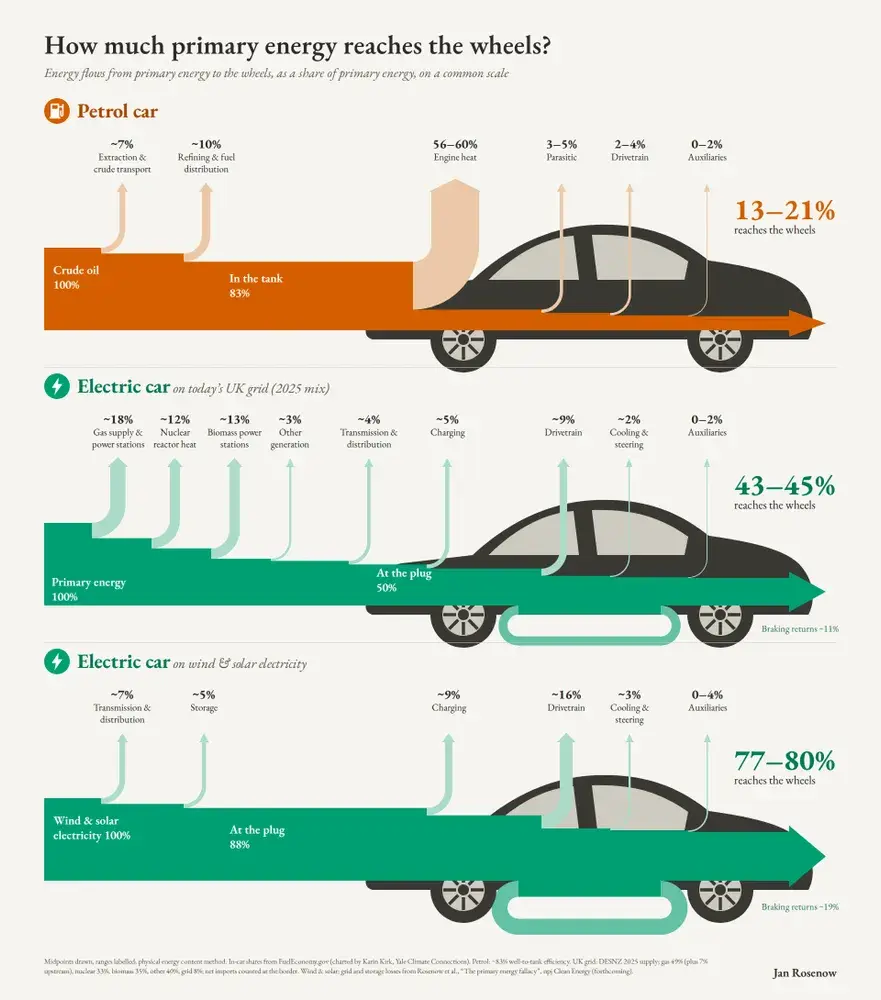
This analysis is fascinating: it breaks down how when you fill up a petrol car most of the energy never moves it.
-
@TimWardCam @Natasha_Jay What figure you get rather depends what question you ask - moving a cyclist requires much less power so it still ends up ahead of a car despite being less efficient, and it's not like people don't eat when they don't cycle, so if you just count the extra energy required you'd get a different figure.
@PeteKirkham @Natasha_Jay Yes, this is one of those (rare?) cases where you *should* only count the marginal cost.
-
@TimWardCam @Natasha_Jay A person on a bicycle is way worse than an ICE car, due to it taking about ten calories of fossil fuel to farm and transport one calorie of food on average in the West, and human bodies are worse than ICE engines at converting fuel to motive power, between 5 and 10 percent, (we are warm blooded and evolved to generate heat). So we end up about 1% efficient converting fossil fuel to movement, better for vegans or subsistance farmers.
@PeteKirkham @TimWardCam @Natasha_Jay Citation needed, and be sure you use the total calories EROEI for meat, not just the protein EROEI (mammal flesh, half the calories are usually fat). Also don't forget that bicycle calorie burn also provides exercise; what's the MPG of a stationary bike at the gym?
Here's what some asshole with a blog wrote, 15 years ago: https://dr2chase.wordpress.com/2011/01/12/overselling-a-vegetarian-diet-underselling-utility-cycling/
Yes, I own my own personal copy of Food, Energy, and Society, 3rd edition.
-
@Natasha_Jay For wind power it ignores how much wind energy the turbine fails to capture. For solar it ignores how much the panels fail to convert to electricity. In what way is this a fair comparison?
For petrol it fails to account for what could have been gained by separating out the hydrogen atoms and fusing them... but I'll let that one slide for now.
@donburi @Natasha_Jay but why would you want those numbers? It's like counting all the water your bucket didn't pick up by the river. It's meaningless in this context. Unlike the energy from the oil
-
@PeteKirkham @TimWardCam @Natasha_Jay Citation needed, and be sure you use the total calories EROEI for meat, not just the protein EROEI (mammal flesh, half the calories are usually fat). Also don't forget that bicycle calorie burn also provides exercise; what's the MPG of a stationary bike at the gym?
Here's what some asshole with a blog wrote, 15 years ago: https://dr2chase.wordpress.com/2011/01/12/overselling-a-vegetarian-diet-underselling-utility-cycling/
Yes, I own my own personal copy of Food, Energy, and Society, 3rd edition.
@dr2chase @TimWardCam @Natasha_Jay So with your blog's figures varying between 20:1 for meat and 1:1.3 for potatoes, so 10:1 for a mixed diet seems about right, then the 10% efficiency figure I remembered seems low compared to 24% quoted in wikipedia (https://en.wikipedia.org/wiki/Human_power#cite_note-2) , but their figure is just for one muscle rather than a whole human. So increase it to 2.4% if you want. The reasons for choosing cycling are not its efficiency, but many other benefits.
-
@dr2chase @TimWardCam @Natasha_Jay So with your blog's figures varying between 20:1 for meat and 1:1.3 for potatoes, so 10:1 for a mixed diet seems about right, then the 10% efficiency figure I remembered seems low compared to 24% quoted in wikipedia (https://en.wikipedia.org/wiki/Human_power#cite_note-2) , but their figure is just for one muscle rather than a whole human. So increase it to 2.4% if you want. The reasons for choosing cycling are not its efficiency, but many other benefits.
@PeteKirkham @TimWardCam @Natasha_Jay there's a bunch of problems with your estimate -- not all meat is beef, all meat is only about 17% of US diet by calories (per quick web search), and marginal calorie consumption from exercise burn is not necessarily like the average, and more so the further you depart from sedentary.
And you completely missed that the calories can be charged to either exercise or transportation. If I spend 3000 calories/week on exercise, transportation is *ZERO*.
-
@PeteKirkham @Natasha_Jay I have seen an analysis which comes to a different conclusion, though I doubt I'll be able to find it.
@TimWardCam @PeteKirkham @Natasha_Jay Apparently it’s heavily dependent on what you eat to make up for the extra calories you burn - ranging from 25 gCO2e/km for bananas (about half the rate of an EV) to 310 gCO2e/km for cheeseburgers (about double that of a petrol car)! Ref: Mike Berners-Lee via https://ourworldindata.org/travel-carbon-footprint
-
@Natasha_Jay I call nonsense. The car isn’t determined by power source so why is a (for eg) Tesla powered by solar going to be getting more power to the wheels than “standard”electricity? Also why is transmission more expensive in one than the other? Is there some underlying assumption that solar is a home generated source? In which case it’s unlikely to fully power the car unless you have a very large array for a house.
The wheels don't get more power. But the percentage of power they get from the original source is greater.
In transmission, the losses are greater for wind & solar, which makes sense makes usually the locations for wind & solar are farther away then that for traditional power plants.
-
This analysis is fascinating: it breaks down how when you fill up a petrol car most of the energy never moves it.
Petrol car: 13–21% of the crude oil's energy reaches wheels.
Electric car on today's UK grid: 43–45%.
Electric car on wind+solar: 77–80%.
via Jan Rosenow, Professor of Energy & Climate Policy at University of Oxford
@Natasha_Jay “There is nothing better than a petrol car” (German car industry)
-
This analysis is fascinating: it breaks down how when you fill up a petrol car most of the energy never moves it.
Petrol car: 13–21% of the crude oil's energy reaches wheels.
Electric car on today's UK grid: 43–45%.
Electric car on wind+solar: 77–80%.
via Jan Rosenow, Professor of Energy & Climate Policy at University of Oxford
@Natasha_Jay this is really interesting, but it feels a bit oversimplified and possibly, but hopefully not aimed at driving a predetermined conclusion for the following reasons:
1. As others have pointed out, crude is fractured into many products, not just Petrol.
2. There doesn't appear to be any acknowledgment for the efficiency of the battery which for Lithium Ion I believe is at best 90%
3. The extra weight of the batteries isn't represented at all, but the petrol heat is??? -
The wheels don't get more power. But the percentage of power they get from the original source is greater.
In transmission, the losses are greater for wind & solar, which makes sense makes usually the locations for wind & solar are farther away then that for traditional power plants.
@number6 @Natasha_Jay not buying that. In the UK we use a single grid. Just because the wind farm puts in 7kW for you car doesn’t mean you’re actually getting that from a wind farm. You’re getting it from the grid which is essentially a unified energy source so transmission isn’t going to be a relationship to the source. (Also where I live the different sources of power are actually at the end of the same cable)
-
@PeteKirkham @TimWardCam @Natasha_Jay there's a bunch of problems with your estimate -- not all meat is beef, all meat is only about 17% of US diet by calories (per quick web search), and marginal calorie consumption from exercise burn is not necessarily like the average, and more so the further you depart from sedentary.
And you completely missed that the calories can be charged to either exercise or transportation. If I spend 3000 calories/week on exercise, transportation is *ZERO*.
@dr2chase @TimWardCam @Natasha_Jay Maybe I should have made explicit the intended subtext that this is a /really bad/ way of comparing transit - utility per unit fossil fuel is far better, but even then I don't expect anyone to change based on an infographic. But it shouldn't be marginal calories, as the person driving will be consuming basal calories at least, and probably a bit more as driving requires effort. But yes, you might get as high as 10% efficiency, still worst by that metric.
-
@dr2chase @TimWardCam @Natasha_Jay Maybe I should have made explicit the intended subtext that this is a /really bad/ way of comparing transit - utility per unit fossil fuel is far better, but even then I don't expect anyone to change based on an infographic. But it shouldn't be marginal calories, as the person driving will be consuming basal calories at least, and probably a bit more as driving requires effort. But yes, you might get as high as 10% efficiency, still worst by that metric.
@dr2chase @TimWardCam @Natasha_Jay I didn't miss the exercise, but it is not part of the metric in the infographic. That is a fault of the metric, not of my calculation. If you ask a different question - for example, it would be equally arbitrary to include listening to a podcast in the car to count the fuel toward entertainment - then you get a different answer.
-
@dr2chase @TimWardCam @Natasha_Jay I didn't miss the exercise, but it is not part of the metric in the infographic. That is a fault of the metric, not of my calculation. If you ask a different question - for example, it would be equally arbitrary to include listening to a podcast in the car to count the fuel toward entertainment - then you get a different answer.
@PeteKirkham @TimWardCam @Natasha_Jay no, the fuel burn does not count towards entertainment, because you can listen to the podcast w/o the fuel burn. There's no way to get aerobic exercise w/o burning calories in muscles, arguably that is the primary activity, and it is just a happy accident that I arrive at some useful destination after my workout. Listening to a podcast will not alter your location.
-
This analysis is fascinating: it breaks down how when you fill up a petrol car most of the energy never moves it.
Petrol car: 13–21% of the crude oil's energy reaches wheels.
Electric car on today's UK grid: 43–45%.
Electric car on wind+solar: 77–80%.
via Jan Rosenow, Professor of Energy & Climate Policy at University of Oxford
@Natasha_Jay hye i understand but how long will the batteries last in an EV if I am using it daily?
We need better public transit
-
@mscheffel @Natasha_Jay no mobile device is with me every car trip, I have the source code to most of my mobile devices & that seems not possible with most cars yet, and I hate the "one thing is broken so we shouldn't care if everything else is broken too" idea.
@mjr @Natasha_Jay regarding the source code on your mobile devices: NERD
 . Kudos to you for taking the effort most don’t. Of course, the carrier will see you always and they are… problematic.
Electric (or any modern gas) cars are all continuous transmitters and receivers. Car manufacturers will always use security theater as a shield from transparency. Not sure we will see a satisfying resolution.
-
This analysis is fascinating: it breaks down how when you fill up a petrol car most of the energy never moves it.
Petrol car: 13–21% of the crude oil's energy reaches wheels.
Electric car on today's UK grid: 43–45%.
Electric car on wind+solar: 77–80%.
via Jan Rosenow, Professor of Energy & Climate Policy at University of Oxford
@Natasha_Jay 66% of all energy generated by our electrical power production system is wasted before it ever reaches an end use. US government data, not speculation.
-
This analysis is fascinating: it breaks down how when you fill up a petrol car most of the energy never moves it.
Petrol car: 13–21% of the crude oil's energy reaches wheels.
Electric car on today's UK grid: 43–45%.
Electric car on wind+solar: 77–80%.
via Jan Rosenow, Professor of Energy & Climate Policy at University of Oxford
I like the 57-60% engine heat. There is a saying, that today a car is a computer on wheels. Turns out, it's rather a heater on wheels, the movement is a side effect ;-).
-
 J jwcph@helvede.net shared this topic