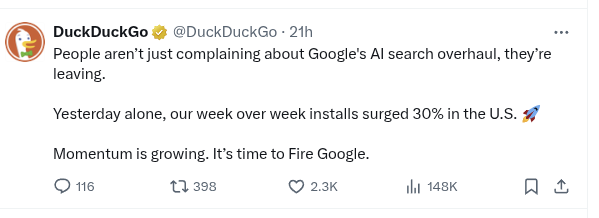
DuckDuckGo's AI-free search saw nearly 28% more visits in the week following Google's insistence that people love AI mode.
-
DuckDuckGo's AI-free search saw nearly 28% more visits in the week following Google's insistence that people love AI mode. Is anyone surprised by this result?
@nixCraft And DuckDuckGo still forces their own AI crap on me. They have no place to speak about Google doing the same thing. noai.duckduckgo.com should be the default, not something I must opt into by configuring my web browser to use it.
-
@nixCraft Serious question: If Google dies, what happens to Android? Google effectively owns it and it shuttering the Android Open Source Project (AOSP) in September.
@Mustardfacial @nixCraft I assume anyone can use a fork of it. Samsung would not have to develop their own OS.
-
@Darkphoenix @nixCraft so you in fact did it on bing as DDG is bing with an extra step
-
DuckDuckGo's AI-free search saw nearly 28% more visits in the week following Google's insistence that people love AI mode. Is anyone surprised by this result?
If only DuckDuckGo would remember that I don't want AI in my search. Nope, every time I open a new tab, it's forgotten yet again.
-
@nixCraft Serious question: If Google dies, what happens to Android? Google effectively owns it and it shuttering the Android Open Source Project (AOSP) in September.
@Mustardfacial people will switch on custom roms. The only thing is that custom rom community not providing any source to install those custom roms easily.. They need to make a better & easy site or forum where any user can go and install any custom rom of their choice, like GrapheneOS working. They also need to provide a proper guide how to unlock bootloader and flash custom recovery & roms. Normal users avoid custom roms because of complex nature of installing custom roms.
@nixCraft -
DuckDuckGo's AI-free search saw nearly 28% more visits in the week following Google's insistence that people love AI mode. Is anyone surprised by this result?
@nixCraft Still millions of users using Google search & ai
-
@shaedrich @Mustardfacial @nixCraft
I didn't explain that very well. My point is, that back in the day Microsoft had a stranglehold on just about everything IT, at least for desktop use. Their Windows operating system was THE way to interact with the internet, multimedia and work.
Then came the mobile platforms, and suddenly Microsoft could no longer operate as if they owned everything. Windows was still king of the desktop, but a huge amount of users did not use a computer at all - they used tablets and phones with non-Microsoft operating systems, and they were now the majority of users.
Internet Explorer is probably the best example of what that meant for Microsoft. In the old days there was IE, and it was the browser your website had to be compatible with. It was slow and not very good, so along came Chrome and started eating Microsofts browser marketshare.
IE was still the king, but now you had to test for two browsers. Microsoft could still do things their way, at least to a point.
Then came Android and Chrome for Android, and suddenly Chrome was so far ahead that Microsoft lost the ability to operate independently. The result? - the end of IE and a surrender to the Chromium engine.
I am almost certainly that Google will face a similar downfall in the AI market.
@madsenandersc @Mustardfacial @nixCraft It's worth mentioning that TCP/IP is a UNIX thing, not an MS one. MS attempted to create a competitor protocol but failed badly. MS's browser was the shittiest browser you could possibly have. People only used it to download other browsers and it was a well known joke. So, MS being good at one thing and one thing only goes way back
-
@shaedrich @Mustardfacial @nixCraft
I didn't explain that very well. My point is, that back in the day Microsoft had a stranglehold on just about everything IT, at least for desktop use. Their Windows operating system was THE way to interact with the internet, multimedia and work.
Then came the mobile platforms, and suddenly Microsoft could no longer operate as if they owned everything. Windows was still king of the desktop, but a huge amount of users did not use a computer at all - they used tablets and phones with non-Microsoft operating systems, and they were now the majority of users.
Internet Explorer is probably the best example of what that meant for Microsoft. In the old days there was IE, and it was the browser your website had to be compatible with. It was slow and not very good, so along came Chrome and started eating Microsofts browser marketshare.
IE was still the king, but now you had to test for two browsers. Microsoft could still do things their way, at least to a point.
Then came Android and Chrome for Android, and suddenly Chrome was so far ahead that Microsoft lost the ability to operate independently. The result? - the end of IE and a surrender to the Chromium engine.
I am almost certainly that Google will face a similar downfall in the AI market.
@madsenandersc @Mustardfacial @nixCraft It might also be worth mentioning that in between Chrome and Edge, there was Firefox, so you had to test for three browsers until IE was then neglected. I know, Firefox now has a vanishingly small market show but that hasn't always been the case
-
@shaedrich @Mustardfacial @nixCraft
I didn't explain that very well. My point is, that back in the day Microsoft had a stranglehold on just about everything IT, at least for desktop use. Their Windows operating system was THE way to interact with the internet, multimedia and work.
Then came the mobile platforms, and suddenly Microsoft could no longer operate as if they owned everything. Windows was still king of the desktop, but a huge amount of users did not use a computer at all - they used tablets and phones with non-Microsoft operating systems, and they were now the majority of users.
Internet Explorer is probably the best example of what that meant for Microsoft. In the old days there was IE, and it was the browser your website had to be compatible with. It was slow and not very good, so along came Chrome and started eating Microsofts browser marketshare.
IE was still the king, but now you had to test for two browsers. Microsoft could still do things their way, at least to a point.
Then came Android and Chrome for Android, and suddenly Chrome was so far ahead that Microsoft lost the ability to operate independently. The result? - the end of IE and a surrender to the Chromium engine.
I am almost certainly that Google will face a similar downfall in the AI market.
@madsenandersc @Mustardfacial @nixCraft Google != Alphabet. Alphabet still has one of the biggest collections of data in the world, which is their primary(!) business model that will keep them relevant for a while. They are essentially an intelligence agency fake shop at an accommodation address
-
If only DuckDuckGo would remember that I don't want AI in my search. Nope, every time I open a new tab, it's forgotten yet again.
@EverydayMoggie @nixCraft
Yeah that annoys me too, enough not to use it. I imagine it doesn't help that I deleted cookies each session. -
@madsenandersc @Mustardfacial @nixCraft Google != Alphabet. Alphabet still has one of the biggest collections of data in the world, which is their primary(!) business model that will keep them relevant for a while. They are essentially an intelligence agency fake shop at an accommodation address
@shaedrich @Mustardfacial @nixCraft
True - I was probably talking about Alphabet instead of Google, to be honest.