Skip to content
  • Hjem
  • Seneste
  • Etiketter
  • Populære
  • Verden
  • Bruger
  • Grupper
Temaer
  • Light
  • Brite
  • Cerulean
  • Cosmo
  • Flatly
  • Journal
  • Litera
  • Lumen
  • Lux
  • Materia
  • Minty
  • Morph
  • Pulse
  • Sandstone
  • Simplex
  • Sketchy
  • Spacelab
  • United
  • Yeti
  • Zephyr
  • Dark
  • Cyborg
  • Darkly
  • Quartz
  • Slate
  • Solar
  • Superhero
  • Vapor

  • Default (No Skin)
  • No Skin
Kollaps
FARVEL BIG TECH
  1. Forside
  2. Ikke-kategoriseret
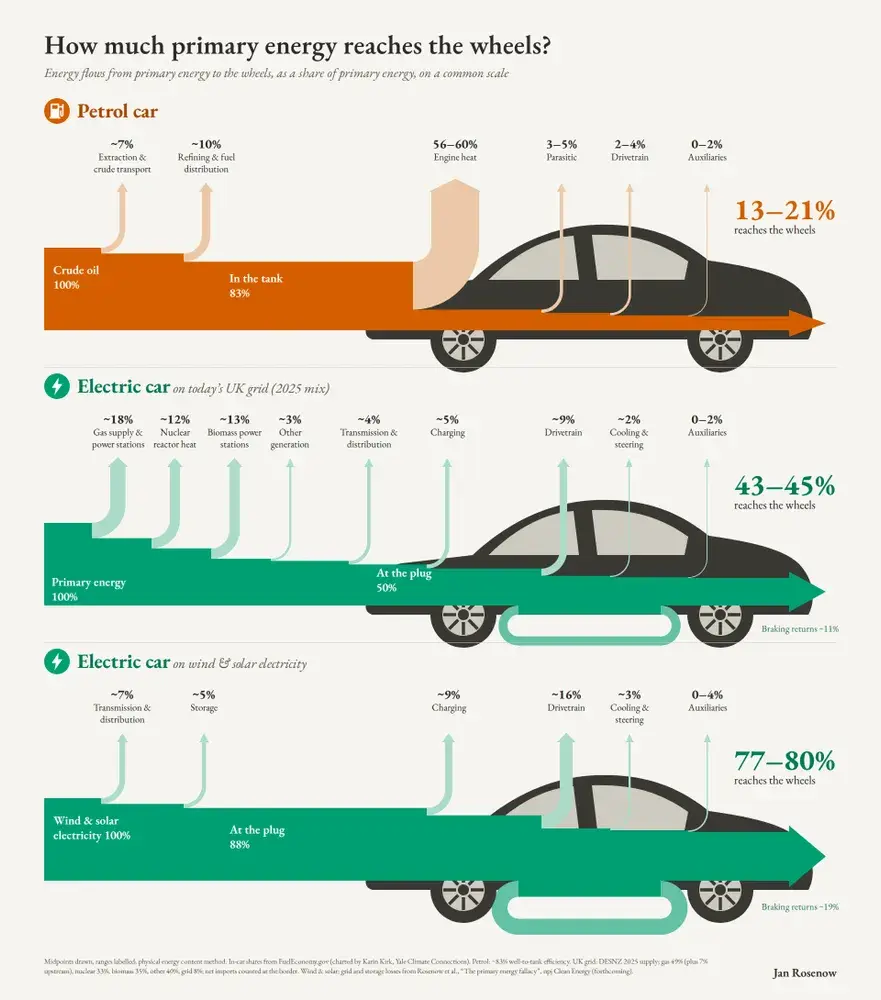
  3. This analysis is fascinating: it breaks down how when you fill up a petrol car most of the energy never moves it.
This analysis is fascinating: it breaks down how when you fill up a petrol car most of the energy never moves it.

Planlagt Fastgjort Låst Flyttet Ikke-kategoriseret
energyclimate
59 Indlæg 40 Posters 0 Visninger
  • Ældste til nyeste
  • Nyeste til ældste
  • Most Votes
Svar
  • Svar som emne
Login for at svare
Denne tråd er blevet slettet. Kun brugere med emne behandlings privilegier kan se den.
  • natasha_jay@tech.lgbtN natasha_jay@tech.lgbt

    This analysis is fascinating: it breaks down how when you fill up a petrol car most of the energy never moves it.

    Petrol car: 13–21% of the crude oil's energy reaches wheels.

    Electric car on today's UK grid: 43–45%.

    Electric car on wind+solar: 77–80%.

    via Jan Rosenow, Professor of Energy & Climate Policy at University of Oxford

    #energy #climate

    D This user is from outside of this forum
    D This user is from outside of this forum
    donburi@universeodon.com
    wrote sidst redigeret af
    #32

    @Natasha_Jay For wind power it ignores how much wind energy the turbine fails to capture. For solar it ignores how much the panels fail to convert to electricity. In what way is this a fair comparison?

    For petrol it fails to account for what could have been gained by separating out the hydrogen atoms and fusing them... but I'll let that one slide for now.

    oerum@ohai.socialO 1 Reply Last reply
    0
    • natasha_jay@tech.lgbtN natasha_jay@tech.lgbt

      This analysis is fascinating: it breaks down how when you fill up a petrol car most of the energy never moves it.

      Petrol car: 13–21% of the crude oil's energy reaches wheels.

      Electric car on today's UK grid: 43–45%.

      Electric car on wind+solar: 77–80%.

      via Jan Rosenow, Professor of Energy & Climate Policy at University of Oxford

      #energy #climate

      riley@toot.catR This user is from outside of this forum
      riley@toot.catR This user is from outside of this forum
      riley@toot.cat
      wrote sidst redigeret af
      #33

      @Natasha_Jay FWIW, I'm not sure this is a particularly enlightening way to think or describe this issue. Using the abstract amount of theoretically available maximal energy is intuitive in only fairly rare and narrow circumstances, and this framing feels weird to me.

      Maybe, describing the inherent conversion efficiency limits from fuel to motion vs electricity to motion would work better? The foundational ratio is still the same, but at least, it'd be close to the abstractions that physicists and engineers actually use in thinking about motor/engine efficiency.

      1 Reply Last reply
      0
      • mespique@beige.partyM mespique@beige.party

        @Natasha_Jay

        It should be noted that the huge drop in petrol cars' efficiency when it reaches the engine and dissipates into heat is NOT going to be improved much upon. There is a fundamental physics limit that prevents it.

        dodo1095zd@mastodon.socialD This user is from outside of this forum
        dodo1095zd@mastodon.socialD This user is from outside of this forum
        dodo1095zd@mastodon.social
        wrote sidst redigeret af
        #34

        @mespique @Natasha_Jay je zajímavé, že u jaderných (atomových) elektráren, se nad tím nikdo nepozastaví... ☝️😉

        1 Reply Last reply
        0
        • natasha_jay@tech.lgbtN natasha_jay@tech.lgbt

          This analysis is fascinating: it breaks down how when you fill up a petrol car most of the energy never moves it.

          Petrol car: 13–21% of the crude oil's energy reaches wheels.

          Electric car on today's UK grid: 43–45%.

          Electric car on wind+solar: 77–80%.

          via Jan Rosenow, Professor of Energy & Climate Policy at University of Oxford

          #energy #climate

          grob@mstdn.socialG This user is from outside of this forum
          grob@mstdn.socialG This user is from outside of this forum
          grob@mstdn.social
          wrote sidst redigeret af
          #35

          @Natasha_Jay he's on Fedi: @janrosenow

          unfortunately not active anymore, but used to post a lot. Maybe give him a follow to summon him back


          1 Reply Last reply
          0
          • jesstheunstill@infosec.exchangeJ jesstheunstill@infosec.exchange

            @Natasha_Jay Also, oil is INCREDIBLY useful for making plastics, fertilizer, chemicals, synthetics, lubricants, and all sorts of other shit that's difficult to replace from natural sources. And then we just go and burn the shit...

            dianea@lgbtqia.spaceD This user is from outside of this forum
            dianea@lgbtqia.spaceD This user is from outside of this forum
            dianea@lgbtqia.space
            wrote sidst redigeret af
            #36

            @JessTheUnstill @Natasha_Jay

            I used to maintain a biodiesel plant. Soybeans in, oil products out. Byproducts were USP grade glycerin, lecithin, etc... And it was done at an incredibly massive scale, efficiently.

            1 Reply Last reply
            0
            • mikerspencer@mastodon.scotM mikerspencer@mastodon.scot

              @MichaelPorter
              The subtitle reads "energy flows... on a common scale."

              I understand the maths and you're explaining it well - thanks! But the figure is still a little confusing that one scenario gets 11% braking returns and the other 19%. Might just have been better to leave that bit off.

              @yugthebug @Natasha_Jay

              michaelporter@ottawa.placeM This user is from outside of this forum
              michaelporter@ottawa.placeM This user is from outside of this forum
              michaelporter@ottawa.place
              wrote sidst redigeret af
              #37

              @mikerspencer @yugthebug @Natasha_Jay Derp, I didn’t even read that. Okay, I see what you’re getting at.

              btw The issue we are discussing came up *repeatedly* when I was teaching science - mainly when a lab result was a percentage, *and* the students had to express uncertainty, which often was a percentage also. So we had to be very clear as to whether a result was
              (25 ± 4)% or 25% ± 4% (i.e. (25 ± 1)%).

              1 Reply Last reply
              0
              • timwardcam@c.imT timwardcam@c.im

                @Natasha_Jay Then do the same for moving a *person* rather than a *car*, and include an e-bike comparison.

                petekirkham@mastodon.scotP This user is from outside of this forum
                petekirkham@mastodon.scotP This user is from outside of this forum
                petekirkham@mastodon.scot
                wrote sidst redigeret af
                #38

                @TimWardCam @Natasha_Jay A person on a bicycle is way worse than an ICE car, due to it taking about ten calories of fossil fuel to farm and transport one calorie of food on average in the West, and human bodies are worse than ICE engines at converting fuel to motive power, between 5 and 10 percent, (we are warm blooded and evolved to generate heat). So we end up about 1% efficient converting fossil fuel to movement, better for vegans or subsistance farmers.

                timwardcam@c.imT dr2chase@ohai.socialD 2 Replies Last reply
                0
                • petekirkham@mastodon.scotP petekirkham@mastodon.scot

                  @TimWardCam @Natasha_Jay A person on a bicycle is way worse than an ICE car, due to it taking about ten calories of fossil fuel to farm and transport one calorie of food on average in the West, and human bodies are worse than ICE engines at converting fuel to motive power, between 5 and 10 percent, (we are warm blooded and evolved to generate heat). So we end up about 1% efficient converting fossil fuel to movement, better for vegans or subsistance farmers.

                  timwardcam@c.imT This user is from outside of this forum
                  timwardcam@c.imT This user is from outside of this forum
                  timwardcam@c.im
                  wrote sidst redigeret af
                  #39

                  @PeteKirkham @Natasha_Jay I have seen an analysis which comes to a different conclusion, though I doubt I'll be able to find it.

                  petekirkham@mastodon.scotP benavison@mastodonapp.ukB 2 Replies Last reply
                  0
                  • natasha_jay@tech.lgbtN natasha_jay@tech.lgbt

                    This analysis is fascinating: it breaks down how when you fill up a petrol car most of the energy never moves it.

                    Petrol car: 13–21% of the crude oil's energy reaches wheels.

                    Electric car on today's UK grid: 43–45%.

                    Electric car on wind+solar: 77–80%.

                    via Jan Rosenow, Professor of Energy & Climate Policy at University of Oxford

                    #energy #climate

                    david@social.piconet.workD This user is from outside of this forum
                    david@social.piconet.workD This user is from outside of this forum
                    david@social.piconet.work
                    wrote sidst redigeret af
                    #40

                    @Natasha_Jay Really makes me wish I had enough solar panels to eliminate the middleman (the national grid) and charge my car directly.

                    1 Reply Last reply
                    0
                    • mjr@masto.bikeM mjr@masto.bike

                      @Natasha_Jay the dodges there are that it doesn't show a hybrid on petrol and that none of the cars seem to have passenger cabin heating, but it's essentially true.

                      Now if only there were more battery cars that weren't spyware-on-wheels...

                      david@social.piconet.workD This user is from outside of this forum
                      david@social.piconet.workD This user is from outside of this forum
                      david@social.piconet.work
                      wrote sidst redigeret af
                      #41

                      @mjr @Natasha_Jay I'm so glad my electric car isn't internet connected at all, but I have noticed a LOT of bluetooth and wifi devices in car parks when I'm sat in it waiting in the rain. Why does an electric car need a connection - except to spy on people...

                      1 Reply Last reply
                      0
                      • timwardcam@c.imT timwardcam@c.im

                        @PeteKirkham @Natasha_Jay I have seen an analysis which comes to a different conclusion, though I doubt I'll be able to find it.

                        petekirkham@mastodon.scotP This user is from outside of this forum
                        petekirkham@mastodon.scotP This user is from outside of this forum
                        petekirkham@mastodon.scot
                        wrote sidst redigeret af
                        #42

                        @TimWardCam @Natasha_Jay What figure you get rather depends what question you ask - moving a cyclist requires much less power so it still ends up ahead of a car despite being less efficient, and it's not like people don't eat when they don't cycle, so if you just count the extra energy required you'd get a different figure.

                        timwardcam@c.imT 1 Reply Last reply
                        0
                        • petekirkham@mastodon.scotP petekirkham@mastodon.scot

                          @TimWardCam @Natasha_Jay What figure you get rather depends what question you ask - moving a cyclist requires much less power so it still ends up ahead of a car despite being less efficient, and it's not like people don't eat when they don't cycle, so if you just count the extra energy required you'd get a different figure.

                          timwardcam@c.imT This user is from outside of this forum
                          timwardcam@c.imT This user is from outside of this forum
                          timwardcam@c.im
                          wrote sidst redigeret af
                          #43

                          @PeteKirkham @Natasha_Jay Yes, this is one of those (rare?) cases where you *should* only count the marginal cost.

                          1 Reply Last reply
                          0
                          • petekirkham@mastodon.scotP petekirkham@mastodon.scot

                            @TimWardCam @Natasha_Jay A person on a bicycle is way worse than an ICE car, due to it taking about ten calories of fossil fuel to farm and transport one calorie of food on average in the West, and human bodies are worse than ICE engines at converting fuel to motive power, between 5 and 10 percent, (we are warm blooded and evolved to generate heat). So we end up about 1% efficient converting fossil fuel to movement, better for vegans or subsistance farmers.

                            dr2chase@ohai.socialD This user is from outside of this forum
                            dr2chase@ohai.socialD This user is from outside of this forum
                            dr2chase@ohai.social
                            wrote sidst redigeret af
                            #44

                            @PeteKirkham @TimWardCam @Natasha_Jay Citation needed, and be sure you use the total calories EROEI for meat, not just the protein EROEI (mammal flesh, half the calories are usually fat). Also don't forget that bicycle calorie burn also provides exercise; what's the MPG of a stationary bike at the gym?

                            Here's what some asshole with a blog wrote, 15 years ago: https://dr2chase.wordpress.com/2011/01/12/overselling-a-vegetarian-diet-underselling-utility-cycling/

                            Yes, I own my own personal copy of Food, Energy, and Society, 3rd edition.

                            petekirkham@mastodon.scotP 1 Reply Last reply
                            0
                            • D donburi@universeodon.com

                              @Natasha_Jay For wind power it ignores how much wind energy the turbine fails to capture. For solar it ignores how much the panels fail to convert to electricity. In what way is this a fair comparison?

                              For petrol it fails to account for what could have been gained by separating out the hydrogen atoms and fusing them... but I'll let that one slide for now.

                              oerum@ohai.socialO This user is from outside of this forum
                              oerum@ohai.socialO This user is from outside of this forum
                              oerum@ohai.social
                              wrote sidst redigeret af
                              #45

                              @donburi @Natasha_Jay but why would you want those numbers? It's like counting all the water your bucket didn't pick up by the river. It's meaningless in this context. Unlike the energy from the oil

                              1 Reply Last reply
                              0
                              • dr2chase@ohai.socialD dr2chase@ohai.social

                                @PeteKirkham @TimWardCam @Natasha_Jay Citation needed, and be sure you use the total calories EROEI for meat, not just the protein EROEI (mammal flesh, half the calories are usually fat). Also don't forget that bicycle calorie burn also provides exercise; what's the MPG of a stationary bike at the gym?

                                Here's what some asshole with a blog wrote, 15 years ago: https://dr2chase.wordpress.com/2011/01/12/overselling-a-vegetarian-diet-underselling-utility-cycling/

                                Yes, I own my own personal copy of Food, Energy, and Society, 3rd edition.

                                petekirkham@mastodon.scotP This user is from outside of this forum
                                petekirkham@mastodon.scotP This user is from outside of this forum
                                petekirkham@mastodon.scot
                                wrote sidst redigeret af
                                #46

                                @dr2chase @TimWardCam @Natasha_Jay So with your blog's figures varying between 20:1 for meat and 1:1.3 for potatoes, so 10:1 for a mixed diet seems about right, then the 10% efficiency figure I remembered seems low compared to 24% quoted in wikipedia (https://en.wikipedia.org/wiki/Human_power#cite_note-2) , but their figure is just for one muscle rather than a whole human. So increase it to 2.4% if you want. The reasons for choosing cycling are not its efficiency, but many other benefits.

                                dr2chase@ohai.socialD 1 Reply Last reply
                                0
                                • petekirkham@mastodon.scotP petekirkham@mastodon.scot

                                  @dr2chase @TimWardCam @Natasha_Jay So with your blog's figures varying between 20:1 for meat and 1:1.3 for potatoes, so 10:1 for a mixed diet seems about right, then the 10% efficiency figure I remembered seems low compared to 24% quoted in wikipedia (https://en.wikipedia.org/wiki/Human_power#cite_note-2) , but their figure is just for one muscle rather than a whole human. So increase it to 2.4% if you want. The reasons for choosing cycling are not its efficiency, but many other benefits.

                                  dr2chase@ohai.socialD This user is from outside of this forum
                                  dr2chase@ohai.socialD This user is from outside of this forum
                                  dr2chase@ohai.social
                                  wrote sidst redigeret af
                                  #47

                                  @PeteKirkham @TimWardCam @Natasha_Jay there's a bunch of problems with your estimate -- not all meat is beef, all meat is only about 17% of US diet by calories (per quick web search), and marginal calorie consumption from exercise burn is not necessarily like the average, and more so the further you depart from sedentary.

                                  And you completely missed that the calories can be charged to either exercise or transportation. If I spend 3000 calories/week on exercise, transportation is *ZERO*.

                                  petekirkham@mastodon.scotP 1 Reply Last reply
                                  0
                                  • timwardcam@c.imT timwardcam@c.im

                                    @PeteKirkham @Natasha_Jay I have seen an analysis which comes to a different conclusion, though I doubt I'll be able to find it.

                                    benavison@mastodonapp.ukB This user is from outside of this forum
                                    benavison@mastodonapp.ukB This user is from outside of this forum
                                    benavison@mastodonapp.uk
                                    wrote sidst redigeret af
                                    #48

                                    @TimWardCam @PeteKirkham @Natasha_Jay Apparently it’s heavily dependent on what you eat to make up for the extra calories you burn - ranging from 25 gCO2e/km for bananas (about half the rate of an EV) to 310 gCO2e/km for cheeseburgers (about double that of a petrol car)! Ref: Mike Berners-Lee via https://ourworldindata.org/travel-carbon-footprint

                                    1 Reply Last reply
                                    0
                                    • dianshuo@mstdn.ioD dianshuo@mstdn.io

                                      @Natasha_Jay I call nonsense. The car isn’t determined by power source so why is a (for eg) Tesla powered by solar going to be getting more power to the wheels than “standard”electricity? Also why is transmission more expensive in one than the other? Is there some underlying assumption that solar is a home generated source? In which case it’s unlikely to fully power the car unless you have a very large array for a house.

                                      number6@fosstodon.orgN This user is from outside of this forum
                                      number6@fosstodon.orgN This user is from outside of this forum
                                      number6@fosstodon.org
                                      wrote sidst redigeret af
                                      #49

                                      @dianshuo @Natasha_Jay

                                      The wheels don't get more power. But the percentage of power they get from the original source is greater.

                                      In transmission, the losses are greater for wind & solar, which makes sense makes usually the locations for wind & solar are farther away then that for traditional power plants.

                                      dianshuo@mstdn.ioD 1 Reply Last reply
                                      0
                                      • natasha_jay@tech.lgbtN natasha_jay@tech.lgbt

                                        This analysis is fascinating: it breaks down how when you fill up a petrol car most of the energy never moves it.

                                        Petrol car: 13–21% of the crude oil's energy reaches wheels.

                                        Electric car on today's UK grid: 43–45%.

                                        Electric car on wind+solar: 77–80%.

                                        via Jan Rosenow, Professor of Energy & Climate Policy at University of Oxford

                                        #energy #climate

                                        martink@gruene.socialM This user is from outside of this forum
                                        martink@gruene.socialM This user is from outside of this forum
                                        martink@gruene.social
                                        wrote sidst redigeret af
                                        #50

                                        @Natasha_Jay “There is nothing better than a petrol car” (German car industry)

                                        1 Reply Last reply
                                        0
                                        • natasha_jay@tech.lgbtN natasha_jay@tech.lgbt

                                          This analysis is fascinating: it breaks down how when you fill up a petrol car most of the energy never moves it.

                                          Petrol car: 13–21% of the crude oil's energy reaches wheels.

                                          Electric car on today's UK grid: 43–45%.

                                          Electric car on wind+solar: 77–80%.

                                          via Jan Rosenow, Professor of Energy & Climate Policy at University of Oxford

                                          #energy #climate

                                          B This user is from outside of this forum
                                          B This user is from outside of this forum
                                          bullspit@mastodon.social
                                          wrote sidst redigeret af
                                          #51

                                          @Natasha_Jay this is really interesting, but it feels a bit oversimplified and possibly, but hopefully not aimed at driving a predetermined conclusion for the following reasons:

                                          1. As others have pointed out, crude is fractured into many products, not just Petrol.
                                          2. There doesn't appear to be any acknowledgment for the efficiency of the battery which for Lithium Ion I believe is at best 90%
                                          3. The extra weight of the batteries isn't represented at all, but the petrol heat is???

                                          1 Reply Last reply
                                          0
                                          Svar
                                          • Svar som emne
                                          Login for at svare
                                          • Ældste til nyeste
                                          • Nyeste til ældste
                                          • Most Votes


                                          • Log ind

                                          • Login or register to search.
                                          Powered by NodeBB Contributors
                                          Graciously hosted by data.coop
                                          • First post
                                            Last post
                                          0
                                          • Hjem
                                          • Seneste
                                          • Etiketter
                                          • Populære
                                          • Verden
                                          • Bruger
                                          • Grupper