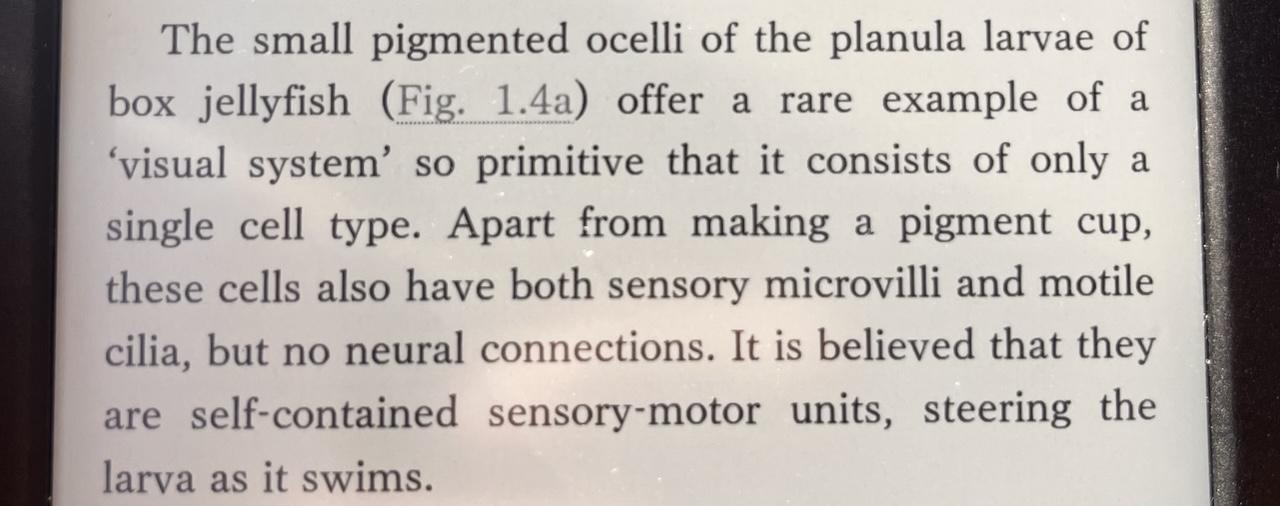
TIL: Box jellyfish larvae have eyes but no brain to connect them to so instead the eyes also swim a bit.
-
TIL: Box jellyfish larvae have eyes but no brain to connect them to so instead the eyes also swim a bit. Source: Animal Eyes, Land & Nilsson, second edition, chapter 1
-
TIL: Box jellyfish larvae have eyes but no brain to connect them to so instead the eyes also swim a bit. Source: Animal Eyes, Land & Nilsson, second edition, chapter 1
Now they’re talking about how some animals make us of polarisation to detect the direction of the sun and also reflecting surfaces. If you’ve ever tried looking through some polarising sunglasses (with one eye) while rotating them you’ll have noticed that they block reflections off horizontal surfaces like water.
-
Now they’re talking about how some animals make us of polarisation to detect the direction of the sun and also reflecting surfaces. If you’ve ever tried looking through some polarising sunglasses (with one eye) while rotating them you’ll have noticed that they block reflections off horizontal surfaces like water.
I wonder if you could make a horrible pair of glasses where one eye was vertically polarised and the other horizontally polarised and train your brain with them until you could instinctively see polarised light sources. Like that trick for finding differences between two images that depends on crossing your eyes and looking at each image with just one eye.
-
I wonder if you could make a horrible pair of glasses where one eye was vertically polarised and the other horizontally polarised and train your brain with them until you could instinctively see polarised light sources. Like that trick for finding differences between two images that depends on crossing your eyes and looking at each image with just one eye.
Next TIL from this book: in the darkest conditions where you can still see enough to not bump into things, the rate of photon capture by each of the receptors in your eyes is about 1 per hour! You’re only able to see anything by averaging together the responses of many many cells. Explains why visual acuity is so diminished when it’s dark.
-
Next TIL from this book: in the darkest conditions where you can still see enough to not bump into things, the rate of photon capture by each of the receptors in your eyes is about 1 per hour! You’re only able to see anything by averaging together the responses of many many cells. Explains why visual acuity is so diminished when it’s dark.
This graph is great, in the text they point out that the range of intensity levels where human eyes work is about 10 orders of magnitude. However photoreceptors themselves only cover about 5 orders of magnitude. To make up the difference we have our iris that contracts at high levels and at low levels we pool information from groups of receptors.
-
This graph is great, in the text they point out that the range of intensity levels where human eyes work is about 10 orders of magnitude. However photoreceptors themselves only cover about 5 orders of magnitude. To make up the difference we have our iris that contracts at high levels and at low levels we pool information from groups of receptors.
From the book: The octopus
 is one of the few known animals that is truly colourblind since it has only one photoreceptor. I found this so surprising I looked it up, turns out there’s currently a bit of a debate and maybe they see colour through a very optically whacky combination of a weird pupil shape and chromatic aberration but it sounds like the jury is still out on this one.
 -
From the book: The octopus
is one of the few known animals that is truly colourblind since it has only one photoreceptor. I found this so surprising I looked it up, turns out there’s currently a bit of a debate and maybe they see colour through a very optically whacky combination of a weird pupil shape and chromatic aberration but it sounds like the jury is still out on this one.So it’s well known that some animals can see distinguish the two linear polarisations of light, there are good reasons to do this: the sky has a pattern of linear polarisation that tells your where the sun is even if it’s cloudy, bees and insects use this to help orient themselves. There’s also evidence that some water bugs (water boatmen / Notonecta) use polarisation cues to find small bodies of water when their own is drying up.
-
So it’s well known that some animals can see distinguish the two linear polarisations of light, there are good reasons to do this: the sky has a pattern of linear polarisation that tells your where the sun is even if it’s cloudy, bees and insects use this to help orient themselves. There’s also evidence that some water bugs (water boatmen / Notonecta) use polarisation cues to find small bodies of water when their own is drying up.
This is already wild to me, it’s like there a whole extra dimension of “colour” that’s completely orthogonal to wavelength. But what’s crazier is that linear polarisation is not the only show in town. There’s also circular polarisation, which, like linear polarisation, comes in two kinds.
-
This is already wild to me, it’s like there a whole extra dimension of “colour” that’s completely orthogonal to wavelength. But what’s crazier is that linear polarisation is not the only show in town. There’s also circular polarisation, which, like linear polarisation, comes in two kinds.
And the machinery required to detect circular polarisation is different from that required to detect linear polarisation. It’s unclear to me if there is much circularly polarised light floating around in nature so sure many no animal cares to see it anyway but…
-
And the machinery required to detect circular polarisation is different from that required to detect linear polarisation. It’s unclear to me if there is much circularly polarised light floating around in nature so sure many no animal cares to see it anyway but…
Enter the mantis shrimp, which apparently has receptors for both linearly polarised _and_ circularly polarised light. And the males have patterns on their bodies that reflect the two circular polarisations differently! No other organism is known to have the optical machinery to resolve this so the mantis shrimp has the most secret love language we know of.
-
 J jwcph@helvede.net shared this topic
