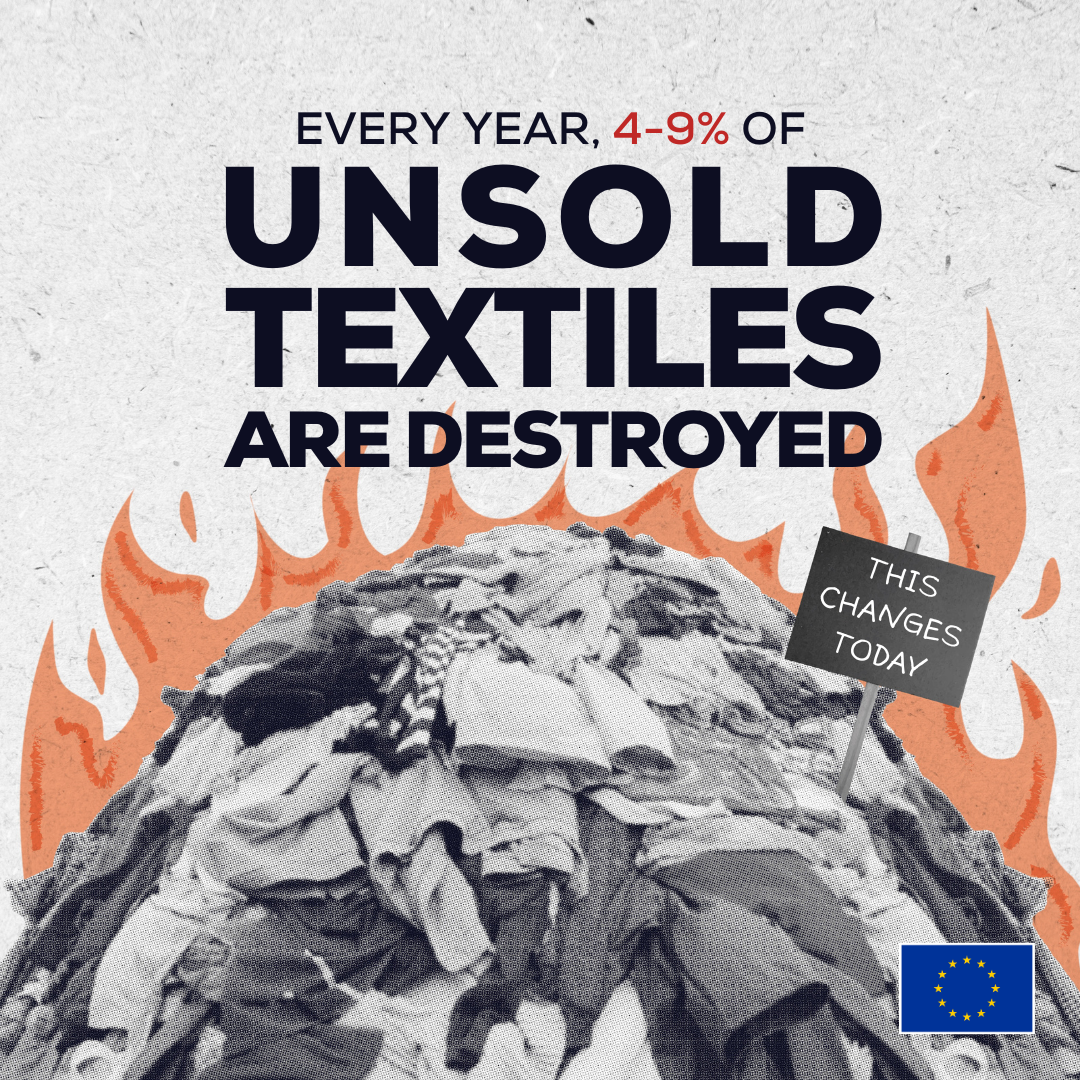
Every year in Europe, an estimated 4-9% of unsold textiles are destroyed before ever being worn, generating around 5.6 million tonnes of CO₂ emissions.
-
Every year in Europe, an estimated 4-9% of unsold textiles are destroyed before ever being worn, generating around 5.6 million tonnes of CO₂ emissions.
We’re putting an end to this wasteful practice.
From today, large companies can no longer destroy unsold clothes, accessories and footwear. They will need to instead prioritise keeping products in use: by selling, donating, or preparing for reuse.
Find out more: https://link.europa.eu/cdYmK9
@EUCommission As always, hope there are no loopholes.
-
Every year in Europe, an estimated 4-9% of unsold textiles are destroyed before ever being worn, generating around 5.6 million tonnes of CO₂ emissions.
We’re putting an end to this wasteful practice.
From today, large companies can no longer destroy unsold clothes, accessories and footwear. They will need to instead prioritise keeping products in use: by selling, donating, or preparing for reuse.
Find out more: https://link.europa.eu/cdYmK9
@EUCommission it’s probably better for public health to incinerate synthetic and mixed material clothes before they contaminate the water
-
@EUCommission it’s probably better for public health to incinerate synthetic and mixed material clothes before they contaminate the water
@Kierkegaanks @EUCommission burning plastics being notoriously healthy..?
-
@Kierkegaanks @EUCommission burning plastics being notoriously healthy..?
@EUCommission @noodlemaz note that I wrote it was probably better, not good
-
Every year in Europe, an estimated 4-9% of unsold textiles are destroyed before ever being worn, generating around 5.6 million tonnes of CO₂ emissions.
We’re putting an end to this wasteful practice.
From today, large companies can no longer destroy unsold clothes, accessories and footwear. They will need to instead prioritise keeping products in use: by selling, donating, or preparing for reuse.
Find out more: https://link.europa.eu/cdYmK9
I hope the execution will be as good as is the aim of this.
I wish you success in this, @EUCommission
-
Every year in Europe, an estimated 4-9% of unsold textiles are destroyed before ever being worn, generating around 5.6 million tonnes of CO₂ emissions.
We’re putting an end to this wasteful practice.
From today, large companies can no longer destroy unsold clothes, accessories and footwear. They will need to instead prioritise keeping products in use: by selling, donating, or preparing for reuse.
Find out more: https://link.europa.eu/cdYmK9
@EUCommission very few of the clothes sold in EU are produced in EU.
-
Every year in Europe, an estimated 4-9% of unsold textiles are destroyed before ever being worn, generating around 5.6 million tonnes of CO₂ emissions.
We’re putting an end to this wasteful practice.
From today, large companies can no longer destroy unsold clothes, accessories and footwear. They will need to instead prioritise keeping products in use: by selling, donating, or preparing for reuse.
Find out more: https://link.europa.eu/cdYmK9
«…the ESPR requires companies to disclose information on the unsold consumer products they discard as waste. It also introduces a ban on the destruction of unsold apparel, clothing accessories and footwear.»
Once again, since avoiding to mention enforcement seems to be the norm with such announcements:
1) Are there consequences for not disclosing such information?
2) Are there consequences for destroying textiles in spite of the announced ban? What are they? -
Every year in Europe, an estimated 4-9% of unsold textiles are destroyed before ever being worn, generating around 5.6 million tonnes of CO₂ emissions.
We’re putting an end to this wasteful practice.
From today, large companies can no longer destroy unsold clothes, accessories and footwear. They will need to instead prioritise keeping products in use: by selling, donating, or preparing for reuse.
Find out more: https://link.europa.eu/cdYmK9
@EUCommission One of the oldest building technologies was plaster and burlap. It should be blatantly obvious that a greater range of textiles should be manufactured for multiple uses.
This is PREscient ethics/math, and the fact that these measures as post de facto negligence, are further penalizing taxpayers, is just as much - if not more abhorrent than the inherent neglect.
Reform, because we have less and less CRUNCH time to adapt.
-
Every year in Europe, an estimated 4-9% of unsold textiles are destroyed before ever being worn, generating around 5.6 million tonnes of CO₂ emissions.
We’re putting an end to this wasteful practice.
From today, large companies can no longer destroy unsold clothes, accessories and footwear. They will need to instead prioritise keeping products in use: by selling, donating, or preparing for reuse.
Find out more: https://link.europa.eu/cdYmK9
@EUCommission So, large companies will have to resort to more non-EU production (if possible...) and do more abusive landfill with the excessive production (as they already do it).
As noted by others, it's all about: 1) how it will be investigated, 2) what happens next
Because I fear the answers are: 1) a (ridiculous) voluntary disclosure, 2) nothing will be enforced for non-EU productionsAs usual, the base idea is great, but it applies to a fictional world.
-
Every year in Europe, an estimated 4-9% of unsold textiles are destroyed before ever being worn, generating around 5.6 million tonnes of CO₂ emissions.
We’re putting an end to this wasteful practice.
From today, large companies can no longer destroy unsold clothes, accessories and footwear. They will need to instead prioritise keeping products in use: by selling, donating, or preparing for reuse.
Find out more: https://link.europa.eu/cdYmK9
@EUCommission Drapes of Wrath
-
Every year in Europe, an estimated 4-9% of unsold textiles are destroyed before ever being worn, generating around 5.6 million tonnes of CO₂ emissions.
We’re putting an end to this wasteful practice.
From today, large companies can no longer destroy unsold clothes, accessories and footwear. They will need to instead prioritise keeping products in use: by selling, donating, or preparing for reuse.
Find out more: https://link.europa.eu/cdYmK9
@EUCommission good job!
-
Every year in Europe, an estimated 4-9% of unsold textiles are destroyed before ever being worn, generating around 5.6 million tonnes of CO₂ emissions.
We’re putting an end to this wasteful practice.
From today, large companies can no longer destroy unsold clothes, accessories and footwear. They will need to instead prioritise keeping products in use: by selling, donating, or preparing for reuse.
Find out more: https://link.europa.eu/cdYmK9
@EUCommission Does this also apply for brand imitations?

-
Every year in Europe, an estimated 4-9% of unsold textiles are destroyed before ever being worn, generating around 5.6 million tonnes of CO₂ emissions.
We’re putting an end to this wasteful practice.
From today, large companies can no longer destroy unsold clothes, accessories and footwear. They will need to instead prioritise keeping products in use: by selling, donating, or preparing for reuse.
Find out more: https://link.europa.eu/cdYmK9
@EUCommission 33 million tonnes of CO2 has been released into the atmosphere by your close Israeli allies. During the genocide. So far.
-
@EUCommission 33 million tonnes of CO2 has been released into the atmosphere by your close Israeli allies. During the genocide. So far.
-
Every year in Europe, an estimated 4-9% of unsold textiles are destroyed before ever being worn, generating around 5.6 million tonnes of CO₂ emissions.
We’re putting an end to this wasteful practice.
From today, large companies can no longer destroy unsold clothes, accessories and footwear. They will need to instead prioritise keeping products in use: by selling, donating, or preparing for reuse.
Find out more: https://link.europa.eu/cdYmK9
@EUCommission omg thats pretty nice
didnt even know companies destroy unsold clothes. that's pretty sad and frustrating. so it's pretty nice that you are doing something about it

-
Every year in Europe, an estimated 4-9% of unsold textiles are destroyed before ever being worn, generating around 5.6 million tonnes of CO₂ emissions.
We’re putting an end to this wasteful practice.
From today, large companies can no longer destroy unsold clothes, accessories and footwear. They will need to instead prioritise keeping products in use: by selling, donating, or preparing for reuse.
Find out more: https://link.europa.eu/cdYmK9
They need to stop making shitty clothes in the first place. Make what people want, not what you think will sell. And put POCKETS in it, ffs.
-
Every year in Europe, an estimated 4-9% of unsold textiles are destroyed before ever being worn, generating around 5.6 million tonnes of CO₂ emissions.
We’re putting an end to this wasteful practice.
From today, large companies can no longer destroy unsold clothes, accessories and footwear. They will need to instead prioritise keeping products in use: by selling, donating, or preparing for reuse.
Find out more: https://link.europa.eu/cdYmK9
@EUCommission your donated clothing ends up being resold in Third World countries like mine... hope you have a good way to figure it out other than yet more directives
-
@EUCommission very few of the clothes sold in EU are produced in EU.
But if a customer orders three sizes of T-shirts from Amazon, keeps the one that fits, and returns the other two, the returned apparel will usually go to a return hub in the same EU country.
-
Every year in Europe, an estimated 4-9% of unsold textiles are destroyed before ever being worn, generating around 5.6 million tonnes of CO₂ emissions.
We’re putting an end to this wasteful practice.
From today, large companies can no longer destroy unsold clothes, accessories and footwear. They will need to instead prioritise keeping products in use: by selling, donating, or preparing for reuse.
Find out more: https://link.europa.eu/cdYmK9
@EUCommission Having minimum standards that prevent the import or manufacture of clothing that effectively already is trash when it hits the shelves would be preferable though.
-
Every year in Europe, an estimated 4-9% of unsold textiles are destroyed before ever being worn, generating around 5.6 million tonnes of CO₂ emissions.
We’re putting an end to this wasteful practice.
From today, large companies can no longer destroy unsold clothes, accessories and footwear. They will need to instead prioritise keeping products in use: by selling, donating, or preparing for reuse.
Find out more: https://link.europa.eu/cdYmK9
@EUCommission So what about Food then?
The amount of Food that is thrown away is incredible!