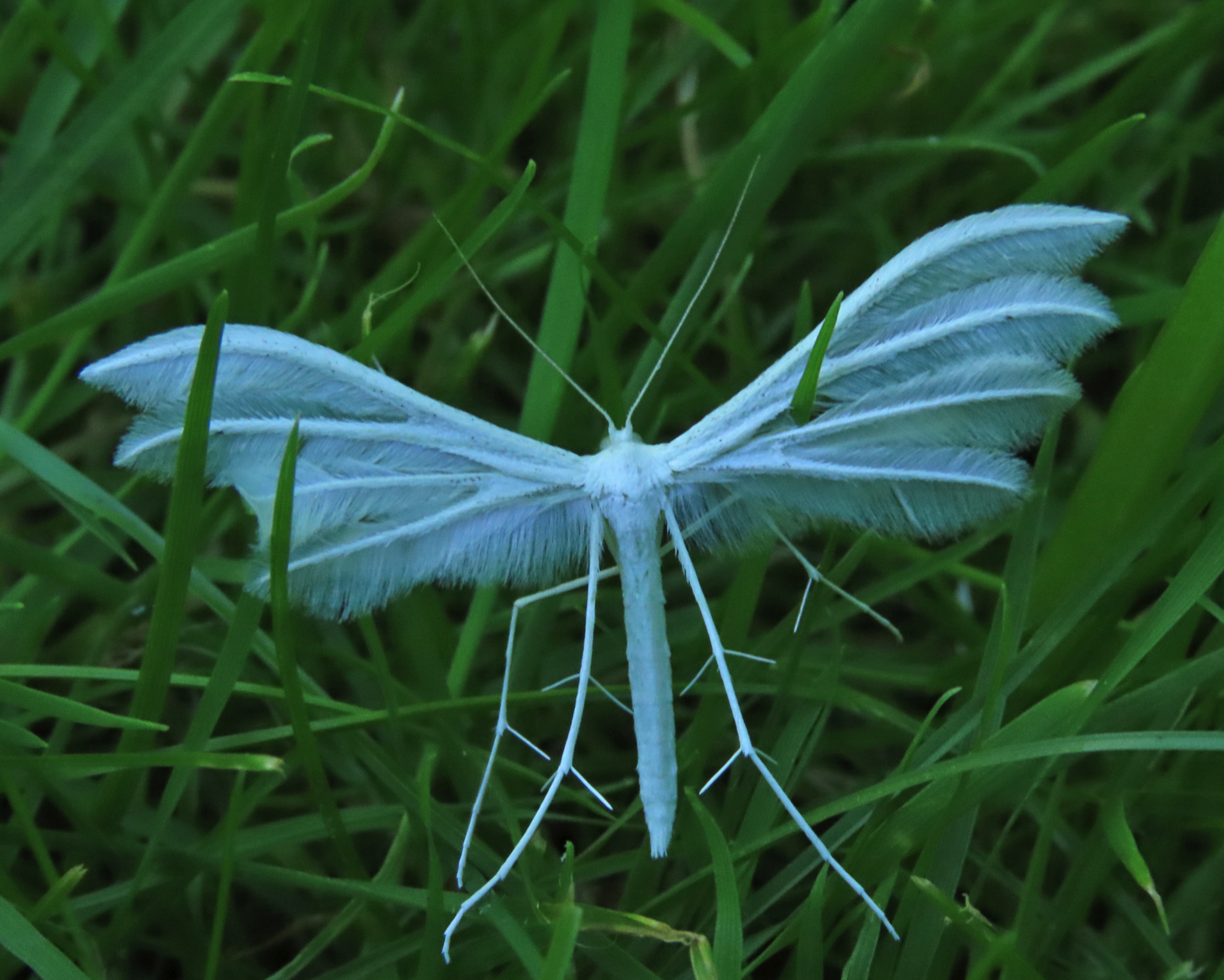
There are magical moths with wings like feathers.
-
@futurebird
1/
It is the White Plume Moth (Pterophorus pentadactyla), a member of the Pterophoridae family. It looks less like a typical moth and more like a miniature, elegant ghost or a tiny piece of down feather dropped in the grass.The evolutionary design behind those bizarre, feathery wings involves a mix of unique aerodynamics and clever camouflage.
@futurebird
2/
Why are the wings like that?The "Fingers" Anatomy: the wings aren't a solid sheet of membrane like a butterfly's. Instead, they are deeply cleft into distinct segments. The forewing is split into two plumes, and the hindwing is split into three. Its scientific name, pentadactyla, literally translates to "five fingers" because of these ten total plumes.
-
@futurebird
2/
Why are the wings like that?The "Fingers" Anatomy: the wings aren't a solid sheet of membrane like a butterfly's. Instead, they are deeply cleft into distinct segments. The forewing is split into two plumes, and the hindwing is split into three. Its scientific name, pentadactyla, literally translates to "five fingers" because of these ten total plumes.
@futurebird
3/
The Viscous Air Effect: To an insect this small, air doesn't behave like a thin gas; it feels thick and viscous, almost like swimming through water. Because of this micro-scale physics, a solid wing isn't strictly necessary. The long, hair-like fringes (modified scales) lining each plume act like an efficient mesh that traps air currents, allowing the moth to generate lift while significantly reducing its body weight. -
@futurebird
3/
The Viscous Air Effect: To an insect this small, air doesn't behave like a thin gas; it feels thick and viscous, almost like swimming through water. Because of this micro-scale physics, a solid wing isn't strictly necessary. The long, hair-like fringes (modified scales) lining each plume act like an efficient mesh that traps air currents, allowing the moth to generate lift while significantly reducing its body weight.@futurebird
4/
The "T-Shape" Disguise: While it is beautifully spread out in this photo, this moth spends most of its time with its wings tightly rolled up parallel to its long, spiky legs. When it folds up, it forms a perfect, rigid "T" shape that mimics a piece of dried grass, a twig, or a weed, rendering it completely invisible to birds. -
@futurebird
4/
The "T-Shape" Disguise: While it is beautifully spread out in this photo, this moth spends most of its time with its wings tightly rolled up parallel to its long, spiky legs. When it folds up, it forms a perfect, rigid "T" shape that mimics a piece of dried grass, a twig, or a weed, rendering it completely invisible to birds.@futurebird
5/
Quick Facts About the White Plume Moth
Flight Style: Because of their feather-like wings, they don't zip around like standard moths. Their flight is a delicate, fluttery, almost clumsy drifting motion, usually close to the ground.Diet: As caterpillars, their favorite food is Bindweed (Convolvulus), a common garden weed. Because they stick to eating weeds, gardeners generally consider them harmless guests rather than pests.
-
@futurebird
5/
Quick Facts About the White Plume Moth
Flight Style: Because of their feather-like wings, they don't zip around like standard moths. Their flight is a delicate, fluttery, almost clumsy drifting motion, usually close to the ground.Diet: As caterpillars, their favorite food is Bindweed (Convolvulus), a common garden weed. Because they stick to eating weeds, gardeners generally consider them harmless guests rather than pests.
@futurebird
6/
Night Owls: They are strictly nocturnal, which is why seeing one fully deployed on green grass during the day makes for such a spectacular photograph.It's a beautiful example of nature strip-mining a design down to the absolute bare essentials needed to fly and hide.
-
There are magical moths with wings like feathers. If you showed me this creature in another context I'd say "fake!"
This is a "plume moth" from outside of Moscow.
I don't know what this adaptation is about, maybe it's just to be etherial and make people think they maybe saw a fairy.
@futurebird Ah, Moscow? Fake then.
-
There are magical moths with wings like feathers. If you showed me this creature in another context I'd say "fake!"
This is a "plume moth" from outside of Moscow.
I don't know what this adaptation is about, maybe it's just to be etherial and make people think they maybe saw a fairy.
@futurebird looks like the cryptid from Disco Elysium
-
There are magical moths with wings like feathers. If you showed me this creature in another context I'd say "fake!"
This is a "plume moth" from outside of Moscow.
I don't know what this adaptation is about, maybe it's just to be etherial and make people think they maybe saw a fairy.
@futurebird I see your fairy and raise you a poodle moth
https://share.google/images/vpkiotwHaPfQeWX6F -
There are magical moths with wings like feathers. If you showed me this creature in another context I'd say "fake!"
This is a "plume moth" from outside of Moscow.
I don't know what this adaptation is about, maybe it's just to be etherial and make people think they maybe saw a fairy.
@futurebird I thought the same when I saw something similar, imagined a little dragon.
-
There are magical moths with wings like feathers. If you showed me this creature in another context I'd say "fake!"
This is a "plume moth" from outside of Moscow.
I don't know what this adaptation is about, maybe it's just to be etherial and make people think they maybe saw a fairy.
@futurebird they are common here, I get them in the polytunnel a lot. When they are resting the 'feathers' all align and their wings look impossibly narrow, certainly not something that could fly. I believe they are very ancient and from this, eventually, the flat wings evolved
-
 B bettina@mastodon.nu shared this topic