I was about to Have Opinions about the threats the US is making to Greenland, Denmark and Europe, then realised I have nothing useful to add, so I pressed Delete.
-
@stevegis_ssg
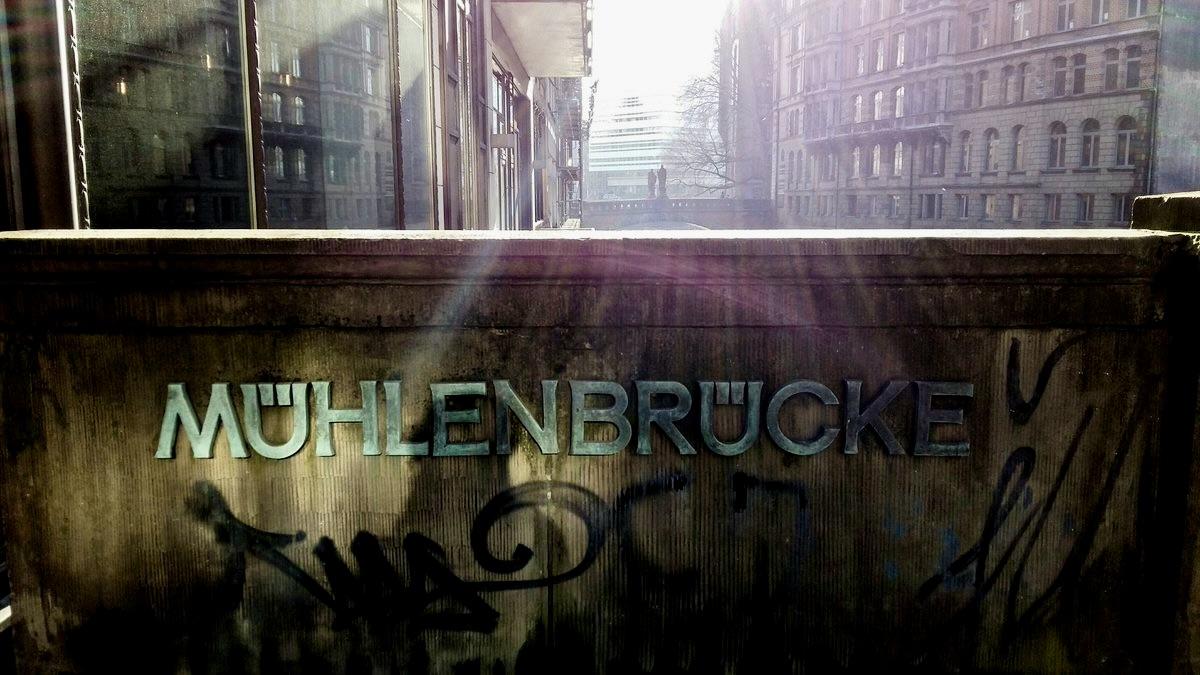
Mind that, regarding the original post of the Mühlenbrücke, your ü description only explains the pronunciation of the first ü in that word. The ü in Brücke is different. Its much shorter (apparantly, WP calls it Near-close near-front rounded vowel, whereas the ü in Mühle is a Close front rounded vowel). Dülon employs the closed form.
@ChristineMalec @CiaraNi@datenhalde @stevegis_ssg @ChristineMalec The variations in a single letter or accent are fascinating
-
@CiaraNi @ChristineMalec If you vocalize the English letter "e" and don't change anything about the position of your teeth and tongue BUT narrow your lips as though vocalizing an "ooo" sound at the same time, you'll come extremely close to the German pronunciation of the "ü."
 ️
️
@courtcan @ChristineMalec Lovely accessible description. Danke!
-
@courtcan Agreed
-
@CiaraNi @ChristineMalec The ü is pronounced like y in Danish. In my experience as a teacher of Danish to foreigners native English speakers find it hard to pronounce at first but basically just start saying eeee and then round your lips and the sound then changes to y. Don't change anything else in or around your mouth, just the lips.
@saederup @ChristineMalec Oh that's interesting - I hadn't thought of a parallel with Danish 'Y'. A very useful comparison and user-friendly description - danke und tak!
-
@CiaraNi there is an umlaut in the plural, Umläute ...
@otte_homan All umlauts should be in the plural so. Both because the umlauts would then have umlauts and because the world could use more nice-looking umlauts
-
@CiaraNi yeah, but there's no umlaut in "Umlaut". So you may say, describing umlauts is possible entirely with lauts. So you can describe umlauts without the need to use them, which makes learning them a lot easier.
At least one thing, we Germans got right, eh?"So you can describe umlauts without the need to use them, which makes learning them a lot easier."
This makes so much sense. Wise language, German.
-
@CiaraNi @mlazz @hanscees If you want to nitpick, umlaut is the phenomenon where an a changes to ä and o to ö when a word is inflected, while dieresis is the diacritical sign on top of a and o in ä and ö.
In many (most?) languages where ä and ö are used, the dieresis is *not* seen as an ”accent”, but ä, ö, and å are separate letters. Just like E is not seen as an F with an extra bar.
-
@CiaraNi @headword @walfischbucht But at least there's a diphtong in "Umlaut". 🫠
@katzentratschen @headword @walfischbucht Doesn't make up for the lack of umlauts though.
-
-
It upsets me that there are no umlauts in the word umlaut
@CiaraNi "eñe" is spelled with an eñe tho.
-
@id1om I would like to have a word with these diacriticless diacritics
@CiaraNi
Per Macron, it's grave and acute. -
-
-
@CiaraNi
Per Macron, it's grave and acute.@id1om It is
-
@CiaraNi "eñe" is spelled with an eñe tho.
@drj Leading by example. Good on ya, eńe
-
@mitradranirban @adriano @courtcan Practising what it preaches
-
@datenhalde @stevegis_ssg @ChristineMalec The variations in a single letter or accent are fascinating
@CiaraNi @datenhalde @ChristineMalec
Seriously.
-
I was about to Have Opinions about the threats the US is making to Greenland, Denmark and Europe, then realised I have nothing useful to add, so I pressed Delete. Instead, here's a picture I took of a bridge because it had splendid umlauts.
I love it, thanks
-
@mitradranirban @adriano @courtcan Practising what it preaches
@CiaraNi @mitradranirban @adriano If interrobang‽ isn't typically spelled with the "‽," it really should be.
-
@CiaraNi @mitradranirban @adriano If interrobang‽ isn't typically spelled with the "‽," it really should be.
@courtcan @CiaraNi @mitradranirban "Interrobang" honestly sounds like you're being questioned at gunpoint.