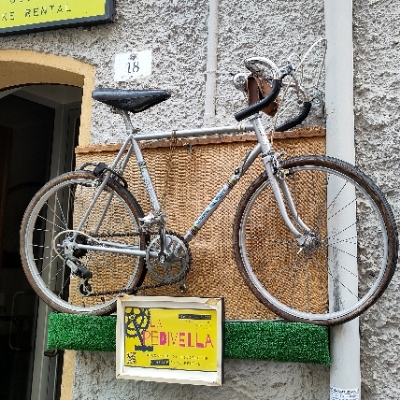
everyone should realize that e-scooters are a physically risky form of transport, especially when driven above about 20km/h.
-
@wsslmn @geonz @adub I mean, I also want to tax vehicles by weight (increasing at the scale of road damage, so by the square or mass^4 depending on who's numbers you believe), charge a fee for cars with only one person in them per km, and eventually ban private vehicle ownership all together.
(Which is also why I'm so down on bikes: I don't think they scale well to "the entire population" as to many people have medical conditions or are just out of shape, and to much of Canada gets icy roads.)
-
@catzilla @PapyrusBrigade @adub
That's why someone invented walking bikes for seniors.
https://www.sollso.com/ -
@catzilla @PapyrusBrigade @adub
That's why someone invented walking bikes for seniors.
https://www.sollso.com/@benbun That's brilliant!
-
@wsslmn @geonz @adub I've read articles about that before and they haven't ever addressed the issue with I've seen: freezing and refreezing. You plow perfectly and move the snow off the path. Then it warms up over the day, melting that snow and forming a lake in the path. It them freezes overnight and you've got a very smooth ice sheet.
This is why when I was biking between the two buildings at my university I stop after the first snowfall, that would happen all fall and most of the winter
@Canageek @geonz @adub That surface would make any way of moving around dangerous and unpredictable. Studded tires could play a role, I once met some Norwegians who cross a frozen lake on mountainbikes with studded tires in winter, making commutes faster in winter. That sounded quite fun

edit: I know most people wouldn't go that far or even think about this. I think it is fun, but there are some real risks here.
-
@Robotistry
Sorta snap, except being on a bicycle seems to not count as sitting for my chronic hip pain. Driving can be excruciating on a bad day, cycling has always been fine so far. The pedal assist is almost always on max though.
@catzilla @PapyrusBrigade @adub -
@adub Are there any configurations that can carry the advantages that escooters (and scooters) bring to a more bike-structured form that doesn't drop the benefits bikes get? (even if it takes a lower max speed than bikes)
- better ability to convert between multi-modal usage much better -- riding to walking to riding
- (related) portability/packageability, to carry onto mass transit or into a friend's car (don't know how wide of a feature this is for escooters -- it's a common reason I grab my plain-scooter over my bike)@gaditb like a kick scooter? my Razr folds nicely, has 20cm diameter wheels, and is great for the last 2-3km or so of a trip.
-
@adub I have a tricycle.
@JerodLycett i should have picked #CycleMaxxing 🫣
-
@adub I'm a fan of (unmotorized) kick scooters too. It's easier to trip on them than on a bike, but as you're already in a standing position you'll often be able to run the momentum off or just scrape the knee when falling, versus falling much farther and in a less advantageous position on a bicycle.
Also here in Germany, kick scooters count as free hand luggage on most buses and trains, whereas bicycles have restrictions during rush hour and require a whole second ticket just for the bike. And e-scooters have been banned completely by many local transit operators because a few shit-quality ones went up in flames and there's apparently no reliable safety certification system to allow specifically safe quality scooters.@LunaDragofelis i'm a big fan of my Razr kickscooter. it folds easily, has 20cm diameter wheels which go over tram tracks, and it's really nimble. a great little conveyance for all the reasons you mention. i wear a skateboarding helmet when i ride. great for up to 3km rides, for me. i haven't tried longer trips.
-
@adub @Daveography the stability of a bicycle is an impressively rich study in dynamics. You can even take away trail and have a stable "bicycle", as in Koojiman et al. (2011) which is also an excellent review of the mechanics in detail (rather than the hand-wavy claims that tend to dominate the subject)
http://ruina.tam.cornell.edu/research/topics/bicycle_mechanics/stablebicycle/
The less-pithy version is: there are zones of stability and instability based on a lot of factors like most complex dynamical systems, and the bicycles we're familiar with just happen to have great big zones of stability, a combination of evolving design and plain old good luck.
@SnoopJ @Daveography cheers.
-
-
*Why bicycles are surprisingly stable*
A common myth is that bicycle stability comes mainly from the spinning wheels acting as gyroscopes. Gyroscopic effects help, but they are actually not the dominant factor.
The major sources of bicycle stability are:
1. Steering geometry (trail)
• The front wheel naturally "falls into" a turn when the bike leans.
• This automatically steers the contact patch underneath the rider's centre of mass.
• The bike performs a kind of continuous self-correction.2. Large wheel diameter
• Large wheels roll smoothly over imperfections.
• Small steering disturbances produce gentler changes in direction.3. Long wheelbase
• Reduces sensitivity to perturbations.
• Creates slower, more manageable dynamics.4. Rider position
• The rider's mass is located relatively high and centred between the wheels.
• Subtle body movements can effectively influence balance.At speeds around 10-20 km/h, many bicycles are remarkably self-stabilizing. If you've ever seen a bicycle coast for a surprising distance riderless, that's evidence of these effects.
@adub the steering geometry thing is super fun, steering the thing mire with sideways leans than with turning the handle

-
@catzilla
@PapyrusBrigade @adub
many, many people can ride bikes.
many, many people reasonably choose not to ride them through the terrain of ubiquitous potential violence created by large-scale private automobile usage.
i salute all the people who have done such great work chiseling real bike infrastructure into urban spaces, in the face of Autopia and its many vicious adherents. but it's a losing battle in most of North America and we need to be real about that -
@adub I'm frustrated by how much money we put into bikes. We could put that into decent transportation like a train or more buses! Things that don't involve showing up at work exhausted and sweaty and with horrible helmet hair, that don't become dangerous due to ice most of the year
-
-
-
-
@renardboy @rey @adub Thanks for this. I wish we could just build sidewalks to be accessible to those, since a lot more places have those then bike lanes
-
*Why bicycles are surprisingly stable*
A common myth is that bicycle stability comes mainly from the spinning wheels acting as gyroscopes. Gyroscopic effects help, but they are actually not the dominant factor.
The major sources of bicycle stability are:
1. Steering geometry (trail)
• The front wheel naturally "falls into" a turn when the bike leans.
• This automatically steers the contact patch underneath the rider's centre of mass.
• The bike performs a kind of continuous self-correction.2. Large wheel diameter
• Large wheels roll smoothly over imperfections.
• Small steering disturbances produce gentler changes in direction.3. Long wheelbase
• Reduces sensitivity to perturbations.
• Creates slower, more manageable dynamics.4. Rider position
• The rider's mass is located relatively high and centred between the wheels.
• Subtle body movements can effectively influence balance.At speeds around 10-20 km/h, many bicycles are remarkably self-stabilizing. If you've ever seen a bicycle coast for a surprising distance riderless, that's evidence of these effects.
@adub it's, um, evidence of something else too...
-
*Why bicycles are surprisingly stable*
A common myth is that bicycle stability comes mainly from the spinning wheels acting as gyroscopes. Gyroscopic effects help, but they are actually not the dominant factor.
The major sources of bicycle stability are:
1. Steering geometry (trail)
• The front wheel naturally "falls into" a turn when the bike leans.
• This automatically steers the contact patch underneath the rider's centre of mass.
• The bike performs a kind of continuous self-correction.2. Large wheel diameter
• Large wheels roll smoothly over imperfections.
• Small steering disturbances produce gentler changes in direction.3. Long wheelbase
• Reduces sensitivity to perturbations.
• Creates slower, more manageable dynamics.4. Rider position
• The rider's mass is located relatively high and centred between the wheels.
• Subtle body movements can effectively influence balance.At speeds around 10-20 km/h, many bicycles are remarkably self-stabilizing. If you've ever seen a bicycle coast for a surprising distance riderless, that's evidence of these effects.
@adub Isn't the self- stabilizing going away (at least in part) as soon as the rider touches the handlebar? You still need to learn to ride a bike and steer for balance.

-
@LunaDragofelis i'm a big fan of my Razr kickscooter. it folds easily, has 20cm diameter wheels which go over tram tracks, and it's really nimble. a great little conveyance for all the reasons you mention. i wear a skateboarding helmet when i ride. great for up to 3km rides, for me. i haven't tried longer trips.
@adub I haven't ridden mine anymore since I gained even more weight (it's a skating tricks scooter designed for 100kg and my body is beyond 150kg now)
It has tiny wheels, but it's not really a problem if I pay attention to the ground in front of me (avoiding rocks and potholes for example). It doesn't fold, but even the few bus drivers who asked me to fold it were fine with it when I told them this model can't be folded.
It is very robust though and has very light rolling wheels so it's easy to go fast (except for my poor stamina).