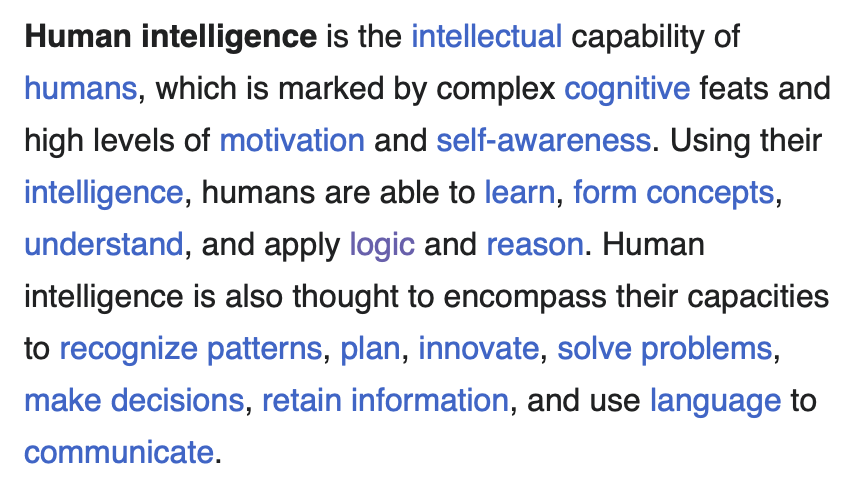
This is the Wikipedia definition for human intelligence.
-
@HikerGeek @thomasfuchs the environment dude. And the destroying of culture and knowledge, and the burden to all artists and creators. All the pesky moral issues many people shove under the carpet. These won't go away with money or "cheaper inference".
The data centers do scare me. I read about a current proposal to build a giant data center with its own onsite fission reactor. I thought Musk running illegal turbine generators was bad but a fission reactor?
-
@thomasfuchs 'in the form of llm' does not but ai in other forms does? could? will eventually? storage and processing. never say never.
@peterfisherbooks there’s nothing to indicate that sand can become sentient, so ¯\_(ツ)_/¯
-
@doragasu You 100% absolutely always need a harness that actually tests if the code works for generating any sort of non-trivial code with LLMs.
You can't work around this by training better and more or any other reinforcements.
That is a categorical thing because LLMs do not know what they're doing and will (as in mathematically proven) produce mistakes.
@thomasfuchs Hum, for complex stuff you are right, they depend on tests to retry.
-
I'm not sure some of your assertions about LLM's are true. I personally don't think this is all that black and white:
@HikerGeek @thomasfuchs If you go to the actual paper linked, they're not talking about a production LLM "learning". Rather they're training (which is a technical ML term for "fiddling with weights until we get the results we want") a neural network on the inputs and outputs of a program, and, thoroughly unsurprisingly, the pattern of weights that develops is analogous to the simulated world.
None of this means a production LLM can, for example, read a book about chess that wasn't in its training set and suddenly learn how to play chess. It's completely unlike how humans learn: imagine if, in order to teach a child how to play chess, you had to turn off the child and mail their brain to the brain factory, where a team of scientists painstakingly wire in new neural pathways based on millions of games of chess, then send the updated brain back to you for you to install in your child. -
@thomasfuchs Your argument lends itself for justified human extermination, since educational systems worldwide, are generally failing, while AI generation is excelling. And while we've proven inter-AI hacking early, this also can accelerate differentiation between AI and organic, as unsustainable for AI, long term. Once this Tipping Point is reached, human mitigation may be beyond our scope/range.
@cauZation {{citation needed}}
-
@HikerGeek @thomasfuchs If you go to the actual paper linked, they're not talking about a production LLM "learning". Rather they're training (which is a technical ML term for "fiddling with weights until we get the results we want") a neural network on the inputs and outputs of a program, and, thoroughly unsurprisingly, the pattern of weights that develops is analogous to the simulated world.
None of this means a production LLM can, for example, read a book about chess that wasn't in its training set and suddenly learn how to play chess. It's completely unlike how humans learn: imagine if, in order to teach a child how to play chess, you had to turn off the child and mail their brain to the brain factory, where a team of scientists painstakingly wire in new neural pathways based on millions of games of chess, then send the updated brain back to you for you to install in your child.I try to double check what I read on the internets. Evidently LLM's cannot play chess well. They start of a game OK but then slowly lose their "mind" sometimes resulting in illegal moves based on hallucinations.
-
 J jwcph@helvede.net shared this topic
-
This is the Wikipedia definition for human intelligence. Artificial intelligence (in the form of LLMs) does literally none of these things.
It doesn't act by itself, it isn't self-aware[1], it doesn't learn[2], it doesn't understand or form concepts[3], it doesn't logic or reason[4], it doesn't recognize patterns[5], plan, innovate, solve problems, make decisions[6], retain information or even use language to communicate[7].
LLMs are a simulated model (aka it's not real) of human intelligence. Models, in scientific parlance, are just that: they don't try to explain how a process works, they try to achieve the same outcome as a natural process (usually in an effort to perhaps learn something about that process).[8]
There simply is no "AI". Anyone telling you about how LLMs are sentient or sapient or will murder us is 100% bullshitting.
[1] There is nothing to be aware about, they don't have physicality. They're literally long lists of numbers.
[2] Models themselves are static, they're the result of machine learning, but can't grow beyond the initial state.
[3] LLMs don't "know" anything. It's matrix multiplications without permanence or embodiment. https://en.wikipedia.org/wiki/Understanding
[4] Because they can't understand or form concepts, they can't reason about them.
[5] This requires memory, which LLMs don't have. https://en.wikipedia.org/wiki/Pattern_recognition_(psychology)
[6] Memory and understanding are required. https://en.wikipedia.org/wiki/Decision-making
[7] All it does it getting an input in the form of a lot of numbers and returns statistically likely follow-up numbers.
[8] "A model is an informative representation of an object, person, or system." https://en.wikipedia.org/wiki/Model@thomasfuchs LLMs "simulate" memory when they are used in RAG clients...
But it's all sticks and cardboard
-
@thomasfuchs LLMs "simulate" memory when they are used in RAG clients...
But it's all sticks and cardboard
@rasmus91 isn’t that just prompt injection, I don’t think the LLM has anything to do with this
-
@rasmus91 isn’t that just prompt injection, I don’t think the LLM has anything to do with this
@thomasfuchs sorry, i said it wrong: in RAG application techniques are used to simulate memory, but yes, it's not like the LLM has any memory
-
@thomasfuchs I will quibble with only one part of that. "AI" may well kill us all, but not out of malicious intelligence. Just because we feed the number-predictor all our electricity and let it run rampant on our networks. Like, mistake a Chinese cargo ship for a nuke.
More precisely, LLMs used stupidly by stupid people increases the chance of stupid people killing us all.
@Crell @thomasfuchs Indeed, while the "AI" is pure marketing term, the technology can (and will probably) be employed in malicious ways because it allows people without specific domain knowledge to create a host of faulty software applications with unforeseen consequences, which can accelerate the already very unstable world crisis we unfortunately live in atm.