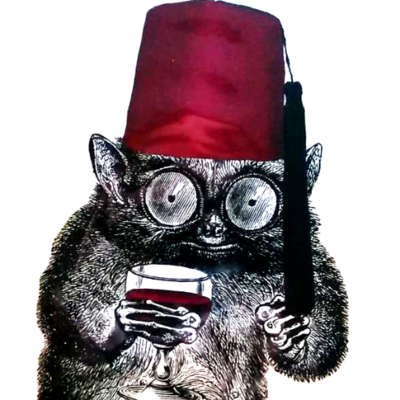
It's well known that an infinite number of monkeys will eventually produce the works of Shakespeare.
-
@mcc exactly 3
@lritter Long-lived monkeys
-
@lritter Long-lived monkeys
@mcc so-called methusamonkeys
-
It's well known that an infinite number of monkeys will eventually produce the works of Shakespeare. However my thesis is that this formulation is naive, and we can in fact establish a far lower bound. Proof: William Shakespeare, a monkey, produced the works of Shakespeare. Therefore the number of monkeys needed to produce the work of Shakespeare is no greater than the number of primates who lived between Altiatlasius koulchii (57 million years ago) and 1610 CE. Roughly how many monkeys is that?
@mcc I thought we were apes
-
@mcc I thought we were apes
@thattommyhall i actually until digging through wikipedia a moment ago assumed apes were a subcategory of monkeys. Apparently the actual monkey/ape supercategory is Simians. I'm not so sure about this. This feels like "bugs" to me.
-
It's well known that an infinite number of monkeys will eventually produce the works of Shakespeare. However my thesis is that this formulation is naive, and we can in fact establish a far lower bound. Proof: William Shakespeare, a monkey, produced the works of Shakespeare. Therefore the number of monkeys needed to produce the work of Shakespeare is no greater than the number of primates who lived between Altiatlasius koulchii (57 million years ago) and 1610 CE. Roughly how many monkeys is that?
@mcc ohy god a breakthrough. But are apes monkeys?
-
@mcc ohy god a breakthrough. But are apes monkeys?
@PsySal This is a good question and according to wikipedia the answer is technically "no". But informally I feel like people use monkeys as a shorthand for what is more properly called simians?
-
It's well known that an infinite number of monkeys will eventually produce the works of Shakespeare. However my thesis is that this formulation is naive, and we can in fact establish a far lower bound. Proof: William Shakespeare, a monkey, produced the works of Shakespeare. Therefore the number of monkeys needed to produce the work of Shakespeare is no greater than the number of primates who lived between Altiatlasius koulchii (57 million years ago) and 1610 CE. Roughly how many monkeys is that?
@mcc it just occurred to me that the phrase “producing the works of Shakespeare”, since the works of Shakespeare are all plays, actually demands the role of stage producer rather than typist in its most natural reading
I am very certain that the chance of successfully stage-producing a single Shakespeare play falls dramatically as the number of producers backstage increases, and that’s the best case scenario of them being literate humans.
-
It's well known that an infinite number of monkeys will eventually produce the works of Shakespeare. However my thesis is that this formulation is naive, and we can in fact establish a far lower bound. Proof: William Shakespeare, a monkey, produced the works of Shakespeare. Therefore the number of monkeys needed to produce the work of Shakespeare is no greater than the number of primates who lived between Altiatlasius koulchii (57 million years ago) and 1610 CE. Roughly how many monkeys is that?
@mcc More than a few. But less than 'infinite'. In fact, compared to 'infinite' , it might as well be 'one'.
One monkey.
"So why couldn't that one monkey have been you?" - my mother.
-
@thattommyhall i actually until digging through wikipedia a moment ago assumed apes were a subcategory of monkeys. Apparently the actual monkey/ape supercategory is Simians. I'm not so sure about this. This feels like "bugs" to me.
@mcc @thattommyhall I remember learning this when I learned that Curious George doesn’t have a tail and is therefore most likely a “curious little ape,” not “monkey.”
-
It's well known that an infinite number of monkeys will eventually produce the works of Shakespeare. However my thesis is that this formulation is naive, and we can in fact establish a far lower bound. Proof: William Shakespeare, a monkey, produced the works of Shakespeare. Therefore the number of monkeys needed to produce the work of Shakespeare is no greater than the number of primates who lived between Altiatlasius koulchii (57 million years ago) and 1610 CE. Roughly how many monkeys is that?
@mcc One
Let me point you to the multiple horse theory, but I have the conjecture it also applies to monkeys
Maybe there's even only one horse-monkey
This is to be determined
-
@mcc One
Let me point you to the multiple horse theory, but I have the conjecture it also applies to monkeys
Maybe there's even only one horse-monkey
This is to be determined
-
@mcc One
Let me point you to the multiple horse theory, but I have the conjecture it also applies to monkeys
Maybe there's even only one horse-monkey
This is to be determined
@Yuki the existence of one (1) horse-monkey would significantly upset evolutionary theory, i'd say
-
It's well known that an infinite number of monkeys will eventually produce the works of Shakespeare. However my thesis is that this formulation is naive, and we can in fact establish a far lower bound. Proof: William Shakespeare, a monkey, produced the works of Shakespeare. Therefore the number of monkeys needed to produce the work of Shakespeare is no greater than the number of primates who lived between Altiatlasius koulchii (57 million years ago) and 1610 CE. Roughly how many monkeys is that?
@mcc William Shakespeare was an ape… unless he had a tail we don’t know about
-
It's well known that an infinite number of monkeys will eventually produce the works of Shakespeare. However my thesis is that this formulation is naive, and we can in fact establish a far lower bound. Proof: William Shakespeare, a monkey, produced the works of Shakespeare. Therefore the number of monkeys needed to produce the work of Shakespeare is no greater than the number of primates who lived between Altiatlasius koulchii (57 million years ago) and 1610 CE. Roughly how many monkeys is that?
@mcc n monkeys (1 per year) seems unlikely so maybe n² monkeys (1 in the first year, 2 in the second, etc.) for about a quadrillion monkeys
-
It's well known that an infinite number of monkeys will eventually produce the works of Shakespeare. However my thesis is that this formulation is naive, and we can in fact establish a far lower bound. Proof: William Shakespeare, a monkey, produced the works of Shakespeare. Therefore the number of monkeys needed to produce the work of Shakespeare is no greater than the number of primates who lived between Altiatlasius koulchii (57 million years ago) and 1610 CE. Roughly how many monkeys is that?
@mcc Minimum bound though; we could have gotten an outlier result
-
It's well known that an infinite number of monkeys will eventually produce the works of Shakespeare. However my thesis is that this formulation is naive, and we can in fact establish a far lower bound. Proof: William Shakespeare, a monkey, produced the works of Shakespeare. Therefore the number of monkeys needed to produce the work of Shakespeare is no greater than the number of primates who lived between Altiatlasius koulchii (57 million years ago) and 1610 CE. Roughly how many monkeys is that?
@mcc using overly generous estimates, let's assume a median number of a thousand extant simian species at any given year, a median simian population of 1 million individuals per species per generation, and a median generation time of 10 years. Atliatlassius is a fine enough spot to start the clock, which i'll round to 60 million years in the interest of conservatism and keeping only one sig fig.
so that gives 6 * 106 * 106 * 103 / 101 = 6 * 1014, or a lower bound of 600,000,000,000,000, or a mere 600 quadrillion monkeys, as a conservative lower bound.
edit: fix typo and clarify simians, not all primates, which would probably add another zero.
-
@thattommyhall i actually until digging through wikipedia a moment ago assumed apes were a subcategory of monkeys. Apparently the actual monkey/ape supercategory is Simians. I'm not so sure about this. This feels like "bugs" to me.
@mcc @thattommyhall yeah, in my experience biologists don't use a cladistic or monophyletic definition of "monkey". So a typical biologist would say that humans are primates and simians and apes, but are not monkeys.
-
It's well known that an infinite number of monkeys will eventually produce the works of Shakespeare. However my thesis is that this formulation is naive, and we can in fact establish a far lower bound. Proof: William Shakespeare, a monkey, produced the works of Shakespeare. Therefore the number of monkeys needed to produce the work of Shakespeare is no greater than the number of primates who lived between Altiatlasius koulchii (57 million years ago) and 1610 CE. Roughly how many monkeys is that?
@mcc LEAN in, sister.
-
It's well known that an infinite number of monkeys will eventually produce the works of Shakespeare. However my thesis is that this formulation is naive, and we can in fact establish a far lower bound. Proof: William Shakespeare, a monkey, produced the works of Shakespeare. Therefore the number of monkeys needed to produce the work of Shakespeare is no greater than the number of primates who lived between Altiatlasius koulchii (57 million years ago) and 1610 CE. Roughly how many monkeys is that?
@mcc interesting theory.
Knowing how fast sapiens monkeys grew in number the last 200years I'd say not more than 20 billions.
Which is far from an infinite number of monkeys, very reassuring -
@mcc One
Let me point you to the multiple horse theory, but I have the conjecture it also applies to monkeys
Maybe there's even only one horse-monkey
This is to be determined