Starting today, USB-C is the mandatory charging standard for all laptops sold in the EU.
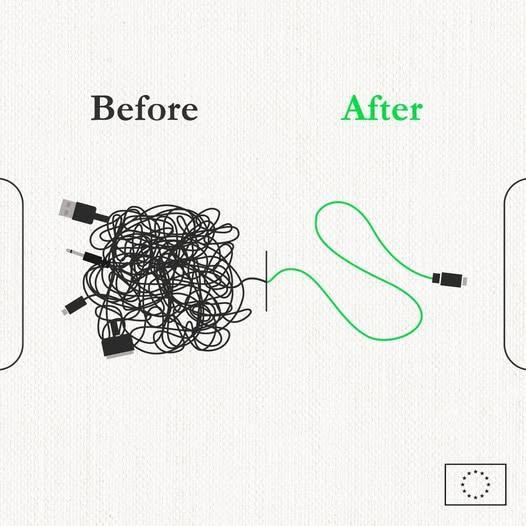
-
@derbruesseler @EUCommission lol ok at this point you're just concern trolling
@hazelnot @derbruesseler @EUCommission I suspect he wants EC to confiscate his older devices and cables.
Maybe with enough posts online EC can have a special law in this case. -
@hazelnot I still have devices that need a USB-A to USB-C cable, and I still end up using different chargers. And as for 'less electronic waste': what about all those chargers that became obsolete because of the new directive? Ever thought about that? // @EUCommission
@derbruesseler @hazelnot @EUCommission So what? Did you think old cables would evaporate when a new interface standard was mandated?
You do realize that some vendors made cables proprietary specifically to make more money and not for any functional reason? This nonsense is now somewhat constrained. Many of us can already use one cable for charging multiple devices and enjoy not having to round up a variety when travelling.
-
Starting today, USB-C is the mandatory charging standard for all laptops sold in the EU.
We are putting an end to cable clutter and unnecessary costs for citizens.
One cable, any brand, less electronic waste.
We are delivering a simpler, more sustainable digital future for Europe.
It's not one cable. It's a mess of many incompatible cables that now all look the same.
-
@raymaccarthy @mmalc @EUCommission @jnfingerle I've never purchased a laptop that didn't come with a charger though
@hazelnot @raymaccarthy @mmalc @EUCommission @jnfingerle
I believe that that's exactly the idea. Same way that phones, at least in Europe, no longer comes with chargers -
Starting today, USB-C is the mandatory charging standard for all laptops sold in the EU.
We are putting an end to cable clutter and unnecessary costs for citizens.
One cable, any brand, less electronic waste.
We are delivering a simpler, more sustainable digital future for Europe.
@EUCommission @Lazarou my box of archaic cables is NOT electronic waste, it's a collection.
-
Starting today, USB-C is the mandatory charging standard for all laptops sold in the EU.
We are putting an end to cable clutter and unnecessary costs for citizens.
One cable, any brand, less electronic waste.
We are delivering a simpler, more sustainable digital future for Europe.
Tagging @beeps for the green astestic
-
@mmalc @raymaccarthy @EUCommission @jnfingerle Mandating USB-C doesn't prevent crappy vendors from misusing the connector, badly implenting the standard or maliciously complying.
It however improves the overall user experience, by e.g requiring a single charger and cable for your iPhone, your partner's Pixel and your daughter's Kindle.
Different product categories will obviously still require different charging bricks due power requirements.
@SamantazFox @mmalc @EUCommission @jnfingerle
You are fortunate.
This is not always true, because there are many different standards that use the USB-C connector. -
It's not one cable. It's a mess of many incompatible cables that now all look the same.
Before the USB-C nightmare I cound tell if a cable was compatible by looking at the plug on the end. Now I need to get out a USB tester and compare cables and power supplies to work out what powers each device efficiently. Or if they even transfer data.
No, the USB-C chargers aren't 'universal' either. They have different power negotiation protocols.
"Universal" is a lie.
-
Starting today, USB-C is the mandatory charging standard for all laptops sold in the EU.
We are putting an end to cable clutter and unnecessary costs for citizens.
One cable, any brand, less electronic waste.
We are delivering a simpler, more sustainable digital future for Europe.
@EUCommission also need to mandate 3.5 jack in every phone
 ️
️ -
@mmalc @raymaccarthy @EUCommission @jnfingerle
My conventional USB-A Chargers still charge my latest mobile, but not in quick charge.
Which is sufficient for radios, headsets ans such stuff. It also preserves the akku with slow charging overnight.
The bad thing about cables is that there is othen rather shown the data rate but not the power it is able to carry.@red_rooster @mmalc @EUCommission @jnfingerle
It's more complicated than that. There are USB-A chargers that can quick charge a USB-C device at 2A. Otherss will run at 500mA.There are multiple charging standards that use a USB-C <> USB-A cable and a USB-C <> USB-A cable. This is not the fault of the EU, but the EU directive fails to take account of the industry or mean manufacturers. Once you could buy a Tablet that slow charged on USB and fast charged on the coax socket even if USB in use.
-
@raymaccarthy @EUCommission @jnfingerle
"Also none of my USB-C chargers or PC USB-C port will charge one USB-C device I have, only a USB-A port on PC or charger works."
Q.E.D.
If you're interested to know why, and what you might perhaps do about it, this article may be useful:
https://plugable.com/blogs/news/understanding-usb-c-charging-issues
@mmalc @EUCommission @jnfingerle
I know why.
Some USB-C chargers and PC host ports by default will output 5V at up to 500 mA. Some do not output at all if there is neither USB power serial signalling nor recognised resistors. Some USB-C gadgets don't do either and need USB-A to USB-C cables (Power only wires, USB-2 or USB-3 all work).The USB-C standard is the worst I've seen in decades. Apple was 1st to mess up USB-A power out.
-
Starting today, USB-C is the mandatory charging standard for all laptops sold in the EU.
We are putting an end to cable clutter and unnecessary costs for citizens.
One cable, any brand, less electronic waste.
We are delivering a simpler, more sustainable digital future for Europe.
poor, overlooked usb-b.
-
@mmalc @raymaccarthy @EUCommission @jnfingerle Mandating USB-C doesn't prevent crappy vendors from misusing the connector, badly implenting the standard or maliciously complying.
It however improves the overall user experience, by e.g requiring a single charger and cable for your iPhone, your partner's Pixel and your daughter's Kindle.
Different product categories will obviously still require different charging bricks due power requirements.
@SamantazFox @mmalc @raymaccarthy @EUCommission @jnfingerle
They also need different USC-C cables. Some new USB-C cables still only support 3 amps of current, up to at 20 volts, 60W. Others currently support higher wattage topping out at 240W, at 5 amps of current and 48v.
High powered chargers won't fast charge with the wrong cable. Or if the power negotiation protocol is different. Some have discreet voltages but others are continuous range.
The whole USB-C thing is a complete mess.
-
@SamantazFox @mmalc @EUCommission @jnfingerle
You are fortunate.
This is not always true, because there are many different standards that use the USB-C connector.@raymaccarthy @mmalc @EUCommission @jnfingerle The law also mandates the use of the USB Power Delivery protocol. It doesn't prevent vendors from shipping something else, but it must be alongside USB PD.
-
@saskboy @derbruesseler @EUCommission
Even 'good' chargers normally only support one power negotiation protocol. You need to test eachbcharger and cable combination with each device for optimal charging.
I've already got multiple USB-C chargers and cables that are now e-waste.
-
@hazelnot I still have devices that need a USB-A to USB-C cable, and I still end up using different chargers. And as for 'less electronic waste': what about all those chargers that became obsolete because of the new directive? Ever thought about that? // @EUCommission
@derbruesseler @hazelnot @EUCommission well all ur cables & charger going to be obsolete after a period of time, no matter EU going to set some standards. But u don't need to carry different cables for different devices after they set new standards. So it's good for user prospective.
-
@SamantazFox @mmalc @raymaccarthy @EUCommission @jnfingerle
They also need different USC-C cables. Some new USB-C cables still only support 3 amps of current, up to at 20 volts, 60W. Others currently support higher wattage topping out at 240W, at 5 amps of current and 48v.
High powered chargers won't fast charge with the wrong cable. Or if the power negotiation protocol is different. Some have discreet voltages but others are continuous range.
The whole USB-C thing is a complete mess.
@geoffl @mmalc @raymaccarthy @EUCommission @jnfingerle When you're dealing with that much power (up to 240W) it's indeed smart for the charger to check that the cable is actually rated accordingly, rather than burning your house down.
As for the protocol, it *must* be USB PD, super simple, no fiddling around.
The only drawback might be the markings (as the USB if is quite bad at this), though from a quick glance at the law it seems that it's being worked on (at least for the chargers).
-
"One cable, any brand, less electronic waste.”
Per the article @jnfingerle posted, unfortunately that's simply not true
(See also: https://www.theatlantic.com/technology/archive/2024/11/usb-c-is-not-universal/680502/)
There are multiple types of USB-C cable with different capabilities, and they're not interchangeable. Previously it was obvious that you couldn't plug device-A into power adapter B; now the connection may fail for no obvious reason.
What's needed now is clear, standardised labeling. It’d be great if you could work on that.
@mmalc @EUCommission Once, a USB-C cable was left plugged into an adapter on a table in the office. I was in a hurry and didn't notice how thin the cable was. I plugged what I thought was the docking station's cable into the notebook and rushed to the daily stand-up. By the time I got back, the cable was hot, and the notebook's charging circuit was fried.
It is also good to know that some product warranties cover charger issues only if the device was charged using its official cable. Oculus Quest 2's manual mentions that it can catch fire otherwise.
 You can take risks or play the unpleasant memory game of "which USB-C cable came or compatible with which device".
 -
@geoffl @mmalc @raymaccarthy @EUCommission @jnfingerle When you're dealing with that much power (up to 240W) it's indeed smart for the charger to check that the cable is actually rated accordingly, rather than burning your house down.
As for the protocol, it *must* be USB PD, super simple, no fiddling around.
The only drawback might be the markings (as the USB if is quite bad at this), though from a quick glance at the law it seems that it's being worked on (at least for the chargers).
@SamantazFox @mmalc @raymaccarthy @EUCommission @jnfingerle
I've got 25W chargers with incompatible power negotiation protocols from each other. 60W chargers that only charge devices some at 15W. Phones than only charge at the fastest speed with the manufacturers charger even if other chargers claim to support the same protocol. The best thing to do is upgrade all your chargers and cables every year, only keeping specific old combinations for certain devices. Same e-waste different hat.
-
@hazelnot @raymaccarthy @mmalc @EUCommission @jnfingerle
I believe that that's exactly the idea. Same way that phones, at least in Europe, no longer comes with chargers@Liza @hazelnot @mmalc @EUCommission @jnfingerle
Fortunately my recent phones did come with chargers. They only slow charge with other chargers and the chargers in the shops, like the USB cables, are often the simplest kind.There are two revisions I know of for USB-PD, two Qualcomm standards, and maybe 3 other USB-A methods.