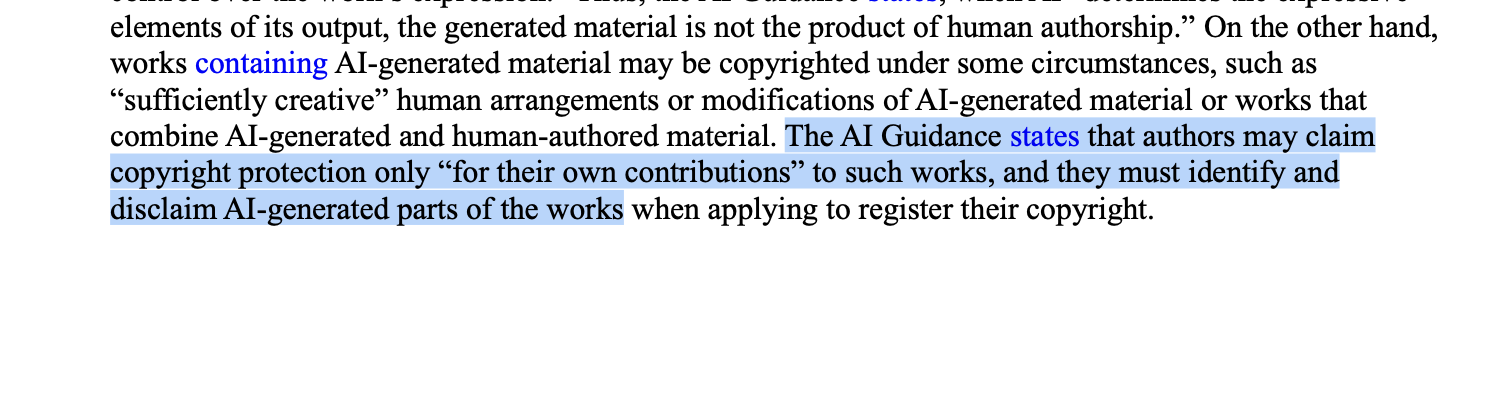
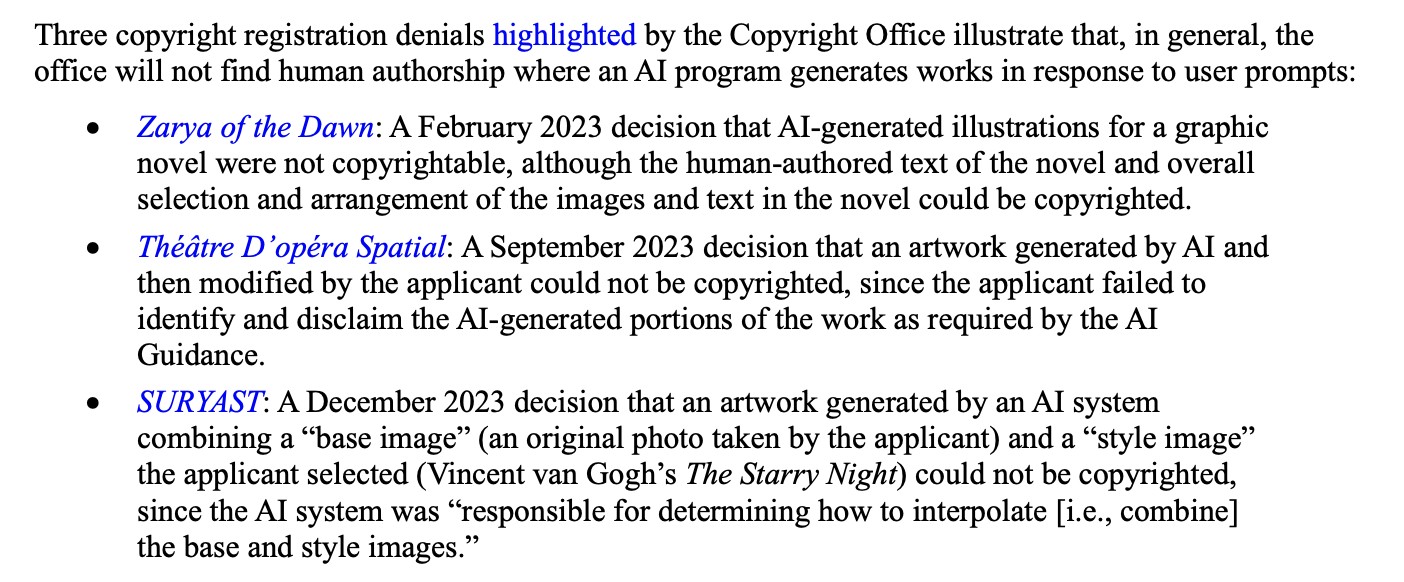
If you use AI-generated code, you currently cannot claim copyright on it in the US.
-
@xaetacore @jamie Why are you regurgitating corporate propaganda?
Yes, many businesses have a contract that state that the business holds the copyright for anything produced on company time, which is generally held to be valid.
When it comes to things outside of company time, businesses love claiming copyright whether or not it's done on company hardware - if the government was legitimate, they would express that such claims are not valid.@Suiseiseki@freesoftwareextremist.com @jamie@zomglol.wtf I was just saying what was on my last 2 contracts and i never report anything i wrote on company hardware because i think those rules are bs just as much as you do
-
@max @fsinn @jamie That's not true. Media organisations and individual journalist make a share of their income from granting licenses for secondary use of their digital works, for copying them or for offering them in libraries. Copyright is one of the few bedrocks of income. It doesn‘t vanish through wishful thinking or ignoring it.
@christianschwaegerl @fsinn @jamie That's the classical model, yes, and it's unfortunate that they have to rely on such an external influence on their integrity and this needs to change.
And it slowly is, both legally (e.g. publicly financed journalism can be one solution to avoid this conflict of interest) as well as illegally (content is reused without permission for "AI" training, or simply shared online for free so that every human has access to the information)
-
@jamie I *am* an IP lawyer and I (along with many others) have been saying it for a while, that if the position the “AI” co’s are taking with respect to the legality of scraping “publicly available” materials were true (that all “publicly available” materials are “public domain” free to be used as raw materials without consent required), then copyright ceases to exist and all their own materials will be free for everyone else to use the very first time they’re leaked. That’ll be fun for the co.
-
It'll be interesting to see what happens when a company pisses off an employee to the point where that person creates a public repo containing all the company's AI-generated code. I guarantee what's AI-generated and what's human-written isn't called out anywhere in the code, meaning the entire codebase becomes public domain.
While the company may have recourse based on the employment agreement (which varies in enforceability by state), I doubt there'd be any on the basis of copyright.
@jamie thy open sourcing of windows 11
-
If you use AI-generated code, you currently cannot claim copyright on it in the US. If you fail to disclose/disclaim exactly which parts were not written by a human, you forfeit your copyright claim on *the entire codebase*.
This means copyright notices and even licenses folks are putting on their vibe-coded GitHub repos are unenforceable. The AI-generated code, and possibly the whole project, becomes public domain.
Source: https://www.congress.gov/crs_external_products/LSB/PDF/LSB10922/LSB10922.8.pdf
@jamie@zomglol.wtf Fantastic read – thanks for sharing!
-
If you use AI-generated code, you currently cannot claim copyright on it in the US. If you fail to disclose/disclaim exactly which parts were not written by a human, you forfeit your copyright claim on *the entire codebase*.
This means copyright notices and even licenses folks are putting on their vibe-coded GitHub repos are unenforceable. The AI-generated code, and possibly the whole project, becomes public domain.
Source: https://www.congress.gov/crs_external_products/LSB/PDF/LSB10922/LSB10922.8.pdf
Additionally, AI generated code can be a copyright infringement if the AI basically generated a copy of some copyrighted code. And if we consider that AI is trained on lots of GPLed code there is a high probability it will generate code that would need to be licensed accordingly.
There is no clean room implementation of anything with AI. The code is immediately tainted.
-
If you use AI-generated code, you currently cannot claim copyright on it in the US. If you fail to disclose/disclaim exactly which parts were not written by a human, you forfeit your copyright claim on *the entire codebase*.
This means copyright notices and even licenses folks are putting on their vibe-coded GitHub repos are unenforceable. The AI-generated code, and possibly the whole project, becomes public domain.
Source: https://www.congress.gov/crs_external_products/LSB/PDF/LSB10922/LSB10922.8.pdf
@jamie@zomglol.wtf brb forking Windows
-
If you use AI-generated code, you currently cannot claim copyright on it in the US. If you fail to disclose/disclaim exactly which parts were not written by a human, you forfeit your copyright claim on *the entire codebase*.
This means copyright notices and even licenses folks are putting on their vibe-coded GitHub repos are unenforceable. The AI-generated code, and possibly the whole project, becomes public domain.
Source: https://www.congress.gov/crs_external_products/LSB/PDF/LSB10922/LSB10922.8.pdf
@jamie Maybe this would also be a problem for somebody that is publishing code with an Open Source license. If you don't have copyright on your vibe code, you can't license it, right?
Feels like it could lead to conflicts like the Google vs Oracle Java debacle. Nobody wants that. -
@katrinatransfem @fsinn @jamie If the material is acquired legally, they don't need a specific "license" to use it as training material. Copyright holders don't get to determine how their work is used after it's acquired, except to prevent its distribution.
Now, for the even larger than normal scumbags like Anthropic and Meta that torrented millions of books, that's certainly a problem. But Google, for instance, actually bought all the books they scanned.
-
If you use AI-generated code, you currently cannot claim copyright on it in the US. If you fail to disclose/disclaim exactly which parts were not written by a human, you forfeit your copyright claim on *the entire codebase*.
This means copyright notices and even licenses folks are putting on their vibe-coded GitHub repos are unenforceable. The AI-generated code, and possibly the whole project, becomes public domain.
Source: https://www.congress.gov/crs_external_products/LSB/PDF/LSB10922/LSB10922.8.pdf
@stroughtonsmith Is this relevant? I honestly don’t know a ton about this but I’m curious if you have thoughts on it…
-
-
@stroughtonsmith Is this relevant? I honestly don’t know a ton about this but I’m curious if you have thoughts on it…
@Verxion I think this is probably right:
-
@Verxion I think this is probably right:
@stroughtonsmith I think that’s fair. I seriously do and so I’m not disagreeing with you.
…the sad thing though (to me anyway) is that this means an indie dev is unlikely to be able to afford to retain ownership like a large corporation can.

-
If you use AI-generated code, you currently cannot claim copyright on it in the US. If you fail to disclose/disclaim exactly which parts were not written by a human, you forfeit your copyright claim on *the entire codebase*.
This means copyright notices and even licenses folks are putting on their vibe-coded GitHub repos are unenforceable. The AI-generated code, and possibly the whole project, becomes public domain.
Source: https://www.congress.gov/crs_external_products/LSB/PDF/LSB10922/LSB10922.8.pdf
@jamie I am afraid you are confusing registering copyright with the existence of copyright. They are not quite the same, and the differences are important.
Current law is that any human-created work is automatically copyrighted the moment it is created.
The link and screenshots you posted aren't about whether the human-written code mixed in with AI-written code is copyrighted—it is—they're about whether the copyright can be _registered_.
(1/2) -
@jamie I am afraid you are confusing registering copyright with the existence of copyright. They are not quite the same, and the differences are important.
Current law is that any human-created work is automatically copyrighted the moment it is created.
The link and screenshots you posted aren't about whether the human-written code mixed in with AI-written code is copyrighted—it is—they're about whether the copyright can be _registered_.
(1/2)@jamie A copyrighted work that isn't registered is still copyrighted. It's not "in the public domain."
Registration, in the U.S., allows for certain copyright enforcement actions that can't be taken for unregistered works. But whether or not a work is registered has no bearing on whether it is copyrighted vs. in the public domain.
(2/2) -
-
If you use AI-generated code, you currently cannot claim copyright on it in the US. If you fail to disclose/disclaim exactly which parts were not written by a human, you forfeit your copyright claim on *the entire codebase*.
This means copyright notices and even licenses folks are putting on their vibe-coded GitHub repos are unenforceable. The AI-generated code, and possibly the whole project, becomes public domain.
Source: https://www.congress.gov/crs_external_products/LSB/PDF/LSB10922/LSB10922.8.pdf
@jamie Just waiting for someone finding derivates of their own GPL code in propritary AI generated code...
-
If you use AI-generated code, you currently cannot claim copyright on it in the US. If you fail to disclose/disclaim exactly which parts were not written by a human, you forfeit your copyright claim on *the entire codebase*.
This means copyright notices and even licenses folks are putting on their vibe-coded GitHub repos are unenforceable. The AI-generated code, and possibly the whole project, becomes public domain.
Source: https://www.congress.gov/crs_external_products/LSB/PDF/LSB10922/LSB10922.8.pdf
@jamie so proprietary projects that are made with llms can be leaked legally since there's no copyright for it ?
-
@fsinn @jamie My understanding was that training an AI model on copyrighted work was fair use, because the actual "distribution"--when the AI generates something from a prompt--uses a diminimus amount of copyrighted content from an individual work, except if the user explicitly prompted something like, "Give me Homer Simpson surfing a space orca," at which point the AI company would throw the user all the way under the bus.
-
@christianschwaegerl @jamie @Azuaron @fsinn
Yes. Any "direct quoting" of copyrighted works, as text files on a disk, for example, would > only be a bunch of numbers < too. ASCI, Unicode, UTF-8, etc. are ways of encoding text into numbers, and displaying text representations (glyphs) of them later.
So LLMs hold "indirect" and maybe "abstract" (or not) numbers related to the copyrighted works. Not sure how that will or should work out, from a legal perspective.