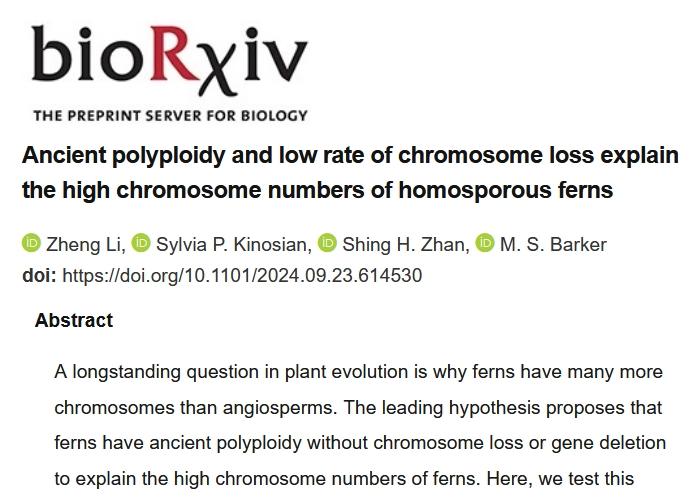
While you have 46 chromosomes, certain ferns carry huge numbers - the record is 1,400!
-
@P__X - what's a cardiomyocyte? A muscle cell in the heart?
@johncarlosbaez yup. heart muscle. It looks like skeletal muscle (striated) with some "twists", like growing in branches and having polyploidy among other stuff.
-
@johncarlosbaez Huh so while I knew ferns were a bit odd, with the two generation thing I hadn't realise they actually had sperm/eggs - and actual moving sperm? Hmm what else in plants moves under it's own steam.
@penguin42 @johncarlosbaez friend of mine is a biology major and she loves ferns, because they are the oddest of them all. I once asked her what is so special about ferns and got a muli-hour lecture for free!


-
@cyclotopie - Animals or seed plants. Is "animals" too unnerving? Okay, I'll get rid of it.
I think the polyploidy is kept, with multiple near-duplicate chromosomes, but there's a difference between the haploid stage of the life cycle where there are N chromosomes and the diploid stage where there are 2N.
(I'm not an expert on this stuff!)
This "chromosome hoarding" likely explains why these ancient plants have survived so many mass extinction events
https://en.wikipedia.org/wiki/Fern_spike
https://www.nybg.org/planttalk/how-ferns-outlived-the-dinosaurs-and-why-that-matters-today/
https://eng.geus.dk/about/news/news-archive/2019/oct/mutant-ferns
https://www.sciencedaily.com/releases/2026/07/260722032105.htm
-
@cyclotopie - Animals or seed plants. Is "animals" too unnerving? Okay, I'll get rid of it.
I think the polyploidy is kept, with multiple near-duplicate chromosomes, but there's a difference between the haploid stage of the life cycle where there are N chromosomes and the diploid stage where there are 2N.
(I'm not an expert on this stuff!)
@johncarlosbaez @cyclotopie *All* land plants (clade Embryophytae, which includes, if I'm reading this right, all multicellular life that photosynthesizes, except various aquatic things lumped under the common name "algae") have alternating diploid and haploid generations. For most of them, though, the haploid generation is microscopic, embedded within and fully dependent on the diploid parent. (Apparently in some mosses it's the other way around.)
-
@johncarlosbaez @cyclotopie *All* land plants (clade Embryophytae, which includes, if I'm reading this right, all multicellular life that photosynthesizes, except various aquatic things lumped under the common name "algae") have alternating diploid and haploid generations. For most of them, though, the haploid generation is microscopic, embedded within and fully dependent on the diploid parent. (Apparently in some mosses it's the other way around.)
@zwol @cyclotopie - thanks. I rewrote things to avoid trouble with this.
Now you've got me curious about mosses!
-
Ferns live a double life, alternating between two completely separate plants each generation. The one you'd recognize as a fern - the leafy thing with fronds - is called the 'sporophyte'. Its cells are 'diploid', meaning they carry two copies of every chromosome, one from each parent, just like your own cells do.
On the undersides of its fronds, the sporophyte produces spores, and it makes them through a special kind of cell division that halves the chromosome count. So while the sporophyte itself is diploid, its spores are 'haploid': they carry just a single copy of each chromosome.
Here's where ferns get weird: those haploid spores don't grow into new leafy ferns! Instead, each spore grows into a tiny, separate plant - often a green heart-shaped flap just a few millimeters across - called a 'gametophyte'.
Being haploid, this has only one copy of each chromosome, and it's this modest little plant, not the showy frond, that produces the eggs and sperm. When a sperm swimming through a film of water reaches an egg and fertilizes it, the two haploid cells combine their single chromosome sets into one cell with a double set: a diploid cell again! That grows into a new leafy sporophyte, and the cycle begins again.
So a fern is really two alternating plants: a big diploid sporophyte that makes spores, and a small haploid gametophyte that makes eggs and sperm.
Ferns can spread quickly because they produce vast numbers of spores, which can be blown by the wind for enormous distances. Then, when a lone spore grows into a little gametophyte, this can fertilize itself!
(2/2)
@johncarlosbaez What!? I had no idea, that's fascinating.
I have a running joke about ferns with my son (which he found exciting when younger, now just embarrassing) having watched lots of TV shows about dinosaurs, especially huge sauropods who ate tons of ferns.
"Uh oh, I see some ferns over there. Better watch out for dinosaurs!"
Now we'd better keep an eye out for gametophytes as well.
-
@johncarlosbaez What!? I had no idea, that's fascinating.
I have a running joke about ferns with my son (which he found exciting when younger, now just embarrassing) having watched lots of TV shows about dinosaurs, especially huge sauropods who ate tons of ferns.
"Uh oh, I see some ferns over there. Better watch out for dinosaurs!"
Now we'd better keep an eye out for gametophytes as well.
@iainmerrick - there are lots of ferns here in Edinburgh; now I'm going to look for gametophytes.
I'll keep an eye out for dinosaurs as well.
-
@penguin42 @johncarlosbaez friend of mine is a biology major and she loves ferns, because they are the oddest of them all. I once asked her what is so special about ferns and got a muli-hour lecture for free!
@attilakinali - I've always found ferns beautiful. After reading this article I want to learn more about them.
-
Ferns live a double life, alternating between two completely separate plants each generation. The one you'd recognize as a fern - the leafy thing with fronds - is called the 'sporophyte'. Its cells are 'diploid', meaning they carry two copies of every chromosome, one from each parent, just like your own cells do.
On the undersides of its fronds, the sporophyte produces spores, and it makes them through a special kind of cell division that halves the chromosome count. So while the sporophyte itself is diploid, its spores are 'haploid': they carry just a single copy of each chromosome.
Here's where ferns get weird: those haploid spores don't grow into new leafy ferns! Instead, each spore grows into a tiny, separate plant - often a green heart-shaped flap just a few millimeters across - called a 'gametophyte'.
Being haploid, this has only one copy of each chromosome, and it's this modest little plant, not the showy frond, that produces the eggs and sperm. When a sperm swimming through a film of water reaches an egg and fertilizes it, the two haploid cells combine their single chromosome sets into one cell with a double set: a diploid cell again! That grows into a new leafy sporophyte, and the cycle begins again.
So a fern is really two alternating plants: a big diploid sporophyte that makes spores, and a small haploid gametophyte that makes eggs and sperm.
Ferns can spread quickly because they produce vast numbers of spores, which can be blown by the wind for enormous distances. Then, when a lone spore grows into a little gametophyte, this can fertilize itself!
(2/2)
@johncarlosbaez i have to point out that the alternating generations thing isn't just a fern thing. all (well, at least land) plants do this, even if the haploid generation is reduced to 'barely noticable' in most of them. like, 'you'll need a microscope' barely noticable.
it's very visible with mosses though, where the green part of the moss is the haploid gametophyte, and the "stalks" that stretch up from the green parts are the diploid sporophytes.
-
@johncarlosbaez i have to point out that the alternating generations thing isn't just a fern thing. all (well, at least land) plants do this, even if the haploid generation is reduced to 'barely noticable' in most of them. like, 'you'll need a microscope' barely noticable.
it's very visible with mosses though, where the green part of the moss is the haploid gametophyte, and the "stalks" that stretch up from the green parts are the diploid sporophytes.
@bnuuy - I've seen those, but not known much about what's going on!
-
@johncarlosbaez i have to point out that the alternating generations thing isn't just a fern thing. all (well, at least land) plants do this, even if the haploid generation is reduced to 'barely noticable' in most of them. like, 'you'll need a microscope' barely noticable.
it's very visible with mosses though, where the green part of the moss is the haploid gametophyte, and the "stalks" that stretch up from the green parts are the diploid sporophytes.
@johncarlosbaez i see @zwol has already made a similar comment. but let me add a bit more:
> (Apparently in some mosses it's the other way around.)
mosses are, uh "early" in land plant evolution history. the generations are more on equal footing, but there was a switch from the haploid generation being the green part, to the diploid generation being the green part, and the switch was made in the transition from mosses to ferns, the, uh, "next step" of land plant evolution.
(the scare quotes are there because technically, evolution doesn't "work like that", much like modern apes aren't the ancestor to humans)for anyone wanting to learn more about this kind of stuff, this is pretty standard biology lecture material. it's typically this pair of introductory lectures that goes through the evolutionary history of plants/animals, respectively. iirc the professor dave explains youtube channel has them in a playlist video format.
-
Ferns live a double life, alternating between two completely separate plants each generation. The one you'd recognize as a fern - the leafy thing with fronds - is called the 'sporophyte'. Its cells are 'diploid', meaning they carry two copies of every chromosome, one from each parent, just like your own cells do.
On the undersides of its fronds, the sporophyte produces spores, and it makes them through a special kind of cell division that halves the chromosome count. So while the sporophyte itself is diploid, its spores are 'haploid': they carry just a single copy of each chromosome.
Here's where ferns get weird: those haploid spores don't grow into new leafy ferns! Instead, each spore grows into a tiny, separate plant - often a green heart-shaped flap just a few millimeters across - called a 'gametophyte'.
Being haploid, this has only one copy of each chromosome, and it's this modest little plant, not the showy frond, that produces the eggs and sperm. When a sperm swimming through a film of water reaches an egg and fertilizes it, the two haploid cells combine their single chromosome sets into one cell with a double set: a diploid cell again! That grows into a new leafy sporophyte, and the cycle begins again.
So a fern is really two alternating plants: a big diploid sporophyte that makes spores, and a small haploid gametophyte that makes eggs and sperm.
Ferns can spread quickly because they produce vast numbers of spores, which can be blown by the wind for enormous distances. Then, when a lone spore grows into a little gametophyte, this can fertilize itself!
(2/2)
@johncarlosbaez Plant biology is freaking wild. Haploid, diploid, genes replicated many times over, methylation (iirc) causing the same genetic structure to produce different fruits (citrus), and/or looking plants (broccoli)
-
@johncarlosbaez i see @zwol has already made a similar comment. but let me add a bit more:
> (Apparently in some mosses it's the other way around.)
mosses are, uh "early" in land plant evolution history. the generations are more on equal footing, but there was a switch from the haploid generation being the green part, to the diploid generation being the green part, and the switch was made in the transition from mosses to ferns, the, uh, "next step" of land plant evolution.
(the scare quotes are there because technically, evolution doesn't "work like that", much like modern apes aren't the ancestor to humans)for anyone wanting to learn more about this kind of stuff, this is pretty standard biology lecture material. it's typically this pair of introductory lectures that goes through the evolutionary history of plants/animals, respectively. iirc the professor dave explains youtube channel has them in a playlist video format.
@bnuuy @johncarlosbaez wikipedia gives me the impression that the "ancestral" state is currently thought to have had haploid and diploid generations that were fully independent and externally almost identical, and mosses and ferns diverged from that baseline in opposite directions.
-
@bnuuy @johncarlosbaez wikipedia gives me the impression that the "ancestral" state is currently thought to have had haploid and diploid generations that were fully independent and externally almost identical, and mosses and ferns diverged from that baseline in opposite directions.
@zwol @johncarlosbaez also looking at wikipedia, yeah, that checks out. or at least doesn't outright contradict that, idk. a lot of this early evolutionary history is pretty fuzzy, we can only guess from comparison of the plants we have today, as well as (very importantly!) genetic evidence to help us reconstruct those "family trees"/cladograms. sometimes people argue about the exact order in which everything split off, or things get re-organized as new evidence rolls in. there's sometimes this "established narrative" that gets taught and happens to sound good, but may or may not be outdated, depending on who you ask.
-
@zwol @johncarlosbaez also looking at wikipedia, yeah, that checks out. or at least doesn't outright contradict that, idk. a lot of this early evolutionary history is pretty fuzzy, we can only guess from comparison of the plants we have today, as well as (very importantly!) genetic evidence to help us reconstruct those "family trees"/cladograms. sometimes people argue about the exact order in which everything split off, or things get re-organized as new evidence rolls in. there's sometimes this "established narrative" that gets taught and happens to sound good, but may or may not be outdated, depending on who you ask.
@bnuuy @johncarlosbaez yeh so much of this is different from what I learned in high school bio 30 years ago...
-
 J jwcph@helvede.net shared this topic