Go paperless.
-
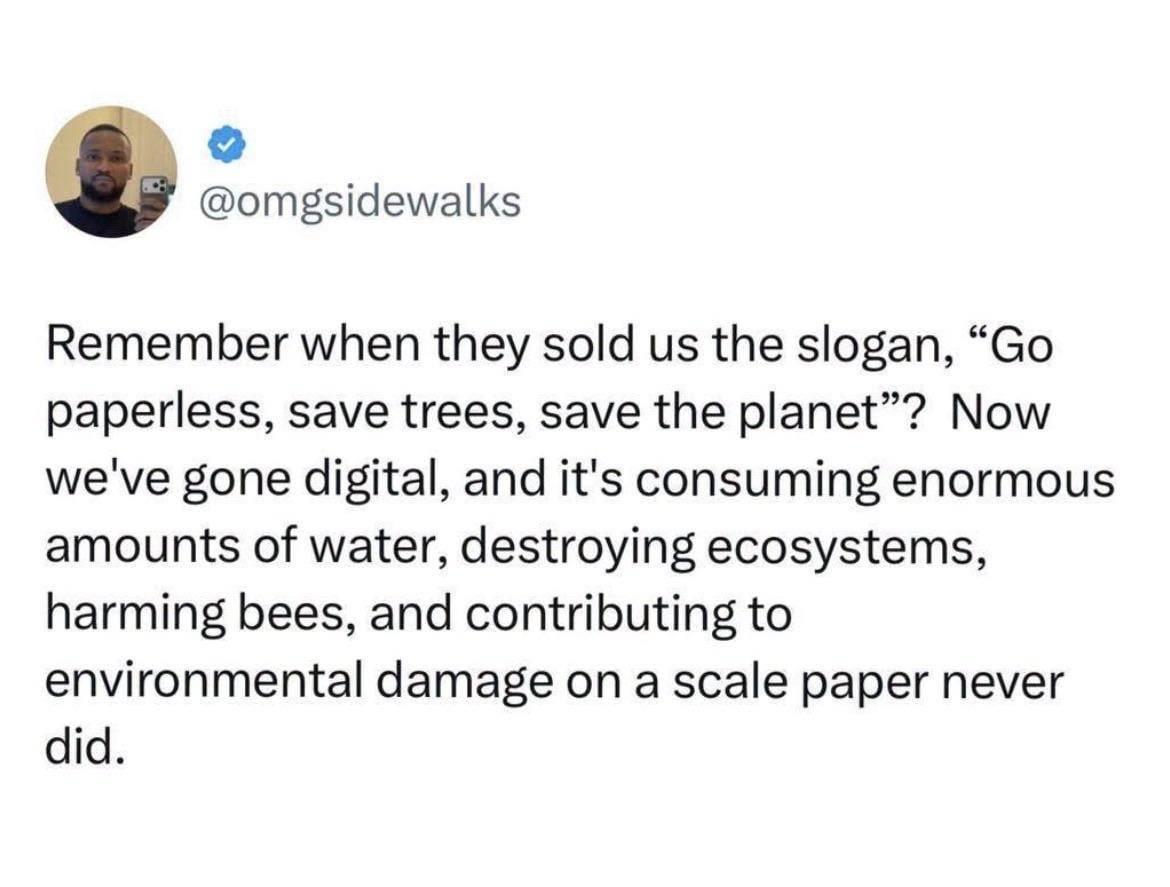
@harld I will keep mentioning the Jevons paradox until everybody understands what it is and how it works
Making use of a resource more profitable increases the return on investment of exploiting that resource.
So increased systems efficiency *increases*, not decreases, resource use.
Unless your approach is to have a fixed expectation for capability and just optimize for lower and lower resource use to achieve that capability. Which is not how capitalism works, at all.
@renardboy @shtrom @harld thank you for this excellent explanation, I hadn't seen the Jevons paradox framed this way before
-
@harld
I never bought it: paper production is based on sustainably harvesting fairly young, fast-growing trees, which absorb way more CO_2 than old trees, which are not used for paper. Therefore, printed paper libraries are actually-existing carbon capture and storage facilities. Not joking.@ancientsounds @harld Libraries (paper books) are carbon capture and storage facilities.
Love it! Another reason to
 libraries
-
Go paperless.
@harld interesting discussion!
-
Go paperless.
@harld Corporations ruin everything.
-
@harld Yeah, though to be fair, it's not the "paperless" part that is consuming all the resources.
-
@harld I will keep mentioning the Jevons paradox until everybody understands what it is and how it works
Making use of a resource more profitable increases the return on investment of exploiting that resource.
So increased systems efficiency *increases*, not decreases, resource use.
Unless your approach is to have a fixed expectation for capability and just optimize for lower and lower resource use to achieve that capability. Which is not how capitalism works, at all.
@renardboy @harld Is 'efficiency' in the sense of cost reduction and 'efficiency' in the sense of use reduction always the same?
I work as a production editor in a publishing office, and we're pretty much paperless. I never print out a damn thing. There are certain advantages for using Word files and pdfs all along the way--usually fewer typos in the finished product. But, being old enough to remember doing it all on paper--even doing layouts with waxers and x-acto knives--I can say that the *process* of editing and proofreading are worse, less efficient, slower, than marking paper by hand.
-
Go paperless.
Coal and Gas: "as long as you aren't blaming us, it's all good."
-
Go paperless.
It's not the digital, though, per se.
-
Go paperless.
@harld pretty big conflation there.
Going paperless didn't get us here, a fascist American tech sector did.
Typing up a report in a word processor is a vastly different proposition to demanding bullshit machines write the same report 100 times until the machine spits out something believable
-
Go paperless.
“People will do the work
So machines have time to think” - #Biftek 2000https://www.youtube.com/watch?v=955dZpR7QwY&list=RD955dZpR7QwY&start_radio=1&rv=955dZpR7QwY
Note: ( Based on samples from Raymond Scott's 1967, "The Paperwork Explosion."
IBM-Jim Henson see: https://www.youtube.com/results?search_query=Raymond+Scott%27s+paperwork+explosion+) -
It's not the digital, though, per se.
I'd like also to mention, that I'd need to store around 10 tons of books if I had them on paper instead of digital/paperless.
Apart from thee question whether I could afford this, I cannot imagine heating these additional room would not over time add up to a hefty carbon footprint.
-
Go paperless.
@harld paperless is better but if you ditch paper for giant companies that will process you data for their benefit then yes, that’s not great.
-
@harld Corporations ruin everything.
-
Go paperless.
@harld Whoever said computers would usher in a paperless society did not envision printers capable of putting out multiple pages in a minute (let alone data centers churning out AI and crypto, with the accompanying resource usage).
A friend told me that when he started working in the computer field right out of college, an older colleague bet him that computers would create paperless workplaces within two years.
The guy had the decency to pay up. In 1967.
-
Go paperless.
@harld I well remember the paperless/save trees argument. Might have worked if society & business didn't decide -- since computers made information collection & analysis so easy to accomplish --- to astronomically increase the amount of data 'necessary'. That's where we lost it..
-
Go paperless.
@harld if we could revive the #emailsignature: "this email was written using no #AI and saved 1,000 trees, 2 aquaspheres and 1 community in Southern Texas. Do you really need to use AI to reply? Think!"
-
Go paperless.
@harld We didn't go paperless at the toilet, that's the reason
-
Go paperless.
@harld The same reflections were circulating with regard to recycling of glass bottles. Recycling required moving them around and the process itself as opposed to putting them in land fills. Recycling seems to have won in most places?
-
Go paperless.
@harld that's not the consequences of socialization though. That's like saying "we've abolished slavery and now climate is out of control".
-
@harld that's not the consequences of socialization though. That's like saying "we've abolished slavery and now climate is out of control".
@walsonde @harld That's an amazing reach.
Using paper is in itself a limiting factor on how much paper you use: you just can't archive everything without curating — as opposed to digital where everything can be stored (just another datacenter bro, just one more).
Slavery, on the other hand, is a direct contributor to climate change/collapse, both in history (like the transatlantic slave trade) and currently (people in different types of enslavement, forced to work in climate destroying schemes).