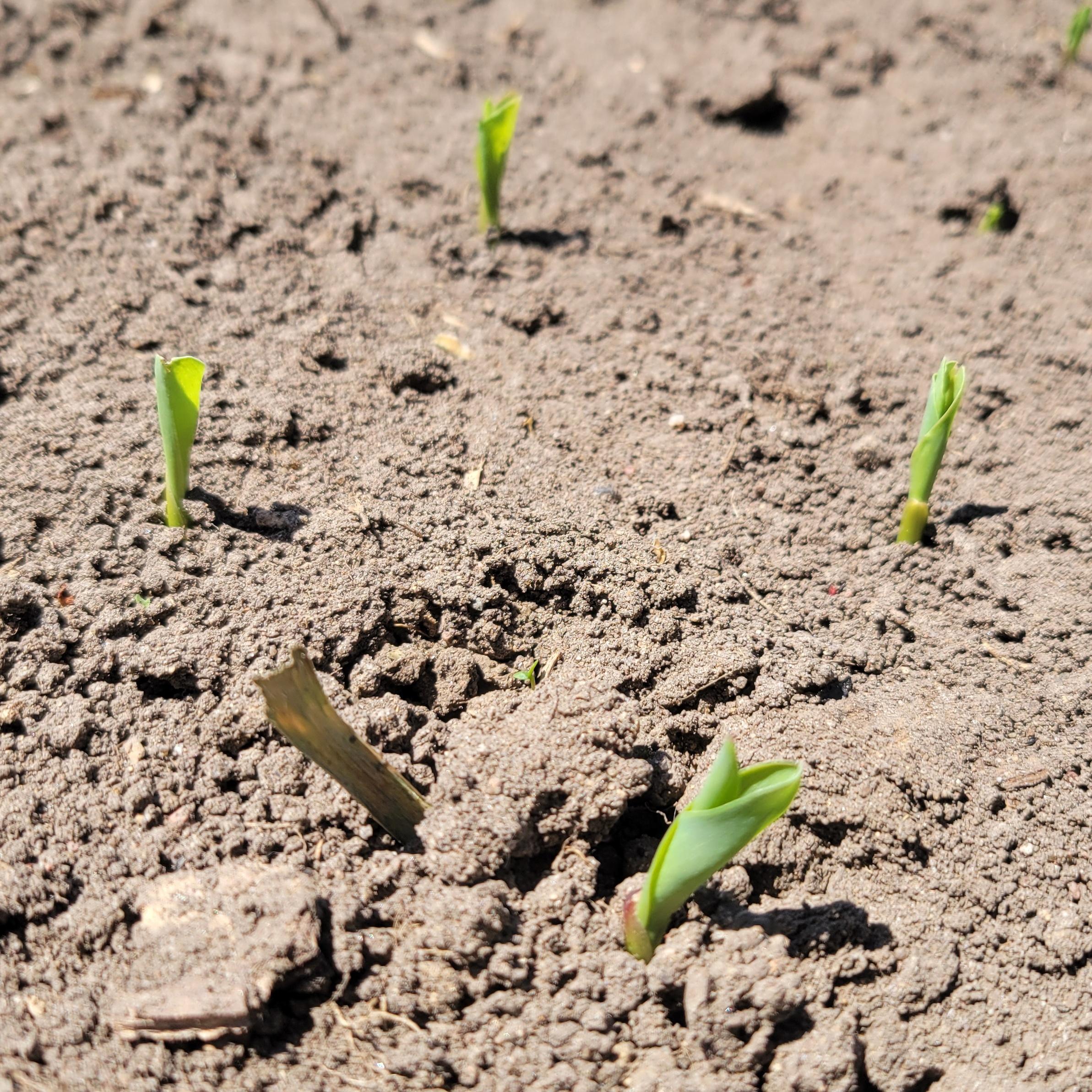
My miniature flour corns are coming up.
-
@clew One of the varieties I got genetics from was Gaspe Flint. That one is commonly available and also has a very short life cycle. https://greatlakesstapleseeds.com/products/gaspe-flint-corn
I'm aiming for larger cobs than that with flour and sweet kernel types.
thank you, adding to potential crop list!
Flour corn is what I personally want, so I’ll be following your results with great interest
-
This is what the last generation looked like. (There were many more tiny cobs, but I culled those early.)
You can't really see the difference between dent and flour kernels in this view, but if you look closely, you can see the wrinkled sweet kernels that I'll plant in summer.
Some genetics in my population originally came from Gaspe Flint, which is available from many sources if you're also interested in short-season corns.
-
Some genetics in my population originally came from Gaspe Flint, which is available from many sources if you're also interested in short-season corns.
I just realized that site is sold out for Gaspe Flint, so here's another. https://www.seedways.org/product-page/gasp%C3%A9-flint-corn
I have no particular reference to either of these vendors. They were early links that came up when I searched, and they had good images/information.
-
@malte I grew the F2s for two years. The days from planting to harvest told me that I should be able to pull off two generations, one after the other, in my short season area.
@thebiologistisn You mean that the corn matures so fast in your area that you can go from seed to cob two times per seasons? I am surprised that's possible
-
@thebiologistisn You mean that the corn matures so fast in your area that you can go from seed to cob two times per seasons? I am surprised that's possible
@malte That's the idea.
Though, the first harvest will be allowed to dry down for planting next year. The second crop will be from a different selection of last year's seed.
It might be pushing it to try and plant the just harvested seeds.
-
@malte That's the idea.
Though, the first harvest will be allowed to dry down for planting next year. The second crop will be from a different selection of last year's seed.
It might be pushing it to try and plant the just harvested seeds.
@malte I will not be surprised if most plants don't make it through the stringent selection criteria of the early generations for this project, but I'm certain that enough will!
-
I just realized that site is sold out for Gaspe Flint, so here's another. https://www.seedways.org/product-page/gasp%C3%A9-flint-corn
I have no particular reference to either of these vendors. They were early links that came up when I searched, and they had good images/information.
Gaspe Flint (and the lab strain I got its genetics theough) tend to place their cobs very low to the ground.
This trait has been naturally selected against in my population, since those cobs tend to get eaten by mice.
I've also been selecting for larger cobs, with more rows of seeds than Gaspe Flint has, though they remain small compared to conventional corns.
-
@malte I will not be surprised if most plants don't make it through the stringent selection criteria of the early generations for this project, but I'm certain that enough will!
@thebiologistisn It's an interesting project and valuable for places like mine where the growing season is relatively short too. Here, I am just adapting my grain corn to a new location with very different soil and water conditions than before. The cobs were tiny last year compared to earlier, but I've seen the improvements before so I will continue to locally adapt it.
-
Gaspe Flint (and the lab strain I got its genetics theough) tend to place their cobs very low to the ground.
This trait has been naturally selected against in my population, since those cobs tend to get eaten by mice.
I've also been selecting for larger cobs, with more rows of seeds than Gaspe Flint has, though they remain small compared to conventional corns.
I kinda wish I had red seeds in the mix, but I'll probably wait until I can find/make lines that have pretty short life cycles already.
Crossing in a full-season red corn feels like it would be too much of a setback.
-
@thebiologistisn It's an interesting project and valuable for places like mine where the growing season is relatively short too. Here, I am just adapting my grain corn to a new location with very different soil and water conditions than before. The cobs were tiny last year compared to earlier, but I've seen the improvements before so I will continue to locally adapt it.
@malte My shorter plants have already shown to be more resistant to lodging than taller types.
I don't know that they'd overcome weed pressure in an open field, but they work well for smaller plots.
What I'm entirely unsure about is how the total yield across the season will compare with typical corn types. I'll have to do some experiments on this later.
-
@malte My shorter plants have already shown to be more resistant to lodging than taller types.
I don't know that they'd overcome weed pressure in an open field, but they work well for smaller plots.
What I'm entirely unsure about is how the total yield across the season will compare with typical corn types. I'll have to do some experiments on this later.
@thebiologistisn Have you tried to breed for tillering as a trait? A colleague in my local adaptation community from further North in Sweden uses it to her benefit and she failed with both Gaspé and Painted Mountain before: https://goingtoseed.discourse.group/t/polar-corn-and-polar-melons-2024/3164