#Deepfakes are everywhere, but #DigitalForensics investigators are fighting back:
-
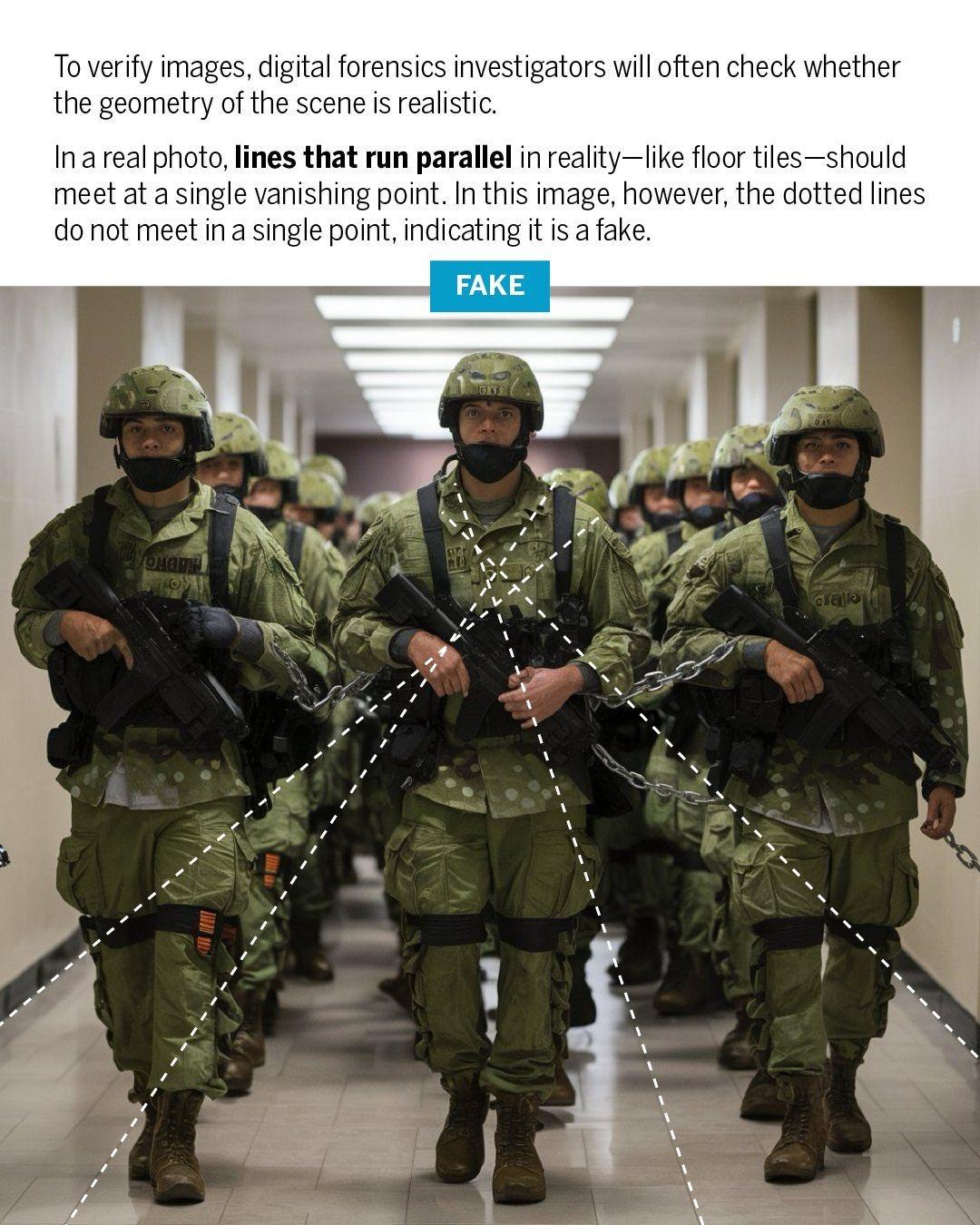
@leah agreed, I just wished the technique they described came with that as a warning, because the (obviously generated, "read" the uniform patches) hallway picture shown would be a *prime* candidate for taking with a fisheye lens or a similarly distorting lens; and the piece of flooring used to extrapolate the straight lines is already honestly too short in the example to be sure. I cannot, over the length of maybe 50px, draw a 1000px line with < 1° error.
@funkylab @leah @mansr @nCrazed @FabMusacchio also wth are these chains doing here lol
-
#Deepfakes are everywhere, but #DigitalForensics investigators are fighting back:
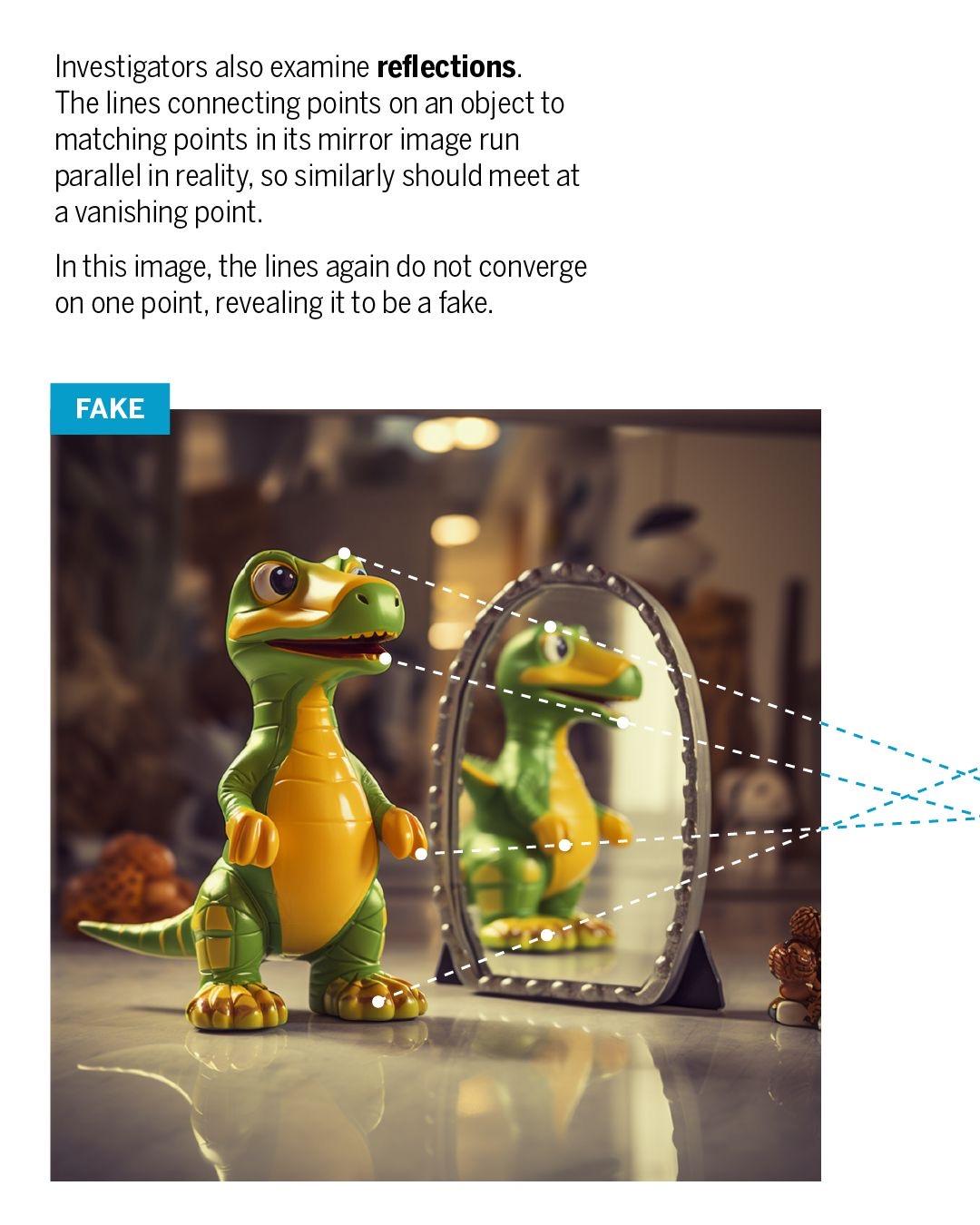
Good points… except the bad one: the dinosaur graphic shows a line connecting different toes to the horizon
-
#Deepfakes are everywhere, but #DigitalForensics investigators are fighting back:
@FabMusacchio What is wild to me is that any photoshopper worth their salt in 2005 wouldn't have screwed the lighting or reflections up.
-
#Deepfakes are everywhere, but #DigitalForensics investigators are fighting back:
@FabMusacchio Plus, in the first photo, those lines of "moving" soldiers are just a little too perfect. Nobody can march in formation without *some* deviation.
-
#Deepfakes are everywhere, but #DigitalForensics investigators are fighting back:
@FabMusacchio Interesting. Should models be able to learn this?
-
#Deepfakes are everywhere, but #DigitalForensics investigators are fighting back:
@FabMusacchio so basically you can determine if an image is a fake using parallel lines. Neat.
-
#Deepfakes are everywhere, but #DigitalForensics investigators are fighting back:
@FabMusacchio Another group of lines I often follow is from the knees, and from the backbone/visible parts of hip, towards the hip joints.
Years of anatomical drawing lessons paying of. -
@FabMusacchio How does this method handle lens distortion?
@mansr @FabMusacchio the middle lines should still meet, the outer ones will cross a little bit in an orderly manner. Not the second to the left and the third to the right.
-
@FabMusacchio I find it so frustrating that we're trying to find mathematical proof that it's fake where it so obvious. Just watch the pictures !!! I hate these times.
@Steel_Virgin @FabMusacchio The goal wasn't to show that picture was fake. The goal was to show the technique of analyzing vanishing point perspective errors.
-
Ooooh - what I like about this is, unlike a lot of "here's how you spot this stuff" advice, these seem like maybe things AI-generated images will have a *very* hard time ever getting consistently right.
@aearo @FabMusacchio What's interesting to me is WHY AI generated images will maybe never get it right.
Put simply, the consumers of the AI generated images do not care whether or not all the lines properly converge onto a vanishing point. Human vision may care about weird extra fingers, but vanishing point convergence? Nope. Don't care.
Human viewers will never notice these perspective errors, so AI models have no incentive to fix them.
-
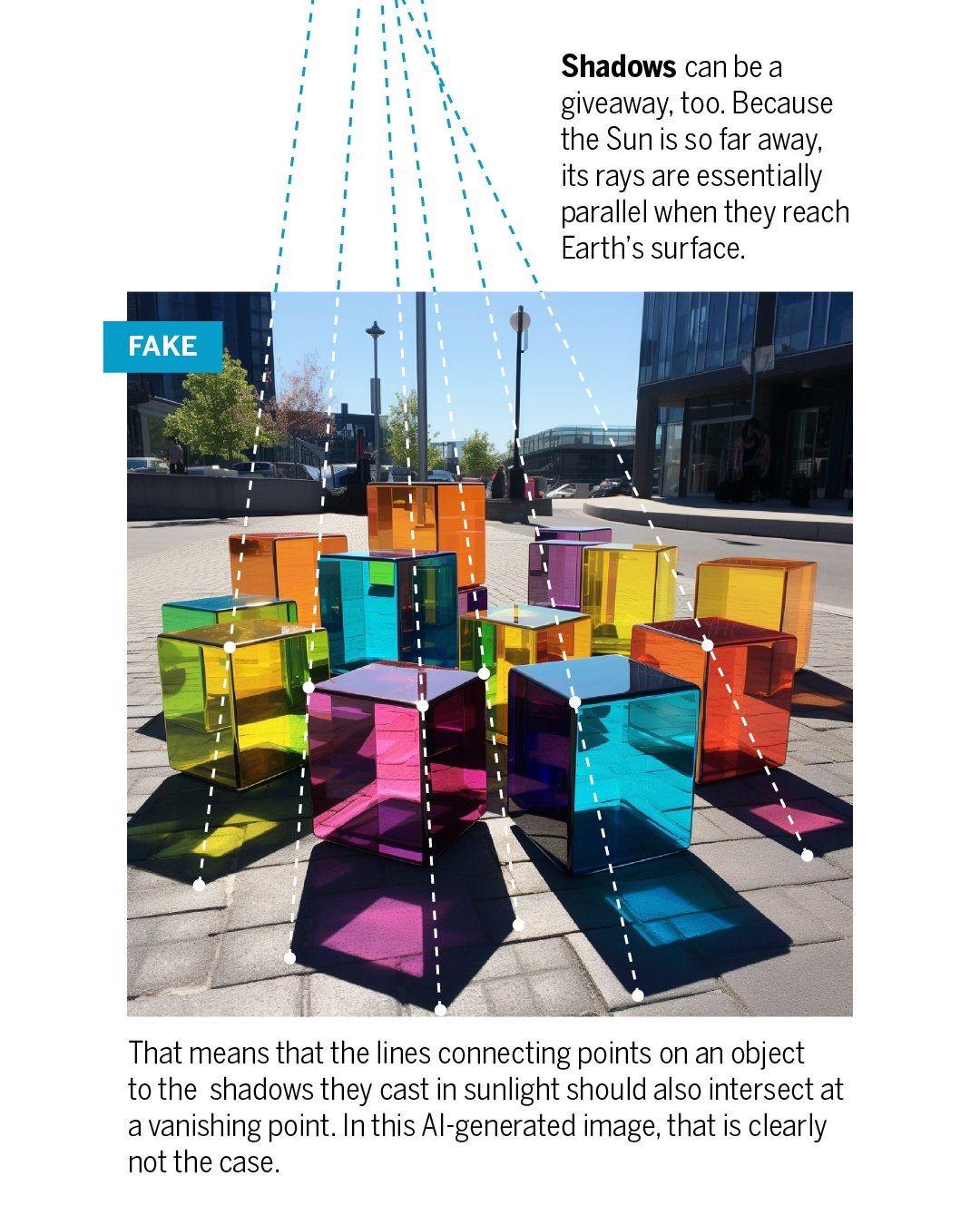
@f4grx @FabMusacchio sun rays are parallel, yet they meet at a point...?
It's not the sun's rays that meet at a point, it's the lines from the objects' shadows to the corresponding points on the objects that should meet at a point.
The statement about the sun's rays being effectively parallel just means that the direction of the light source can be considered the same for all objects.
-
@FabMusacchio So if I want to commit a murder, I have years to prepare it and I know the place will be surveilled with cameras, I should pave it with slightly non-parallell tiles, to get a plausible deniability.
@microblogc @FabMusacchio I was thinking, what if it was just paved a bit wonky.
-
@FabMusacchio Interesting. Should models be able to learn this?
@jfparis as soon as there are programs to do those analysis automatically, this will be used as feedback loop for the models....
-
#Deepfakes are everywhere, but #DigitalForensics investigators are fighting back:
@FabMusacchio In the third photo, the second paragraph of added text contradicts the first paragraph. (The first paragraph is correct, and the second is false. What is wrong is not a slightly inconsistent vanishing point, it is that the shadows are at visibly different angles in the first place. There should be no measurable vanishing point at all.)
-
#Deepfakes are everywhere, but #DigitalForensics investigators are fighting back:
@FabMusacchio soldier faces behind front ones are melting as well. But this is more scientific approach and will work all the time
-
@nartagnan en fait, je vois même pas comment intégrer ça au process d'entrainement, sans que cela devienne une machine à gaz, ce qui est déjà le cas however, genre encoder un raytracer
@tk @nartagnan @legendarybassoon @grototo @AudeCaussarieu
Générer plein d'images par IA, demander a des petites sous payées de dessiner les lignes fuites. On fait deux jeux de données : les images avec un seul point d'intersection et les autres. On rajoute des vrais images dans la première catégorie. On lance l'entraînement d’un modèle ou un fine tunning d’un modèle existant.
-
@tk @nartagnan @legendarybassoon @grototo @AudeCaussarieu
Générer plein d'images par IA, demander a des petites sous payées de dessiner les lignes fuites. On fait deux jeux de données : les images avec un seul point d'intersection et les autres. On rajoute des vrais images dans la première catégorie. On lance l'entraînement d’un modèle ou un fine tunning d’un modèle existant.
@youen
@tk @legendarybassoon @grototo @AudeCaussarieuOui, c'est faisable.
Mais se concentrer sur X c'est délaisser Y.
Au début, quand il fallait compter les doigts des mains, les modeles qui étaient bons sur les mains étaient mauvais sur le reste.L'amélioration n'est venue qu'en multipllant le nb de paramètre des modèles. Et donc le coût de génération d'une seule image.
C'est exponentiel.
Et j'ose croire qu'il n'y a plu moyen de multiplier encore par 2 leurs coûts, sans revenus.
-
@FabMusacchio @Jenetrix I feel like I'm in a Realism 101 illustration class
 @OctaviaConAmore @FabMusacchio @Jenetrix That sounds like something interesting to read about. Do you have recommendations?
 -
@aearo @FabMusacchio What's interesting to me is WHY AI generated images will maybe never get it right.
Put simply, the consumers of the AI generated images do not care whether or not all the lines properly converge onto a vanishing point. Human vision may care about weird extra fingers, but vanishing point convergence? Nope. Don't care.
Human viewers will never notice these perspective errors, so AI models have no incentive to fix them.
That, but I also think it's a really hard, abstract thing to train the models on regardless.
I could be wrong about this! Maybe it's easier than I think. But it's not like you can just say to the model "oh yeah, and make sure all the edges of things follow the rules of perspective." It has to learn those rules the same way it learns everything else - basically, by looking at a bunch of examples and getting a "feel" for what's right. (Well, "a feel" = "the values of the model's weights updated to produce this result" and so forth, but yunno.)
But it's not the kind of detail that immediately jumps out, as long as it's not *too* wrong. Observing it requires both figuring out which lines are relevant, and knowing how those lines should behave, and image-gen AI has no special ability to do either of those things. It has no ability to follow rules precisely.
The fact that human brains can also look at the pictures and not immediately go "wait, that's wrong" gives me confidence that AI models won't get it either. Even humans generally need to get out a ruler and start measuring. I think it's hard for human brains to just see it for pretty much the same reason it's hard for AI, but until AGI is a thing, strategies like "know the rules concretely" and "draw a line with a ruler" are more or less out of reach for the AI.
-
 P pelle@veganism.social shared this topic