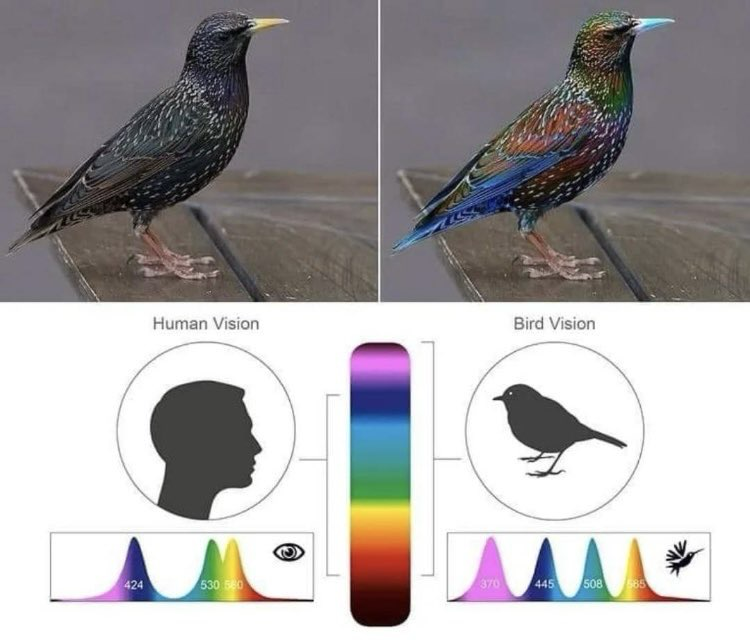
TIL crows, starlings and similar birds only *look* black to us — they’re actually very colorful in ways human eyes are unable to perceive.
-
TIL crows, starlings and similar birds only *look* black to us — they’re actually very colorful in ways human eyes are unable to perceive. 🤯
Remember that next time people can’t see your “colors”.
Some colors just require different eyes.
-
TIL crows, starlings and similar birds only *look* black to us — they’re actually very colorful in ways human eyes are unable to perceive. 🤯
Remember that next time people can’t see your “colors”.
Some colors just require different eyes.
@leaverou
I was in a zoo JUST today, where I read a sign stating that blackbirds only seem black to humans, while actually being colorful in the bird world. This sign made me a bit mad by telling me such a thing without explaining why. Now only a few hours later, I stumble upon this. Fedi is amazing! -
@leaverou I don't think that infography makes any sense. We do have a sensibility to green, but we still see colors from 400nm to 800nm. Also, what species of crow is that? I don't know any with white spots and a yellow beak.
Is there any source for that?
Edit: definitely, the curves don't mean anything
The curves seem to be showing the sensitivity of cone cells in human eyes vs bird eyes. Humans (who aren't color blind or tetrochromats) have cells most sensitive to blue, green, and red, around the wavelengths indicates. The graphic shows that, though not in a super literal way. There are long tails on all those curves in real life. A color like yellow lights up both the green and red receptors, and that's how our brain distinguishes it from pure green or pure red.
I don't know as much about bird vision, but I think the curve is suggesting that they also have cells sensitive to UV light, and that their visible light receptor cells are most sensitive at different wavelengths than ours
There's nothing on the chart that indicates what wavelengths are actually being scattered from "black" bird feathers, but if it's in the gap between our green and red receptors, or if it's in the UV, birds eyes would be more sensitive to it. Though we CAN see some UV at the lower wavelengths if it's really bright, and we can of course see yellow and orange... Birds would just see them more brightly. The picture someone shared in another reply showing what a black bird looks like to a camera in really bright sunlight seems like a pretty good indication of what colors birds might be seeing with their more sensitive receptors at some of these wavelengths - but they are probably seeing them as brighter colors even in dimmer lighting.
-
TIL crows, starlings and similar birds only *look* black to us — they’re actually very colorful in ways human eyes are unable to perceive. 🤯
Remember that next time people can’t see your “colors”.
Some colors just require different eyes.
@leaverou gimme birbs eyes please 🥺
-
TIL crows, starlings and similar birds only *look* black to us — they’re actually very colorful in ways human eyes are unable to perceive. 🤯
Remember that next time people can’t see your “colors”.
Some colors just require different eyes.
@leaverou starlings are kaleidoscopic
-
@leaverou Could you make the colors visible by taking a photo in RAW format and adjusting the color settings? I don't know how camera sensors work, but maybe they're able to capture these colors.
@alpacamale @leaverou
No, because the camera sensors, especially decent ones have a colour filter array to suit both typical RGB displays and the human eye response.Just out of band IR or UV will create false RGB, some phone cameras will show white or blue for near IR (point TV remote at it) and a UV fly trap will look a quite different colour on phone than by naked eye.
The displays typically have narrow R, G & B at peaks of human response and good camera filters use R, G & B curves.
-
@leaverou Who keeps putting the UV at the lower, and infrared at the upper part of the spectrum??!
@ShnoofleBear @leaverou
Sometimes shorter wave (UV) is towards orgin. Or it can be labelled in wavelength, but ordered by frequency, so IR is toward origin, -
@alpacamale @leaverou
No, because the camera sensors, especially decent ones have a colour filter array to suit both typical RGB displays and the human eye response.Just out of band IR or UV will create false RGB, some phone cameras will show white or blue for near IR (point TV remote at it) and a UV fly trap will look a quite different colour on phone than by naked eye.
The displays typically have narrow R, G & B at peaks of human response and good camera filters use R, G & B curves.
@raymaccarthy @leaverou Damn. But thanks for the explanation.
-
@leaverou That's a starling, not a crow, but very cool nonetheless! Magpies also have pretty iridescent green-black feathers, while crows and ravens seem inky black - would love to see a bird's eye version of a raven.
-
 P pelle@veganism.social shared this topic
-
@raymaccarthy @leaverou Damn. But thanks for the explanation.
@alpacamale @leaverou
You need a UV camera and then edit the regular RGB to fake colours and then the mono UV as Blue. The simple way is to use two layers and mess with colour balance hue on the colour one till far blue is black and the mono UV layer till it's only far blue and merge.You can't ever see what birds or any creature (or Alien) with better colour vision sees, but you can downgrade to what dogs or cattle see.
Some women are a bit tetrachromatic on retina but eye filters it. -
-
@leaverou Could you make the colors visible by taking a photo in RAW format and adjusting the color settings? I don't know how camera sensors work, but maybe they're able to capture these colors.
@alpacamale @leaverou General camera sensors are designed to respond in the same way human perception does, thus producing what we consider to be natural photographs.
-
The curves seem to be showing the sensitivity of cone cells in human eyes vs bird eyes. Humans (who aren't color blind or tetrochromats) have cells most sensitive to blue, green, and red, around the wavelengths indicates. The graphic shows that, though not in a super literal way. There are long tails on all those curves in real life. A color like yellow lights up both the green and red receptors, and that's how our brain distinguishes it from pure green or pure red.
I don't know as much about bird vision, but I think the curve is suggesting that they also have cells sensitive to UV light, and that their visible light receptor cells are most sensitive at different wavelengths than ours
There's nothing on the chart that indicates what wavelengths are actually being scattered from "black" bird feathers, but if it's in the gap between our green and red receptors, or if it's in the UV, birds eyes would be more sensitive to it. Though we CAN see some UV at the lower wavelengths if it's really bright, and we can of course see yellow and orange... Birds would just see them more brightly. The picture someone shared in another reply showing what a black bird looks like to a camera in really bright sunlight seems like a pretty good indication of what colors birds might be seeing with their more sensitive receptors at some of these wavelengths - but they are probably seeing them as brighter colors even in dimmer lighting.
@marymessall @leaverou yes, thank you, I think it's about that. I'd enjoy a source to better understand all of this, and yes, ideally compare the colors curve of the bird with the human vision.
-
@leaverou I don't think that infography makes any sense. We do have a sensibility to green, but we still see colors from 400nm to 800nm. Also, what species of crow is that? I don't know any with white spots and a yellow beak.
Is there any source for that?
Edit: definitely, the curves don't mean anything
Do an image search for starlings.
-
TIL crows, starlings and similar birds only *look* black to us — they’re actually very colorful in ways human eyes are unable to perceive. 🤯
Remember that next time people can’t see your “colors”.
Some colors just require different eyes.
@leaverou *yells this forever in 'autistic'*
-
TIL crows, starlings and similar birds only *look* black to us — they’re actually very colorful in ways human eyes are unable to perceive. 🤯
Remember that next time people can’t see your “colors”.
Some colors just require different eyes.
@leaverou even the physical definition of a black body emits electromagnetic radiation following Plank's law. The definition of something being "black" is if it looks black to humans because it is a useful definition, but yes, if you start looking in other parts of the electromagnetic spectrum you will find all sorts of interesting stuff that humans are blind to.
Did you know that phones would be really shiny if you could see radio frequency?
-
@leaverou I don't think that infography makes any sense. We do have a sensibility to green, but we still see colors from 400nm to 800nm. Also, what species of crow is that? I don't know any with white spots and a yellow beak.
Is there any source for that?
Edit: definitely, the curves don't mean anything
@petitmote The alt text is wrong: that's very much a starling, which even to my human (pretty-sure-non-tetrachromatic) eyes only need a little sunlight on them to be irridescent.
-
@leaverou Could you make the colors visible by taking a photo in RAW format and adjusting the color settings? I don't know how camera sensors work, but maybe they're able to capture these colors.
@alpacamale Cameras sensors work in black & white and have colour filters in front of it.
The exact filter layout varies depending on exact sensor types/brands (there's more than one type of filter), unless filter is removed, they all filter out infrared and ultraviolet. So you can't "see" ultra-violet by just editing RAW. Nor printers and screen can render it.
One might amplify visible colors and add fake colours, such as violet (instead of UV, which can't be seen by humans anyway)
-
TIL crows, starlings and similar birds only *look* black to us — they’re actually very colorful in ways human eyes are unable to perceive. 🤯
Remember that next time people can’t see your “colors”.
Some colors just require different eyes.
@leaverou so now we are birds haha
-
TIL crows, starlings and similar birds only *look* black to us — they’re actually very colorful in ways human eyes are unable to perceive. 🤯
Remember that next time people can’t see your “colors”.
Some colors just require different eyes.
@leaverou birds are tetrachromats and can see UV.