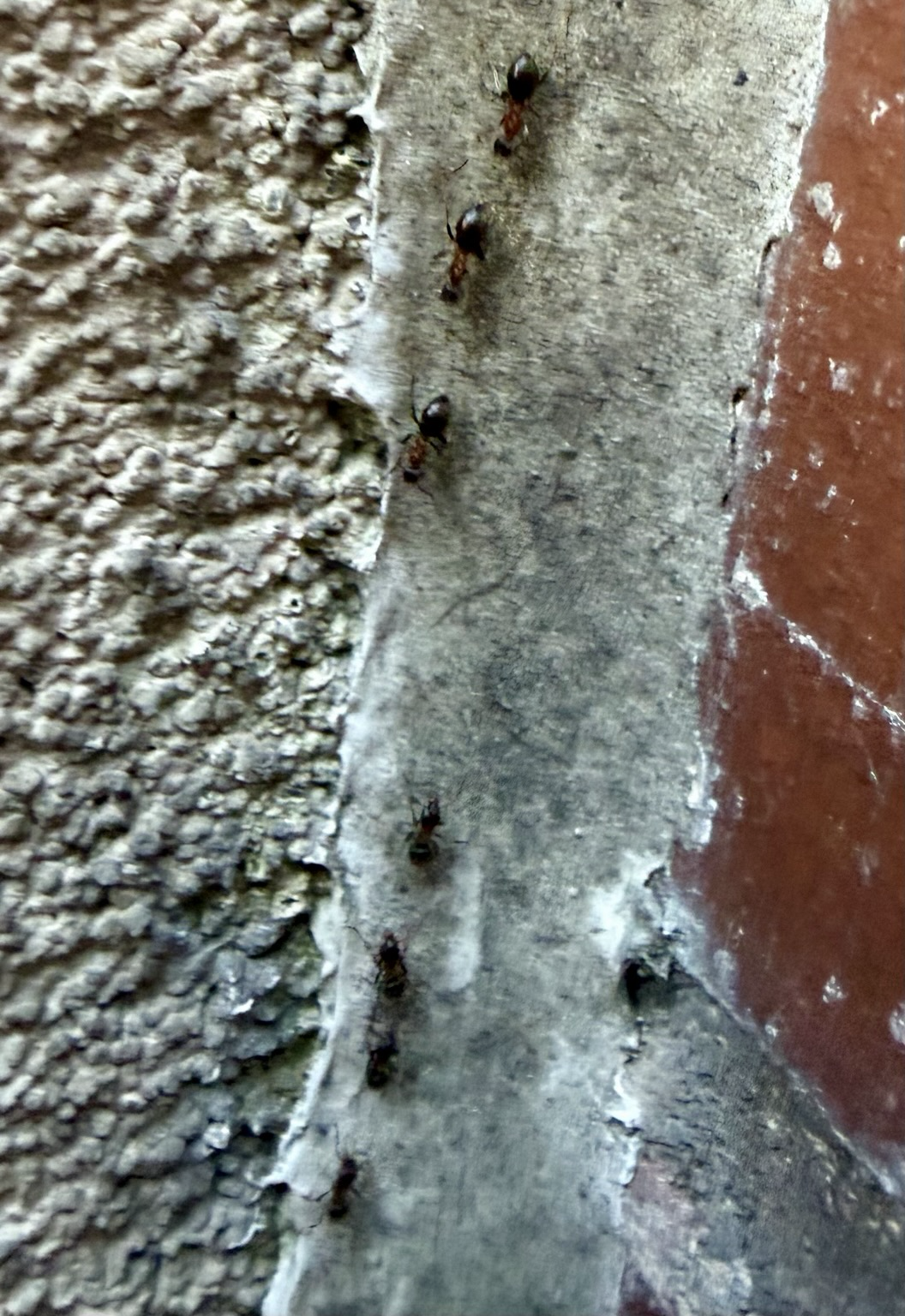
This three year-old colony of Lasius emarginatus is already active early this morning.
-
This three year-old colony of Lasius emarginatus is already active early this morning. These ants are retrieving food from the sidewalk. The “Manhattant” (their local common name) often forms, orderly linear trails, taking advantage of vertical channels in brickwork and and the orthogonal geometry of the city. Could this affinity for lines be the reason why this ant is so successful in New York City?
For the time being, this is an invasive species found only in New York City.
-
This three year-old colony of Lasius emarginatus is already active early this morning. These ants are retrieving food from the sidewalk. The “Manhattant” (their local common name) often forms, orderly linear trails, taking advantage of vertical channels in brickwork and and the orthogonal geometry of the city. Could this affinity for lines be the reason why this ant is so successful in New York City?
For the time being, this is an invasive species found only in New York City.
@futurebird "For the time being, this is an invasive species found only in New York City." Isn't that an oxymoron? They had to come from somewhere, right?
-
This three year-old colony of Lasius emarginatus is already active early this morning. These ants are retrieving food from the sidewalk. The “Manhattant” (their local common name) often forms, orderly linear trails, taking advantage of vertical channels in brickwork and and the orthogonal geometry of the city. Could this affinity for lines be the reason why this ant is so successful in New York City?
For the time being, this is an invasive species found only in New York City.
It’s a little odd that this species has not spread beyond New York. (They were spotted in Hoboken across the Hudson river. But they have been in New York for almost 15 years and not even made it to Greenwich!) invasive species of insects tend to quickly spread to every environment they can exploit, but the Manhattant seems to only really like New York City and especially Manhattan (someone joked it’s because they don’t know how to drive. )
-
@futurebird "For the time being, this is an invasive species found only in New York City." Isn't that an oxymoron? They had to come from somewhere, right?
@danpmoore
They are only *invasive* in New York. They’re native to central and eastern Europe, but in that part of the world, they tend to live in forests, not cities. -
It’s a little odd that this species has not spread beyond New York. (They were spotted in Hoboken across the Hudson river. But they have been in New York for almost 15 years and not even made it to Greenwich!) invasive species of insects tend to quickly spread to every environment they can exploit, but the Manhattant seems to only really like New York City and especially Manhattan (someone joked it’s because they don’t know how to drive. )
This is *The City We Became* kind of stuff.
-
It’s a little odd that this species has not spread beyond New York. (They were spotted in Hoboken across the Hudson river. But they have been in New York for almost 15 years and not even made it to Greenwich!) invasive species of insects tend to quickly spread to every environment they can exploit, but the Manhattant seems to only really like New York City and especially Manhattan (someone joked it’s because they don’t know how to drive. )
@futurebird Perhaps they agree with Dr Johnson(in a deliberate misquote) "When you are tired of New York, you are tired of life"
-
This three year-old colony of Lasius emarginatus is already active early this morning. These ants are retrieving food from the sidewalk. The “Manhattant” (their local common name) often forms, orderly linear trails, taking advantage of vertical channels in brickwork and and the orthogonal geometry of the city. Could this affinity for lines be the reason why this ant is so successful in New York City?
For the time being, this is an invasive species found only in New York City.
@futurebird Nowhere else would be as good for their financial manipulations.
-
It’s a little odd that this species has not spread beyond New York. (They were spotted in Hoboken across the Hudson river. But they have been in New York for almost 15 years and not even made it to Greenwich!) invasive species of insects tend to quickly spread to every environment they can exploit, but the Manhattant seems to only really like New York City and especially Manhattan (someone joked it’s because they don’t know how to drive. )
@futurebird They didn't Escape From New York
-
 J jwcph@helvede.net shared this topic