Skip to content

Solarpunk Urbanism

A community to discuss solarpunk and other new and alternative urbanisms that seek to break away from our currently ecologically destructive urbanisms.

  • Henri Lefebvre, The Right to the City — In brief, the right to the city is the right to the production of a city. The labor of a worker is the source of most of the value of a commodity that is expropriated by the owner. The worker, therefore, has a right to benefit from that value denied to them. In the same way, the urban citizen produces and reproduces the city through their own daily actions. However, the the city is expropriated from the urbanite by the rich and the state. The right to the city is therefore the right to appropriate the city by and for those who make and remake it.

Checkout these related communities:

  • !15minutecity@slrpnk.net
25 Emner 45 Indlæg
  • 14 Votes
    1 Indlæg
    0 Visninger
    Ingen har svaret
  • EXACTLY How To Make Any Place Beautiful

    1
    9 Votes
    1 Indlæg
    0 Visninger
    Ingen har svaret
  • 9 Votes
    1 Indlæg
    3 Visninger
    Ingen har svaret
  • 4 Votes
    1 Indlæg
    1 Visninger
    Ingen har svaret
  • 22 Votes
    1 Indlæg
    2 Visninger
    Ingen har svaret
  • Can we get a text synopsis for the video-impaired?

    2
    6 Votes
    2 Indlæg
    0 Visninger
    hallettj@leminal.spaceH
    It’s about the Dutch-style bike intersection, specifically the first one built in Montreal. It sort of extends bike lanes through the intersection. Instead of bikes and cars mixing in the entire square area of the intersection, there are concrete curb islands inside each corner of the intersection separating car lanes from bike lanes. Turning cars have to go around the inside of the islands, which makes drivers slow down which adds safety. Bike lanes are on the outer sides of the islands which reduces the distance cyclists have to ride where they might intersect with a car since cyclists are protected by the islands for parts of the crossing through the intersection. There are other interesections that use the same idea, but apply it to pedestrians rather than bikes. Drivers complain that the design is a “labyrinth”. The video argues people will get used to it when there are more of these. Left turns are intended to be two-phase, like with unprotected left-turn boxes. First you ride straight across the intersection. Then you stop in a box in the perpendicular bike lane on the other side which is protected by one of those islands. The box provides space to turn left before stopping. Then when you get a green light for that direction you proceed. Some cyclists seem to be confused about how left turns are supposed to work. One cyclist merged into traffic before turning, performing the turn in the car lane. Another cyclist crossed both lanes of car traffic before the intersection, rode across the intersection in the bike lane, but going the wrong direction, and finally turned left into the bike lane on the other side.
  • 3 Votes
    2 Indlæg
    5 Visninger
    F
    Vehicles aren’t actually much heavier than they have been for some time. If you look back through the most popular cars in the US by year, you’ll see a lot of land yachts. Every once in a while, you’ll see something actually small, like a VW Bug, but then it’s right back to big ass metal box. The 1980s did see a lot of smaller cars, but it didn’t take long before the US went back to heft. Conversely, tires and brakes have improved substantially over the years. The stopping distance of modern cars is actually very, very good. This is somewhat negated by a move towards low rolling resistance tires, particularly on hybrids and EVs. The height issue on trucks is a way bigger problem. Easy for an adult to be hidden in front of it, to say nothing of kids.
  • 5 Votes
    1 Indlæg
    2 Visninger
    Ingen har svaret
  • 6 Votes
    3 Indlæg
    3 Visninger
    _
    Specifically it looks like the biggest increases are on urban principal arterial and and urban minor arterial. I suspect larger vehicle sizes impact the trend on a broad scale, but consideration should be kept for increasing demand for urban arterial roads, and widening existing ones as metro areas continue to sprawl at more local scales. I’d be very interested to see the data on pedestrian deaths by road type contrasted to road infrastructure growth by type. The fact that Rural Principal arterial deaths practically disappeared around the same time that urban arterial deaths started increasing could speak to a change in road classification or area designation between rural and suburban.
  • 0 Votes
    1 Indlæg
    0 Visninger
    Ingen har svaret
  • How Japanese 'tiny forests' are sweeping Scotland

    solarpunk gardening urbanism
    1
    1
    56 Votes
    1 Indlæg
    6 Visninger
    Ingen har svaret
  • >They all revolve around ensuring a city is self-sustainable.

    1
    6 Votes
    1 Indlæg
    4 Visninger
    Ingen har svaret
  • Could Cities Grow All Their Textiles? Yes! | Edenicity Episode 157

    urbanism
    1
    8 Votes
    1 Indlæg
    5 Visninger
    Ingen har svaret
  • These neighborhoods built right next to each other are so different

    urbanism
    1
    10 Votes
    1 Indlæg
    3 Visninger
    Ingen har svaret
  • The problem is storage and the solution is shared bikes.

    3
    2 Votes
    3 Indlæg
    9 Visninger
    A
    I got lucky on this recently. Saw someone threw away a working washing machine. I will never buy one because it supports companies who block repair (all of them have contempt for repairers). So the only way for me to get one is to pull one from a dump. I saw on one on a curb saying it just needed to be cleaned or something. I went straight to a shop that has cargo bikes and was able to rent one on the spot. They take reservations but I got lucky. Went straight to the washing machine and it was still there. I was surprised the bike could take the weight and was surprised how well it handled. but fuck apps The problem with most shared bikes is they impose a closed-source app exclusively from Google. I got lucky that a local shop has a website for reservations and you can just walk in and pick it up at the shop – which means a human has to collect a cash deposit. But no shitty app.
  • Yes, going fare-free can make transit better

    urbanism
    2
    1
    46 Votes
    2 Indlæg
    6 Visninger
    mrmakabar@slrpnk.netM
    There are also indirect links. Transit riders are also citizens, who can lobby for better transit. At the same time transit has a lot of indirect advantages. When moving from cars to transit, there are less cars on the road, which means less lanes are needed, which then reduces cost. As for allowing certain groups to ride free, just add it on top of existing systems or make guidelines easy. Say if you get some social security benefit, you get a transit pass as well, everybody under 18 can ride for free given they show some ID or maybe students can use their university ID to use transit. Edit: Also free transit makes transfers easier.
  • 2 Votes
    5 Indlæg
    11 Visninger
    O
    Yes, I have an attic. Through it runs my AC ducts which are insulated pretty poorly from what I can tell. And yes, additional insulation above the ceiling of the interior spaces. The attic itself is at deadly temperatures pretty much all summer long. It’s difficult for me to imagine that permanently shading the roof and leaving an air gap above it would not improve things in addition to the presence of insulation and the attic itself, since it would lower temps in the attic even further. Regardless of the presence of insulation, reducing the delta between the attic temp and interior temp seems like it would be a win to me. My question, ultimately, is how much would a spaced layer above the roof impact this. To me, it feels like it would impact that delta a lot, but maybe not.
  • 13 Votes
    6 Indlæg
    52 Visninger
    A
    No black paint wouldn’t cost more than white; But epdm rubber and asphalt are commonly used on flat roofs and they are black.
  • 22 Votes
    1 Indlæg
    27 Visninger
    Ingen har svaret
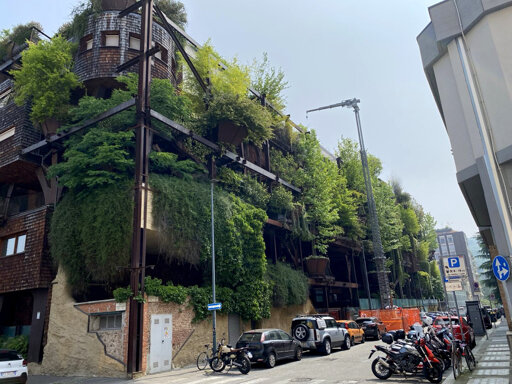
  • A few more recent photos of this Solar Punk masterpiece in Turin.

    urbanism
    1
    1
    73 Votes
    1 Indlæg
    30 Visninger
    Ingen har svaret