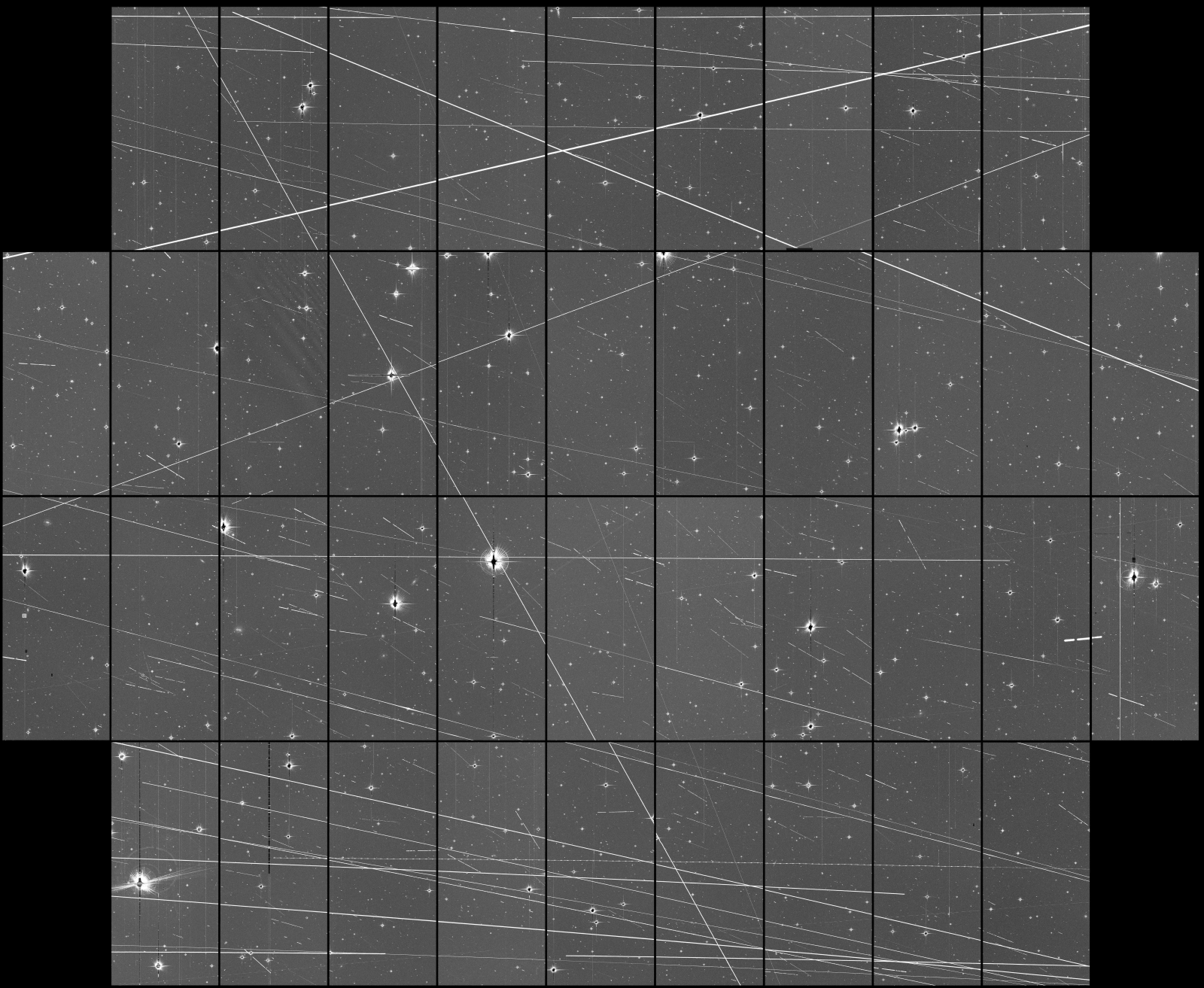
I have a really nice (horrifying) image stack that one of my research team members made, that powerfully demonstrates what a huge problem satellite streaks are for wide-field imaging.
-
I have a really nice (horrifying) image stack that one of my research team members made, that powerfully demonstrates what a huge problem satellite streaks are for wide-field imaging. This is a 3 hour stack of star-subtracted 5 minute exposures using the Canada-France-Hawaii Telescope. The short diagonal lines are asteroids. The long diagonal lines are sunlit satellites that passed through the field of view during the exposure.
Paradoxically, an asteroid can hit the Earth by traveling hidden by the satellite streaks.
-
Now the really horrible part: this image was taken in August 2022. According to @planet4589.bsky.social's website https://planet4589.org/space/stats/out/stat001.txt, there are almost TEN THOUSAND MORE ACTIVE SATELLITES today than there were in August 2022.
Fuck.
@sundogplanets @planet4589.bsky.social
and we have not Talked about the Kessler-syndrom what us locked in on our planet for generations.
But a Couple of Billonairs can do what ever they want

-
Now the really horrible part: this image was taken in August 2022. According to @planet4589.bsky.social's website https://planet4589.org/space/stats/out/stat001.txt, there are almost TEN THOUSAND MORE ACTIVE SATELLITES today than there were in August 2022.
Fuck.
@sundogplanets @planet4589.bsky.social@bsky.brid.gy
Arrrrgh!
Well, if Elon's Empire crashes, how long before they all fall down?
Sadly Bezo's Bazaar isn't as likely to fail.
-
 J jwcph@helvede.net shared this topic
-
Now the really horrible part: this image was taken in August 2022. According to @planet4589.bsky.social's website https://planet4589.org/space/stats/out/stat001.txt, there are almost TEN THOUSAND MORE ACTIVE SATELLITES today than there were in August 2022.
Fuck.
@sundogplanets Eliminating our ability to observe is not the way I thought we would avoid the "Don't Look Up" scenario.

-
Now the really horrible part: this image was taken in August 2022. According to @planet4589.bsky.social's website https://planet4589.org/space/stats/out/stat001.txt, there are almost TEN THOUSAND MORE ACTIVE SATELLITES today than there were in August 2022.
Fuck.
@sundogplanets @planet4589.bsky.social And I was just thinking at the photo: “That is not so bad for a three-hour exposure.”
-
I have a really nice (horrifying) image stack that one of my research team members made, that powerfully demonstrates what a huge problem satellite streaks are for wide-field imaging. This is a 3 hour stack of star-subtracted 5 minute exposures using the Canada-France-Hawaii Telescope. The short diagonal lines are asteroids. The long diagonal lines are sunlit satellites that passed through the field of view during the exposure.
@sundogplanets Just curious: What does "star-subtracted" mean here?
(I still see a large number of pretty compact objects.) -
I have a really nice (horrifying) image stack that one of my research team members made, that powerfully demonstrates what a huge problem satellite streaks are for wide-field imaging. This is a 3 hour stack of star-subtracted 5 minute exposures using the Canada-France-Hawaii Telescope. The short diagonal lines are asteroids. The long diagonal lines are sunlit satellites that passed through the field of view during the exposure.
UFO's Sam. U.F.OHS!
Clearly this is an invasion. What's captured here are the naked manships without their towel cloaks exposing themselves.
A scientist posted images from their secret CFH alien containment facility of a baby Pierson's Puppeteer this past week as well.
Perhaps we should start planting corn in these wide-fields to block them from spying on us and we can hear them rustling around.May The Farce Be With You
-
I have a really nice (horrifying) image stack that one of my research team members made, that powerfully demonstrates what a huge problem satellite streaks are for wide-field imaging. This is a 3 hour stack of star-subtracted 5 minute exposures using the Canada-France-Hawaii Telescope. The short diagonal lines are asteroids. The long diagonal lines are sunlit satellites that passed through the field of view during the exposure.
@sundogplanets as a follow up, I would ask what percentage of the night-sky is obscured by this? Is the addition light pollution a concern for accuracy?
-
@sundogplanets @planet4589.bsky.social@bsky.brid.gy
Arrrrgh!
Well, if Elon's Empire crashes, how long before they all fall down?
Sadly Bezo's Bazaar isn't as likely to fail.
@raymaccarthy @sundogplanets
And to think it was so ridiculous to have a satellite fall on your boyfriend in Northern Exposure. -
I have a really nice (horrifying) image stack that one of my research team members made, that powerfully demonstrates what a huge problem satellite streaks are for wide-field imaging. This is a 3 hour stack of star-subtracted 5 minute exposures using the Canada-France-Hawaii Telescope. The short diagonal lines are asteroids. The long diagonal lines are sunlit satellites that passed through the field of view during the exposure.