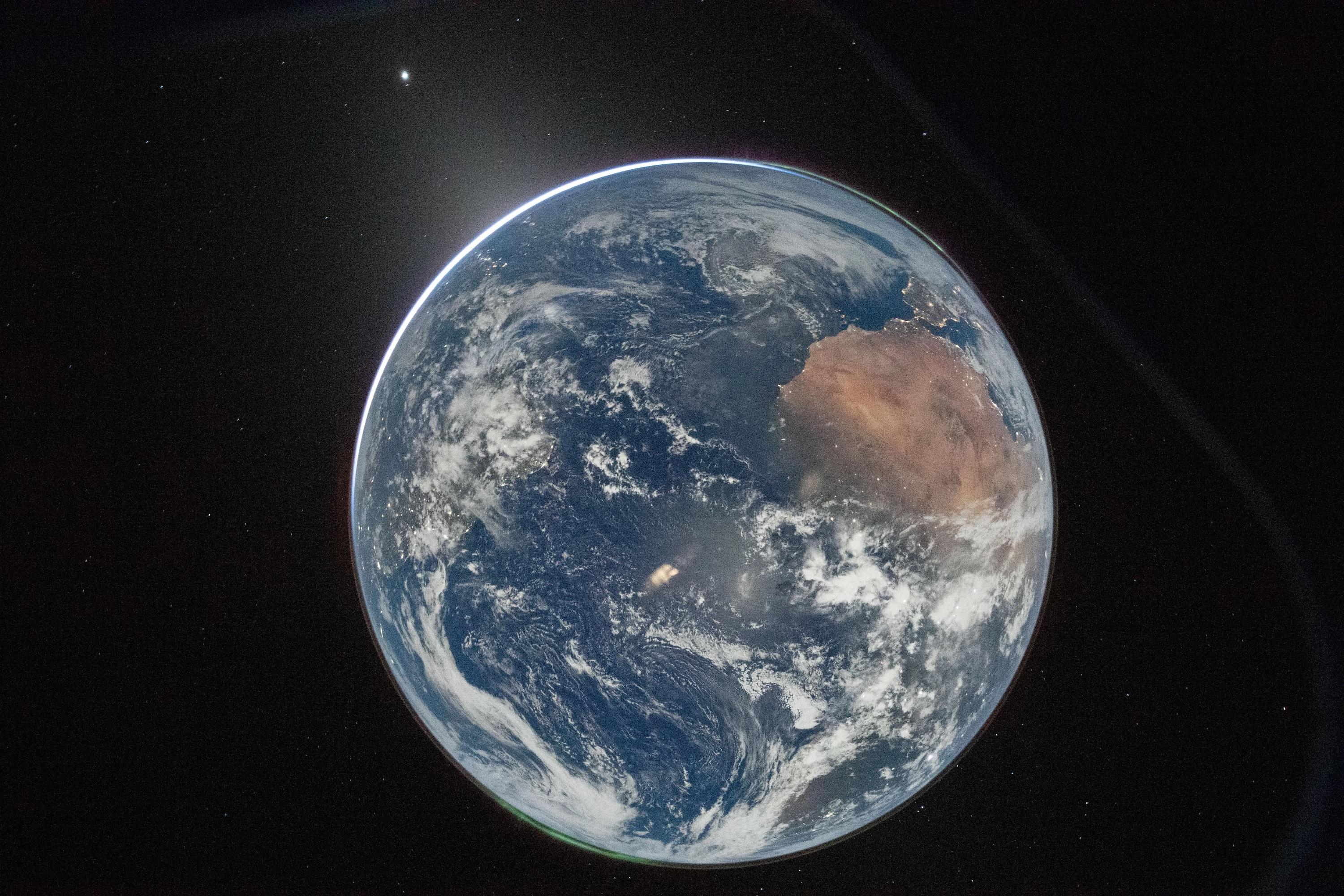
What an amazing view of Earth from Artemis II.
-
What an amazing view of Earth from Artemis II.
The Sun is behind the Earth, illuminating a thin crescent. This low-light shot, taken by Reid Wiseman using a Nikon D5, shows auroras over the poles, city lights, and the glow of the atmosphere.
And yes, there are stars!
https://www.nasa.gov/image-article/hello-world/ #space #science #nature #technology
@coreyspowell
I love the auroras illuminating the atmosphere around the Earth.But what is seen near the center of the image?
-
What an amazing view of Earth from Artemis II.
The Sun is behind the Earth, illuminating a thin crescent. This low-light shot, taken by Reid Wiseman using a Nikon D5, shows auroras over the poles, city lights, and the glow of the atmosphere.
And yes, there are stars!
https://www.nasa.gov/image-article/hello-world/ #space #science #nature #technology
Not a human anywhere. Nice.
-
What an amazing view of Earth from Artemis II.
The Sun is behind the Earth, illuminating a thin crescent. This low-light shot, taken by Reid Wiseman using a Nikon D5, shows auroras over the poles, city lights, and the glow of the atmosphere.
And yes, there are stars!
https://www.nasa.gov/image-article/hello-world/ #space #science #nature #technology
at a safe distance it does seem beautiful
-
What an amazing view of Earth from Artemis II.
The Sun is behind the Earth, illuminating a thin crescent. This low-light shot, taken by Reid Wiseman using a Nikon D5, shows auroras over the poles, city lights, and the glow of the atmosphere.
And yes, there are stars!
https://www.nasa.gov/image-article/hello-world/ #space #science #nature #technology
@coreyspowell What is the shiny thing on the South Atlantic Ocean?
-
@coreyspowell What is the shiny thing on the South Atlantic Ocean?
Reflection in the capsule window.
-
@coreyspowell
I love the auroras illuminating the atmosphere around the Earth.But what is seen near the center of the image?
A reflection in the capsule window.
-
What an amazing view of Earth from Artemis II.
The Sun is behind the Earth, illuminating a thin crescent. This low-light shot, taken by Reid Wiseman using a Nikon D5, shows auroras over the poles, city lights, and the glow of the atmosphere.
And yes, there are stars!
https://www.nasa.gov/image-article/hello-world/ #space #science #nature #technology
@coreyspowell The atmosphere like a thin shell enabling and protecting all life on the surface which we are recklessly damaging.
-
Reflection in the capsule window.
@czauner Thanks!
-
To be clear: We're basically looking at an eclipse of the Sun, by the Earth.
This is the night side of our planet, illuminated by the light of the full Moon, seen in a long exposure. Wow!
@coreyspowell
Thanks for the clarification!I’ve been to Sahara when the landscape around me was lit up by just stars and the full moon, but I never thought about the fact that all Northern Africa and much of the rest of the planet also was lit up.
Yet another obvious thing I did not think of…
-
What an amazing view of Earth from Artemis II.
The Sun is behind the Earth, illuminating a thin crescent. This low-light shot, taken by Reid Wiseman using a Nikon D5, shows auroras over the poles, city lights, and the glow of the atmosphere.
And yes, there are stars!
https://www.nasa.gov/image-article/hello-world/ #space #science #nature #technology
What I see in this image is a little blue ball, that in all the reachable universe, is the sole place humanity (and so much else!) can ever *thrive*, without the intense use of inherently fragile and fallible high tech adaptations, if then. Yet, year by year the dominant civilizations here are so busy-- arrogantly destroying it's life-giving biosphere and the incredibly beautiful web of life that depends upon it. And all for greed. More, more more. When will it ever be enough?
-
What an amazing view of Earth from Artemis II.
The Sun is behind the Earth, illuminating a thin crescent. This low-light shot, taken by Reid Wiseman using a Nikon D5, shows auroras over the poles, city lights, and the glow of the atmosphere.
And yes, there are stars!
https://www.nasa.gov/image-article/hello-world/ #space #science #nature #technology
@coreyspowell Boring. We've seen this in 1968 #Apollo8.
-
@peteriskrisjanis @coreyspowell
After 1969 once again the overview.
Haven't learnt then, won't now. -
What an amazing view of Earth from Artemis II.
The Sun is behind the Earth, illuminating a thin crescent. This low-light shot, taken by Reid Wiseman using a Nikon D5, shows auroras over the poles, city lights, and the glow of the atmosphere.
And yes, there are stars!
https://www.nasa.gov/image-article/hello-world/ #space #science #nature #technology
@coreyspowell @inthehands Whenever I see these shots, I am reminded that we’re all astronauts. Our (sometimes) environmentally controlled craft is spherical in shape, moving through space at 67,000 MPH as it orbits the sun. We have some water and toilet issues, and many of us suffer from Outlook glitches, too.
-
What an amazing view of Earth from Artemis II.
The Sun is behind the Earth, illuminating a thin crescent. This low-light shot, taken by Reid Wiseman using a Nikon D5, shows auroras over the poles, city lights, and the glow of the atmosphere.
And yes, there are stars!
https://www.nasa.gov/image-article/hello-world/ #space #science #nature #technology
@coreyspowell So glad they finally took a photo with stars visible. It's been a point of debate for way too long.
-
What an amazing view of Earth from Artemis II.
The Sun is behind the Earth, illuminating a thin crescent. This low-light shot, taken by Reid Wiseman using a Nikon D5, shows auroras over the poles, city lights, and the glow of the atmosphere.
And yes, there are stars!
https://www.nasa.gov/image-article/hello-world/ #space #science #nature #technology
@coreyspowell Thanks for posting this photo and sharing the link!
 ️
️Is there some reason why this image has been rotated? The one on the website is oriented differently (see attached image).
The description from NASA website seems to match up with this image, especially the fairly bright "zodiacal light" - a term which I learned today!
-
@coreyspowell
I love the auroras illuminating the atmosphere around the Earth.But what is seen near the center of the image?
@Earl @coreyspowell Just the reflection of the lights inside the craft.
-
@coreyspowell Thanks for posting this photo and sharing the link!
️Is there some reason why this image has been rotated? The one on the website is oriented differently (see attached image).
The description from NASA website seems to match up with this image, especially the fairly bright "zodiacal light" - a term which I learned today!
@ahimsa_pdx @coreyspowell I can see why, flipping the image orients it to roughly north to south rather than the inverse.
-
@coreyspowell Thanks for posting this photo and sharing the link!
️Is there some reason why this image has been rotated? The one on the website is oriented differently (see attached image).
The description from NASA website seems to match up with this image, especially the fairly bright "zodiacal light" - a term which I learned today!
-
@ahimsa_pdx @coreyspowell I can see why, flipping the image orients it to roughly north to south rather than the inverse.
@nini @coreyspowell
I'm not completely against the idea of rotating an image (there is no "north" in space) but then the alt text should be rewritten to match the image.The bright slice of light (zodiacal light) is in the lower right in the original orientation shown on the website but in the rotated image it is in the upper left.
I found that a bit confusing.
-
@vk6flab Or, you could see the pro version the Canadian Space Agency had already made:
https://artemis.cdnspace.ca/