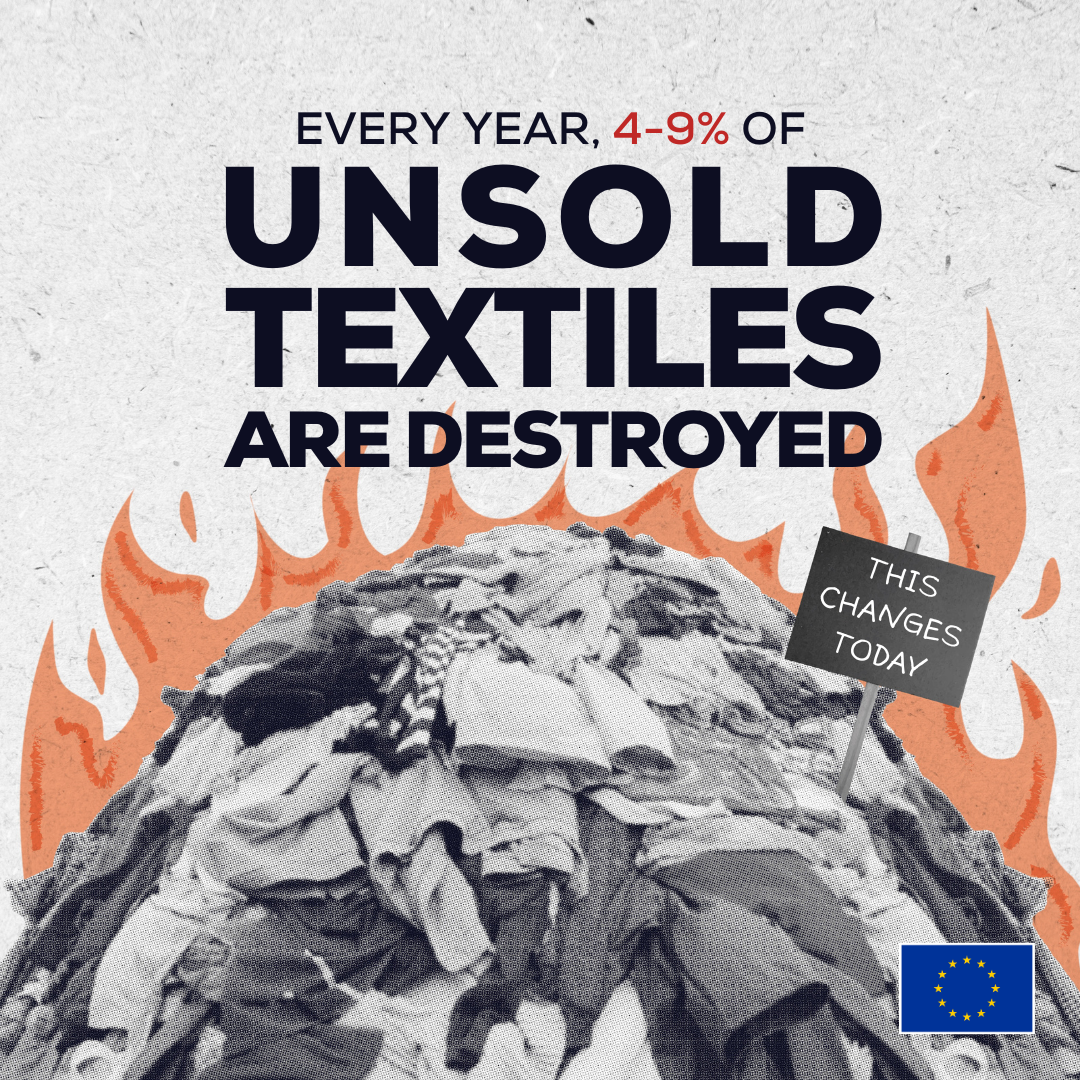
Every year in Europe, an estimated 4-9% of unsold textiles are destroyed before ever being worn, generating around 5.6 million tonnes of CO₂ emissions.
-
Every year in Europe, an estimated 4-9% of unsold textiles are destroyed before ever being worn, generating around 5.6 million tonnes of CO₂ emissions.
We’re putting an end to this wasteful practice.
From today, large companies can no longer destroy unsold clothes, accessories and footwear. They will need to instead prioritise keeping products in use: by selling, donating, or preparing for reuse.
Find out more: https://link.europa.eu/cdYmK9
-
Every year in Europe, an estimated 4-9% of unsold textiles are destroyed before ever being worn, generating around 5.6 million tonnes of CO₂ emissions.
We’re putting an end to this wasteful practice.
From today, large companies can no longer destroy unsold clothes, accessories and footwear. They will need to instead prioritise keeping products in use: by selling, donating, or preparing for reuse.
Find out more: https://link.europa.eu/cdYmK9
@EUCommission nach dem was ich mitbekommen hab dürfen die weiterhin vernichtet werden...
-
Every year in Europe, an estimated 4-9% of unsold textiles are destroyed before ever being worn, generating around 5.6 million tonnes of CO₂ emissions.
We’re putting an end to this wasteful practice.
From today, large companies can no longer destroy unsold clothes, accessories and footwear. They will need to instead prioritise keeping products in use: by selling, donating, or preparing for reuse.
Find out more: https://link.europa.eu/cdYmK9
@EUCommission man hat hoffentlich auch den Export dieser Textilen verboten denn ansonsten verlagert man die Vernichtung und es wäre Greenwashing wovon ich ausgehe.
und mit unseren Altkleidern haben wir schon verschiedene Wirtschaftsräume im Bereich der Textilien zerstört.
-
Every year in Europe, an estimated 4-9% of unsold textiles are destroyed before ever being worn, generating around 5.6 million tonnes of CO₂ emissions.
We’re putting an end to this wasteful practice.
From today, large companies can no longer destroy unsold clothes, accessories and footwear. They will need to instead prioritise keeping products in use: by selling, donating, or preparing for reuse.
Find out more: https://link.europa.eu/cdYmK9
@EUCommission As always, hope there are no loopholes.
-
Every year in Europe, an estimated 4-9% of unsold textiles are destroyed before ever being worn, generating around 5.6 million tonnes of CO₂ emissions.
We’re putting an end to this wasteful practice.
From today, large companies can no longer destroy unsold clothes, accessories and footwear. They will need to instead prioritise keeping products in use: by selling, donating, or preparing for reuse.
Find out more: https://link.europa.eu/cdYmK9
@EUCommission it’s probably better for public health to incinerate synthetic and mixed material clothes before they contaminate the water
-
@EUCommission it’s probably better for public health to incinerate synthetic and mixed material clothes before they contaminate the water
@Kierkegaanks @EUCommission burning plastics being notoriously healthy..?
-
@Kierkegaanks @EUCommission burning plastics being notoriously healthy..?
@EUCommission @noodlemaz note that I wrote it was probably better, not good
-
Every year in Europe, an estimated 4-9% of unsold textiles are destroyed before ever being worn, generating around 5.6 million tonnes of CO₂ emissions.
We’re putting an end to this wasteful practice.
From today, large companies can no longer destroy unsold clothes, accessories and footwear. They will need to instead prioritise keeping products in use: by selling, donating, or preparing for reuse.
Find out more: https://link.europa.eu/cdYmK9
I hope the execution will be as good as is the aim of this.
I wish you success in this, @EUCommission
-
Every year in Europe, an estimated 4-9% of unsold textiles are destroyed before ever being worn, generating around 5.6 million tonnes of CO₂ emissions.
We’re putting an end to this wasteful practice.
From today, large companies can no longer destroy unsold clothes, accessories and footwear. They will need to instead prioritise keeping products in use: by selling, donating, or preparing for reuse.
Find out more: https://link.europa.eu/cdYmK9
@EUCommission very few of the clothes sold in EU are produced in EU.
-
Every year in Europe, an estimated 4-9% of unsold textiles are destroyed before ever being worn, generating around 5.6 million tonnes of CO₂ emissions.
We’re putting an end to this wasteful practice.
From today, large companies can no longer destroy unsold clothes, accessories and footwear. They will need to instead prioritise keeping products in use: by selling, donating, or preparing for reuse.
Find out more: https://link.europa.eu/cdYmK9
«…the ESPR requires companies to disclose information on the unsold consumer products they discard as waste. It also introduces a ban on the destruction of unsold apparel, clothing accessories and footwear.»
Once again, since avoiding to mention enforcement seems to be the norm with such announcements:
1) Are there consequences for not disclosing such information?
2) Are there consequences for destroying textiles in spite of the announced ban? What are they? -
Every year in Europe, an estimated 4-9% of unsold textiles are destroyed before ever being worn, generating around 5.6 million tonnes of CO₂ emissions.
We’re putting an end to this wasteful practice.
From today, large companies can no longer destroy unsold clothes, accessories and footwear. They will need to instead prioritise keeping products in use: by selling, donating, or preparing for reuse.
Find out more: https://link.europa.eu/cdYmK9
@EUCommission One of the oldest building technologies was plaster and burlap. It should be blatantly obvious that a greater range of textiles should be manufactured for multiple uses.
This is PREscient ethics/math, and the fact that these measures as post de facto negligence, are further penalizing taxpayers, is just as much - if not more abhorrent than the inherent neglect.
Reform, because we have less and less CRUNCH time to adapt.
-
Every year in Europe, an estimated 4-9% of unsold textiles are destroyed before ever being worn, generating around 5.6 million tonnes of CO₂ emissions.
We’re putting an end to this wasteful practice.
From today, large companies can no longer destroy unsold clothes, accessories and footwear. They will need to instead prioritise keeping products in use: by selling, donating, or preparing for reuse.
Find out more: https://link.europa.eu/cdYmK9
@EUCommission So, large companies will have to resort to more non-EU production (if possible...) and do more abusive landfill with the excessive production (as they already do it).
As noted by others, it's all about: 1) how it will be investigated, 2) what happens next
Because I fear the answers are: 1) a (ridiculous) voluntary disclosure, 2) nothing will be enforced for non-EU productionsAs usual, the base idea is great, but it applies to a fictional world.
-
Every year in Europe, an estimated 4-9% of unsold textiles are destroyed before ever being worn, generating around 5.6 million tonnes of CO₂ emissions.
We’re putting an end to this wasteful practice.
From today, large companies can no longer destroy unsold clothes, accessories and footwear. They will need to instead prioritise keeping products in use: by selling, donating, or preparing for reuse.
Find out more: https://link.europa.eu/cdYmK9
@EUCommission Drapes of Wrath
-
Every year in Europe, an estimated 4-9% of unsold textiles are destroyed before ever being worn, generating around 5.6 million tonnes of CO₂ emissions.
We’re putting an end to this wasteful practice.
From today, large companies can no longer destroy unsold clothes, accessories and footwear. They will need to instead prioritise keeping products in use: by selling, donating, or preparing for reuse.
Find out more: https://link.europa.eu/cdYmK9
@EUCommission good job!
-
Every year in Europe, an estimated 4-9% of unsold textiles are destroyed before ever being worn, generating around 5.6 million tonnes of CO₂ emissions.
We’re putting an end to this wasteful practice.
From today, large companies can no longer destroy unsold clothes, accessories and footwear. They will need to instead prioritise keeping products in use: by selling, donating, or preparing for reuse.
Find out more: https://link.europa.eu/cdYmK9
@EUCommission Does this also apply for brand imitations?

-
Every year in Europe, an estimated 4-9% of unsold textiles are destroyed before ever being worn, generating around 5.6 million tonnes of CO₂ emissions.
We’re putting an end to this wasteful practice.
From today, large companies can no longer destroy unsold clothes, accessories and footwear. They will need to instead prioritise keeping products in use: by selling, donating, or preparing for reuse.
Find out more: https://link.europa.eu/cdYmK9
@EUCommission 33 million tonnes of CO2 has been released into the atmosphere by your close Israeli allies. During the genocide. So far.
-
@EUCommission 33 million tonnes of CO2 has been released into the atmosphere by your close Israeli allies. During the genocide. So far.
-
Every year in Europe, an estimated 4-9% of unsold textiles are destroyed before ever being worn, generating around 5.6 million tonnes of CO₂ emissions.
We’re putting an end to this wasteful practice.
From today, large companies can no longer destroy unsold clothes, accessories and footwear. They will need to instead prioritise keeping products in use: by selling, donating, or preparing for reuse.
Find out more: https://link.europa.eu/cdYmK9
@EUCommission omg thats pretty nice
didnt even know companies destroy unsold clothes. that's pretty sad and frustrating. so it's pretty nice that you are doing something about it

-
Every year in Europe, an estimated 4-9% of unsold textiles are destroyed before ever being worn, generating around 5.6 million tonnes of CO₂ emissions.
We’re putting an end to this wasteful practice.
From today, large companies can no longer destroy unsold clothes, accessories and footwear. They will need to instead prioritise keeping products in use: by selling, donating, or preparing for reuse.
Find out more: https://link.europa.eu/cdYmK9
They need to stop making shitty clothes in the first place. Make what people want, not what you think will sell. And put POCKETS in it, ffs.
-
Every year in Europe, an estimated 4-9% of unsold textiles are destroyed before ever being worn, generating around 5.6 million tonnes of CO₂ emissions.
We’re putting an end to this wasteful practice.
From today, large companies can no longer destroy unsold clothes, accessories and footwear. They will need to instead prioritise keeping products in use: by selling, donating, or preparing for reuse.
Find out more: https://link.europa.eu/cdYmK9
@EUCommission your donated clothing ends up being resold in Third World countries like mine... hope you have a good way to figure it out other than yet more directives