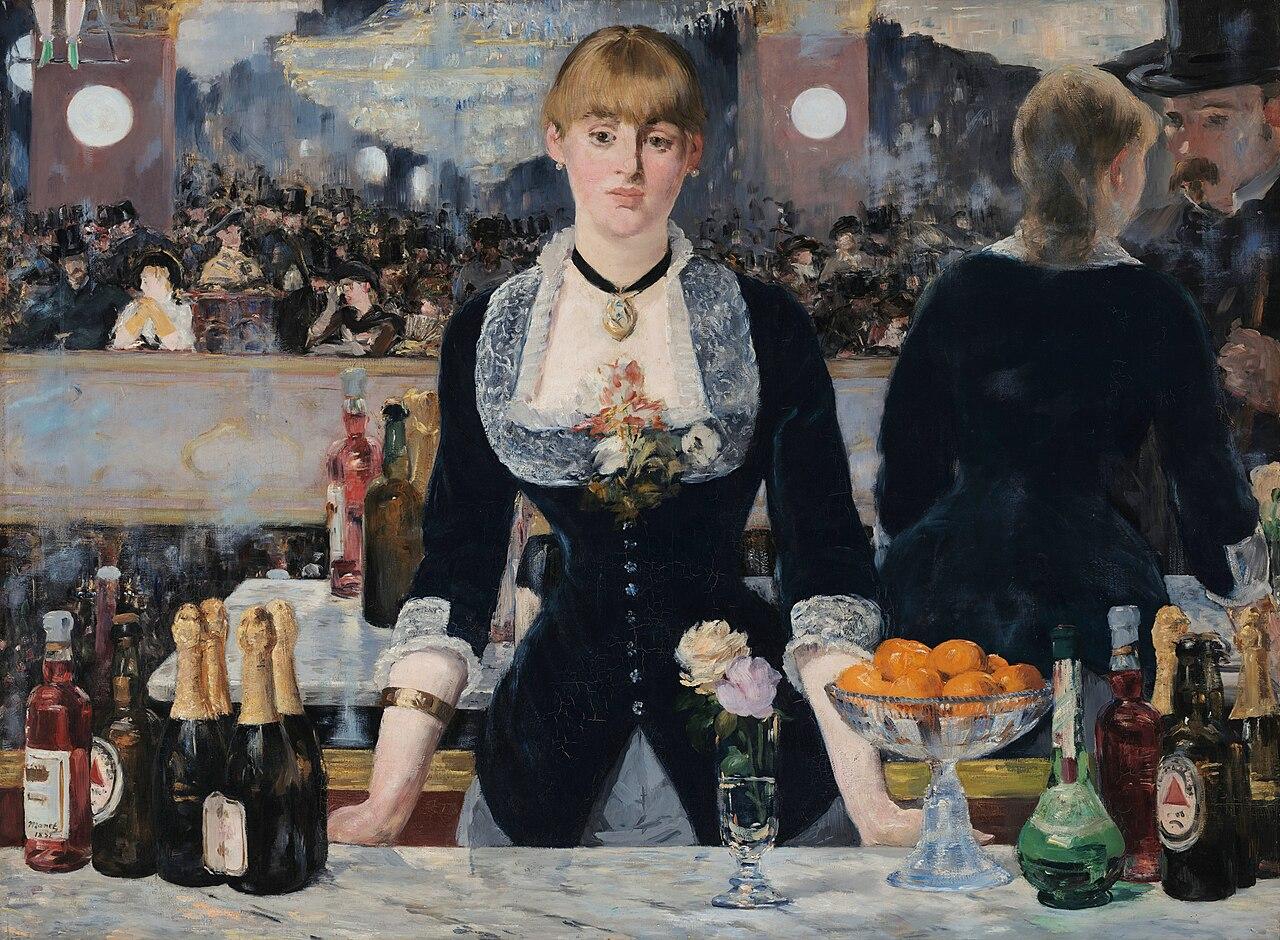
Manet's famous painting Un Bar aux Folies-Bergère never appealed to me.
-
@johncarlosbaez Wow! I had always just assumed it was a double-sided bar and there were two barmaids! I hadn't recognized it as involving reflections.
I remember being fascinated by mirrors when I was maybe three or four. I have a very clear memory of looking into one that hung on a hallway wall, looking into it at an angle and being amazed by how much imagery was in the reflection. I wondered how so much could fit into one piece of glass. It seemed magical.
@bodhipaksa - I too had tried to rationalize it as two separate barmaids, but I felt uncomfortable about that.
I bet Manet guessed we would do that.
Some commenters have read a lot into the meaning of the mirror here, and I think they're right, though some intellectuals have a way of sounding so pompous you want to dismiss them:
"Asserting the presence of the mirror has been crucial for many modern interpreters. It provides a meaningful parallel with Las Meninas, a masterpiece by an artist Manet admired, Diego Velázquez. There has been a considerable development of this topic since Michel Foucault broached it in his book The Order of Things (1966).
The art historian Jeffrey Meyers describes the intentional play on perspective and the apparent violation of the operations of mirrors: "Behind her, and extending for the entire length of the four-and-a-quarter-foot painting, is the gold frame of an enormous mirror. The French philosopher Maurice Merleau-Ponty has called a mirror 'the instrument of a universal magic that changes things into spectacles, spectacles into things, me into others, and others into me.' We, the viewers, stand opposite the barmaid on the other side of the counter and, looking at the reflection in the mirror, see exactly what she sees... A critic has noted that Manet's 'preliminary study shows her placed off to the right, whereas in the finished canvas she is very much the centre of attention.' Though Manet shifted her from the right to the center, he kept her reflection on the right. Seen in the mirror, she seems engaged with a customer; in full face, she's self-protectively withdrawn and remote."
https://en.wikipedia.org/wiki/A_Bar_at_the_Folies-Berg%C3%A8re
-
@ojs @johncarlosbaez I would in fact say she doesn’t seem to be serving the man. A more plausible version is that she served the man already and she is looking at the next customer, the viewer/painter/photographer.
@antopatriarca @ojs - It's so thought-provoking!
Here's my impression of the painting. In the reflection she seems to be serving the man. In the direct view, she seems to be facing me. And this adds an excellent extra layer to the overall symbolism. The barmaid is forced to be "two-faced": to be a good barmaid, she has to make every customer feel special, as if she's only serving them.
In *reality*, for this scene to be possible, she must be no longer serving the man, and already facing the next customer (the painter/photographer).
-
Manet's famous painting Un Bar aux Folies-Bergère never appealed to me. But now I realize its genius, and my spine tingles every time I see it.
The perspective looks all wrong. You're staring straight at this barmaid, but her reflection in the mirror is way off to right. Even worse, her reflection is facing a guy who doesn't appear in the main view!
But in 2000, a researcher showed this perspective is actually possible!!! To prove it, he did a photographic reconstruction of this scene. Check it out in my next post.
This blows my mind.
(1/3)
@johncarlosbaez @zeitz Knowing the painting nearly my whole life and it is only now that I understand the composition.
Thanks! -
@johncarlosbaez @zeitz Knowing the painting nearly my whole life and it is only now that I understand the composition.
Thanks!@aoe - yeah, ain't it amazing?
I didn't figure this out myself. I would never have figured it out.
-
@bodhipaksa - I too had tried to rationalize it as two separate barmaids, but I felt uncomfortable about that.
I bet Manet guessed we would do that.
Some commenters have read a lot into the meaning of the mirror here, and I think they're right, though some intellectuals have a way of sounding so pompous you want to dismiss them:
"Asserting the presence of the mirror has been crucial for many modern interpreters. It provides a meaningful parallel with Las Meninas, a masterpiece by an artist Manet admired, Diego Velázquez. There has been a considerable development of this topic since Michel Foucault broached it in his book The Order of Things (1966).
The art historian Jeffrey Meyers describes the intentional play on perspective and the apparent violation of the operations of mirrors: "Behind her, and extending for the entire length of the four-and-a-quarter-foot painting, is the gold frame of an enormous mirror. The French philosopher Maurice Merleau-Ponty has called a mirror 'the instrument of a universal magic that changes things into spectacles, spectacles into things, me into others, and others into me.' We, the viewers, stand opposite the barmaid on the other side of the counter and, looking at the reflection in the mirror, see exactly what she sees... A critic has noted that Manet's 'preliminary study shows her placed off to the right, whereas in the finished canvas she is very much the centre of attention.' Though Manet shifted her from the right to the center, he kept her reflection on the right. Seen in the mirror, she seems engaged with a customer; in full face, she's self-protectively withdrawn and remote."
https://en.wikipedia.org/wiki/A_Bar_at_the_Folies-Berg%C3%A8re
@johncarlosbaez Yes, that style of writing is just ... no.
It always reminds me of one of my favorite Calvin and Hobbes cartoons. I'm sure you know it.
-
@antopatriarca @ojs - It's so thought-provoking!
Here's my impression of the painting. In the reflection she seems to be serving the man. In the direct view, she seems to be facing me. And this adds an excellent extra layer to the overall symbolism. The barmaid is forced to be "two-faced": to be a good barmaid, she has to make every customer feel special, as if she's only serving them.
In *reality*, for this scene to be possible, she must be no longer serving the man, and already facing the next customer (the painter/photographer).
@johncarlosbaez @ojs yes, I agree. In the painting the mirror seems to be showing a different scene than the non-mirrored part. It is only from the explanation of what we are seeing that the interpretation of the two customers start to appear.
-
@bodhipaksa - I too had tried to rationalize it as two separate barmaids, but I felt uncomfortable about that.
I bet Manet guessed we would do that.
Some commenters have read a lot into the meaning of the mirror here, and I think they're right, though some intellectuals have a way of sounding so pompous you want to dismiss them:
"Asserting the presence of the mirror has been crucial for many modern interpreters. It provides a meaningful parallel with Las Meninas, a masterpiece by an artist Manet admired, Diego Velázquez. There has been a considerable development of this topic since Michel Foucault broached it in his book The Order of Things (1966).
The art historian Jeffrey Meyers describes the intentional play on perspective and the apparent violation of the operations of mirrors: "Behind her, and extending for the entire length of the four-and-a-quarter-foot painting, is the gold frame of an enormous mirror. The French philosopher Maurice Merleau-Ponty has called a mirror 'the instrument of a universal magic that changes things into spectacles, spectacles into things, me into others, and others into me.' We, the viewers, stand opposite the barmaid on the other side of the counter and, looking at the reflection in the mirror, see exactly what she sees... A critic has noted that Manet's 'preliminary study shows her placed off to the right, whereas in the finished canvas she is very much the centre of attention.' Though Manet shifted her from the right to the center, he kept her reflection on the right. Seen in the mirror, she seems engaged with a customer; in full face, she's self-protectively withdrawn and remote."
https://en.wikipedia.org/wiki/A_Bar_at_the_Folies-Berg%C3%A8re
@johncarlosbaez "I bet Manet guessed we would do that."
Yes, there's so much thought gone into this that he must have intended to fool us, giving a thrill to those who were careful enough to see what was actually going on.
-
@johncarlosbaez Yes, that style of writing is just ... no.
It always reminds me of one of my favorite Calvin and Hobbes cartoons. I'm sure you know it.
@bodhipaksa - Yes. I learned a lot about writing from Feynman, who actually didn't write most of his books: other people transcribed what he said. That direct conversational style works really well to get people to focus on what you're really saying.
My last post got too long, but I wanted to say that I've always loved pairs of mirrors, either parallel or at right angles in a corner. They create whole new worlds.
-
@hungryjoe - yes, I've had Bass ale and instantly recognized that bottle *as soon as someone pointed it out to me*. (My blindness to what's going on in paintings kind of astounds me.)
@johncarlosbaez @hungryjoe The red triangle is also the first registered trademark. The company had somebody wait overnight outside the registration office to ensure they got the first one after the law became applicable.
That painting was used as a case study in my first year undergrad physics, not seen this interpretation before
-
@johncarlosbaez @ojs yes, I agree. In the painting the mirror seems to be showing a different scene than the non-mirrored part. It is only from the explanation of what we are seeing that the interpretation of the two customers start to appear.
@antopatriarca @johncarlosbaez @ojs I always thought that this is the painter's reflection in the mirror.
-
@antopatriarca @ojs - It's so thought-provoking!
Here's my impression of the painting. In the reflection she seems to be serving the man. In the direct view, she seems to be facing me. And this adds an excellent extra layer to the overall symbolism. The barmaid is forced to be "two-faced": to be a good barmaid, she has to make every customer feel special, as if she's only serving them.
In *reality*, for this scene to be possible, she must be no longer serving the man, and already facing the next customer (the painter/photographer).
@johncarlosbaez @antopatriarca @ojs
Waldy did a nice item on it a few years ago:
https://www.youtube.com/watch?v=Ye5kbf2_wdI
#art #Manet #ABarAtFoliesBergère #Suzon -
@johncarlosbaez @antopatriarca @ojs
Waldy did a nice item on it a few years ago:
https://www.youtube.com/watch?v=Ye5kbf2_wdI
#art #Manet #ABarAtFoliesBergère #Suzon@spacemagick @antopatriarca @ojs - coo, I'll check it out. Great thumbnail.
-
This diagram shows how the perspective works in Manet's famous painting Un bar aux Folies Bergère. We are viewing the woman at an angle, and while the man is outside our field of view, his reflection can be seen.
Astounding! But it's not just a technical feat. It allowed Manet to make a deep point. While the woman is busy serving her customer, she is internally completely detached - perhaps bored, perhaps introspective. She is SPLIT.
To fully understand the painting you also need to know that many of the barmaids at the Folies Bergère also served as prostitutes. Standing behind the oranges, the champagne and a bottle of Bass ale, the woman is just as much a commodity as these other things. But she is coldly detached from her objectification.
The woman in the painting was actually a real person, known as Suzon, who worked at the Folies-Bergère in the early 1880s. For his painting, Manet posed her in his studio.
Before I understood this painting, I wasn't really looking at it - I didn't see it. I didn't even see the green shoes of the trapeze artist. I can often grasp music quite quickly. But paintings often fail to move me until someone explains them.
When Manet came out with this painting in 1882, some critics mocked him for his poor understanding of perspective. Some said he was going senile. It was, in fact, his last major painting. But he was a genius, and he was going... whoosh... over their heads, just like he went over mine.
This diagram created by Malcolm Park and Darren McKimm. For more details go here:
https://www.getty.edu/art/exhibitions/manet_bar/looking_glass.html
(3/3)
@johncarlosbaez It is very interesting, especially that the perspective implies that the scene was seen away from the center of vision, i.e. the observer was watching from the corner of his eyes, implying it was shameful of sorts. At least that is how I interpret the schema with the frame of view not being aligned with the center of vision.
-
This diagram shows how the perspective works in Manet's famous painting Un bar aux Folies Bergère. We are viewing the woman at an angle, and while the man is outside our field of view, his reflection can be seen.
Astounding! But it's not just a technical feat. It allowed Manet to make a deep point. While the woman is busy serving her customer, she is internally completely detached - perhaps bored, perhaps introspective. She is SPLIT.
To fully understand the painting you also need to know that many of the barmaids at the Folies Bergère also served as prostitutes. Standing behind the oranges, the champagne and a bottle of Bass ale, the woman is just as much a commodity as these other things. But she is coldly detached from her objectification.
The woman in the painting was actually a real person, known as Suzon, who worked at the Folies-Bergère in the early 1880s. For his painting, Manet posed her in his studio.
Before I understood this painting, I wasn't really looking at it - I didn't see it. I didn't even see the green shoes of the trapeze artist. I can often grasp music quite quickly. But paintings often fail to move me until someone explains them.
When Manet came out with this painting in 1882, some critics mocked him for his poor understanding of perspective. Some said he was going senile. It was, in fact, his last major painting. But he was a genius, and he was going... whoosh... over their heads, just like he went over mine.
This diagram created by Malcolm Park and Darren McKimm. For more details go here:
https://www.getty.edu/art/exhibitions/manet_bar/looking_glass.html
(3/3)
@johncarlosbaez
It was this painting and this explanation that hooked me into Art History as a degree subject.
It was part of the Humanities introduction, and we later did the sort of deep dive into the location, the people and the sociology of it later.
There's so much to see and learn from apparently straightforward artworks! -
Manet's famous painting Un Bar aux Folies-Bergère never appealed to me. But now I realize its genius, and my spine tingles every time I see it.
The perspective looks all wrong. You're staring straight at this barmaid, but her reflection in the mirror is way off to right. Even worse, her reflection is facing a guy who doesn't appear in the main view!
But in 2000, a researcher showed this perspective is actually possible!!! To prove it, he did a photographic reconstruction of this scene. Check it out in my next post.
This blows my mind.
(1/3)
@johncarlosbaez Did we get recommended the same video on YouTube?
-
Manet's famous painting Un Bar aux Folies-Bergère never appealed to me. But now I realize its genius, and my spine tingles every time I see it.
The perspective looks all wrong. You're staring straight at this barmaid, but her reflection in the mirror is way off to right. Even worse, her reflection is facing a guy who doesn't appear in the main view!
But in 2000, a researcher showed this perspective is actually possible!!! To prove it, he did a photographic reconstruction of this scene. Check it out in my next post.
This blows my mind.
(1/3)
Oh, dear. I always thought that there were literally two barmaids working and it was a two-sided bar.

-
Manet's famous painting Un Bar aux Folies-Bergère never appealed to me. But now I realize its genius, and my spine tingles every time I see it.
The perspective looks all wrong. You're staring straight at this barmaid, but her reflection in the mirror is way off to right. Even worse, her reflection is facing a guy who doesn't appear in the main view!
But in 2000, a researcher showed this perspective is actually possible!!! To prove it, he did a photographic reconstruction of this scene. Check it out in my next post.
This blows my mind.
(1/3)
@johncarlosbaez I loved the analysis at https://www.arte.tv/fr/videos/123385-000-A/le-monde-dans-un-tableau/ (in French)
especially the japanese point of view.
-
@johncarlosbaez @antopatriarca @ojs
Waldy did a nice item on it a few years ago:
https://www.youtube.com/watch?v=Ye5kbf2_wdI
#art #Manet #ABarAtFoliesBergère #Suzon@spacemagick @johncarlosbaez @antopatriarca @ojs "Waldy", heh. In our family we call him "Wally the hobbit" and watch anything he makes.
-
Manet's famous painting Un Bar aux Folies-Bergère never appealed to me. But now I realize its genius, and my spine tingles every time I see it.
The perspective looks all wrong. You're staring straight at this barmaid, but her reflection in the mirror is way off to right. Even worse, her reflection is facing a guy who doesn't appear in the main view!
But in 2000, a researcher showed this perspective is actually possible!!! To prove it, he did a photographic reconstruction of this scene. Check it out in my next post.
This blows my mind.
(1/3)
@johncarlosbaez This painting and your thread caused an interesting discussion with my 16-year old son and my wife, starting with my son asking "why do you have this painting open in your computer".
Edit. My son doesn't buy your explanation. I haven't made up my mind.
-
@johncarlosbaez This painting and your thread caused an interesting discussion with my 16-year old son and my wife, starting with my son asking "why do you have this painting open in your computer".
Edit. My son doesn't buy your explanation. I haven't made up my mind.
@johncarlosbaez From my reading of the painting, the first thing that caught my attention was not what you pointed out about the perspective, but the expression of the face. The painting is all about that, as I understand it.