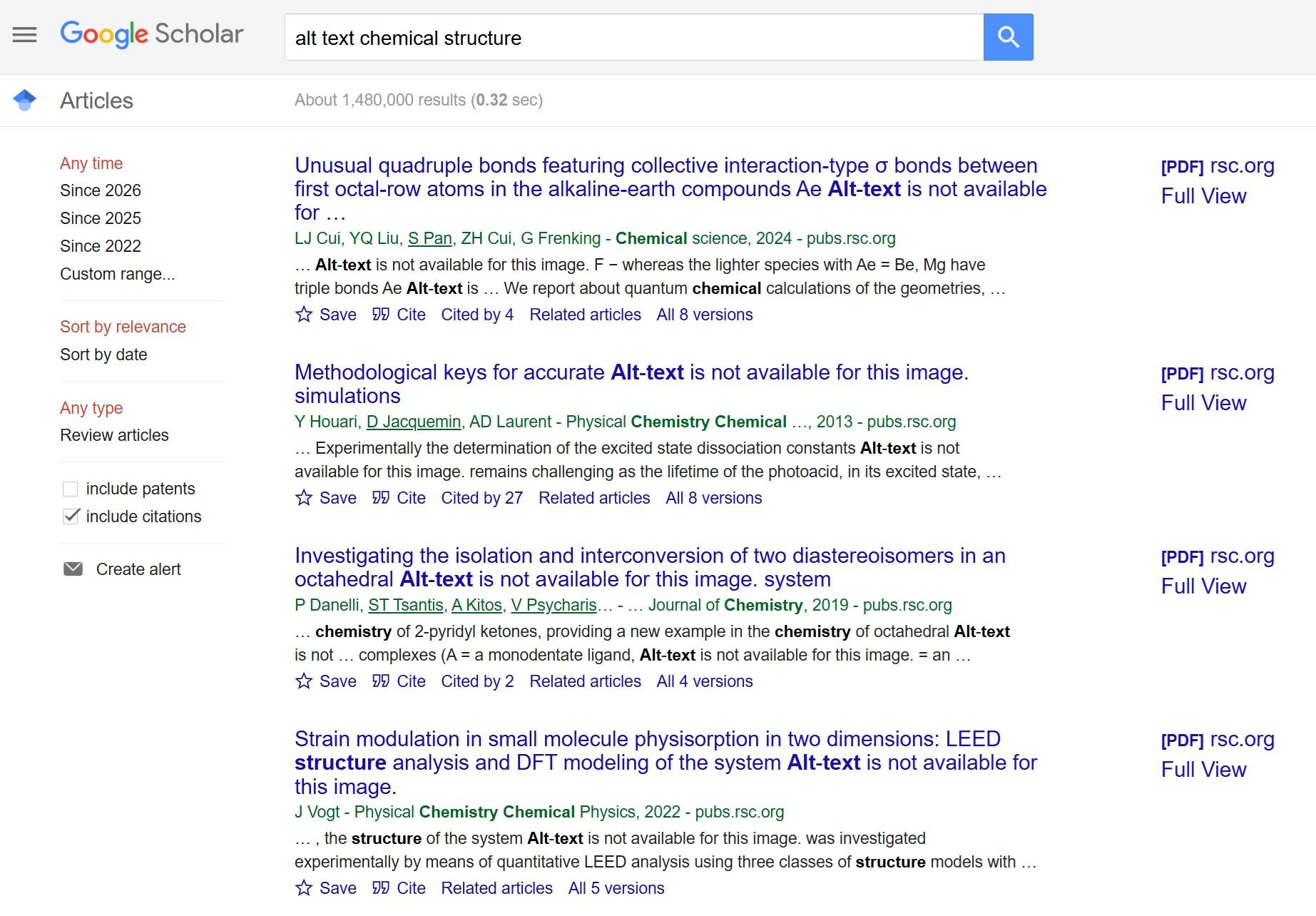
I'm trying to find guidelines for writing alt text for chemical structures and the Google Scholar search for "alt text chemical structure" is embarassingly bad.
-
Anyway, if you are aware of guidelines for writing good alt text for chemistry structure images (think organic chemistry with all of the chains and rings), let me know! #accessibility #a11y
@briney not chemistry specifically, but I have found this guide to be really helpful for writing alt-text (or creating alternative files that are text only) for many different complex image types: http://diagramcenter.org/table-of-contents-2.html
-
@carolski Thanks for the link. I will be sure to check out his work. And I'm glad you worked with someone to create good alt text! There is sadly a lack of awareness of accessibility issues in a lot of science.
@briney It was really fun! And during a very early time in the pandemic, it was something I could do that didn’t require me leaving home. I felt lucky to have the chance to do it.
-
@briney It was really fun! And during a very early time in the pandemic, it was something I could do that didn’t require me leaving home. I felt lucky to have the chance to do it.
@carolski Writing a book is a big project but rewarding!
I'm actually writing a book on scientific data sharing and trying to include some accessibility principles in the book, hence the alt text question.
-
@briney not chemistry specifically, but I have found this guide to be really helpful for writing alt-text (or creating alternative files that are text only) for many different complex image types: http://diagramcenter.org/table-of-contents-2.html
@ardeninred I love this resource but I'm a bit disappointed that the only chemistry content they describe is the chemical element.
-
Anyway, if you are aware of guidelines for writing good alt text for chemistry structure images (think organic chemistry with all of the chains and rings), let me know! #accessibility #a11y
@briney I honestly thought there'd be some good guidelines out there, but I'm coming up with nothing useful from ACS (American Chemical Society) or RSC (Royal Society of Chemistry).
Julia Winter's company (Alchemie) is working on some sort of algorithmic alt-text generation. You can read some of the basic ideas here: https://pubs.acs.org/jceda8/article/101/7/2880/156131/The-Lewis-Structure-Explorer-Accessible-by-Design and more https://www.linkedin.com/pulse/accessibility-crisis-organic-chemistry-what-instructors-really-mc47c/ and a commercial product: https://www.alchem.ie/piph
ACS has a committee that I would have thought would have guidance (https://www.acs.org/about/governance/committees/chemists-with-disabilities.html) but all I could find was "Complex graphics and some other sections of online material may still require the use of a human reader or sufficiently written alt-text to be fully accessible to individuals with visual disabilities. This is due in part to the fact
that no standard requirements for figure creation and alt-text to describe figures are in place for most online publications.”Hey - if you find something good out there, please share!

-
@briney I honestly thought there'd be some good guidelines out there, but I'm coming up with nothing useful from ACS (American Chemical Society) or RSC (Royal Society of Chemistry).
Julia Winter's company (Alchemie) is working on some sort of algorithmic alt-text generation. You can read some of the basic ideas here: https://pubs.acs.org/jceda8/article/101/7/2880/156131/The-Lewis-Structure-Explorer-Accessible-by-Design and more https://www.linkedin.com/pulse/accessibility-crisis-organic-chemistry-what-instructors-really-mc47c/ and a commercial product: https://www.alchem.ie/piph
ACS has a committee that I would have thought would have guidance (https://www.acs.org/about/governance/committees/chemists-with-disabilities.html) but all I could find was "Complex graphics and some other sections of online material may still require the use of a human reader or sufficiently written alt-text to be fully accessible to individuals with visual disabilities. This is due in part to the fact
that no standard requirements for figure creation and alt-text to describe figures are in place for most online publications.”Hey - if you find something good out there, please share!
@QuantumDot2 thanks for sharing what you found. I too am suprised that there’s nothing from ASC or RSC. With the new U.S. accessibility rules going into effect next year, I really hope someone is working on this!
-
@briney I honestly thought there'd be some good guidelines out there, but I'm coming up with nothing useful from ACS (American Chemical Society) or RSC (Royal Society of Chemistry).
Julia Winter's company (Alchemie) is working on some sort of algorithmic alt-text generation. You can read some of the basic ideas here: https://pubs.acs.org/jceda8/article/101/7/2880/156131/The-Lewis-Structure-Explorer-Accessible-by-Design and more https://www.linkedin.com/pulse/accessibility-crisis-organic-chemistry-what-instructors-really-mc47c/ and a commercial product: https://www.alchem.ie/piph
ACS has a committee that I would have thought would have guidance (https://www.acs.org/about/governance/committees/chemists-with-disabilities.html) but all I could find was "Complex graphics and some other sections of online material may still require the use of a human reader or sufficiently written alt-text to be fully accessible to individuals with visual disabilities. This is due in part to the fact
that no standard requirements for figure creation and alt-text to describe figures are in place for most online publications.”Hey - if you find something good out there, please share!
@QuantumDot2 @briney @belehaa @carolski I found a handful of things (including that same ACS not particularly helpful guidance) last time I looked
limited help, but maybe something to start with (Lewis structures aren't really on the scale of what you want to describe): https://pubs.acs.org/jceda8/article/101/7/2880/156131/The-Lewis-Structure-Explorer-Accessible-by-Design
and this from libretexts for designing coursework: https://commons.libretexts.org/insight/organic-chemistry-accessibility
I think there are arguments to be made for InChI keys rather than (or in addition to) SMILES for things that have ambiguous SMILES, but I think libretexts is probably on the right track
-
@bnut thank you so much for sharing the resource and your experience. This is really helpful, especially to know these strategies have been used in the classroom.
-
@QuantumDot2 @briney @belehaa @carolski I found a handful of things (including that same ACS not particularly helpful guidance) last time I looked
limited help, but maybe something to start with (Lewis structures aren't really on the scale of what you want to describe): https://pubs.acs.org/jceda8/article/101/7/2880/156131/The-Lewis-Structure-Explorer-Accessible-by-Design
and this from libretexts for designing coursework: https://commons.libretexts.org/insight/organic-chemistry-accessibility
I think there are arguments to be made for InChI keys rather than (or in addition to) SMILES for things that have ambiguous SMILES, but I think libretexts is probably on the right track
@SRLevine @QuantumDot2 @belehaa @carolski oooh thanks. I have a feeling like guidance is going to be scattered across a bunch of different resources like this.
-
I'm trying to find guidelines for writing alt text for chemical structures and the Google Scholar search for "alt text chemical structure" is embarassingly bad. The top 9 results show up because of the text: "alt text is not available for this image," which is just layers of awful. #accessibility #a11y
One thing I get hung up on about this is that a systematic IUPAC name for any structure, in principal, should describe a structure fully.
This is a level of completeness that very few visual depictions of any kind have available, even if only in principle.
But as most of us who've worked with these things understand, that's cold comfort, because it transmutes the problem into one of being able to read and understand those names, which can contain highly nested components, punctuation, Greek letters, italics, and so on.
These are almost certainly very unhelpful when passed through a screen reader, for instance.
There's a reason we use diagrams so much!
-
 F folfdk@helvede.net shared this topic