The German state election yesterday is a perfect demonstration of why Proportional Representation (PR) is far superior for democracy than First Past the Post (FPTP).
-
The German state election yesterday is a perfect demonstration of why Proportional Representation (PR) is far superior for democracy than First Past the Post (FPTP).
TLDR: Thanks to Proportionality, the AfD only won a minority, not majority parliament because the state parliament always reflects the popular vote.
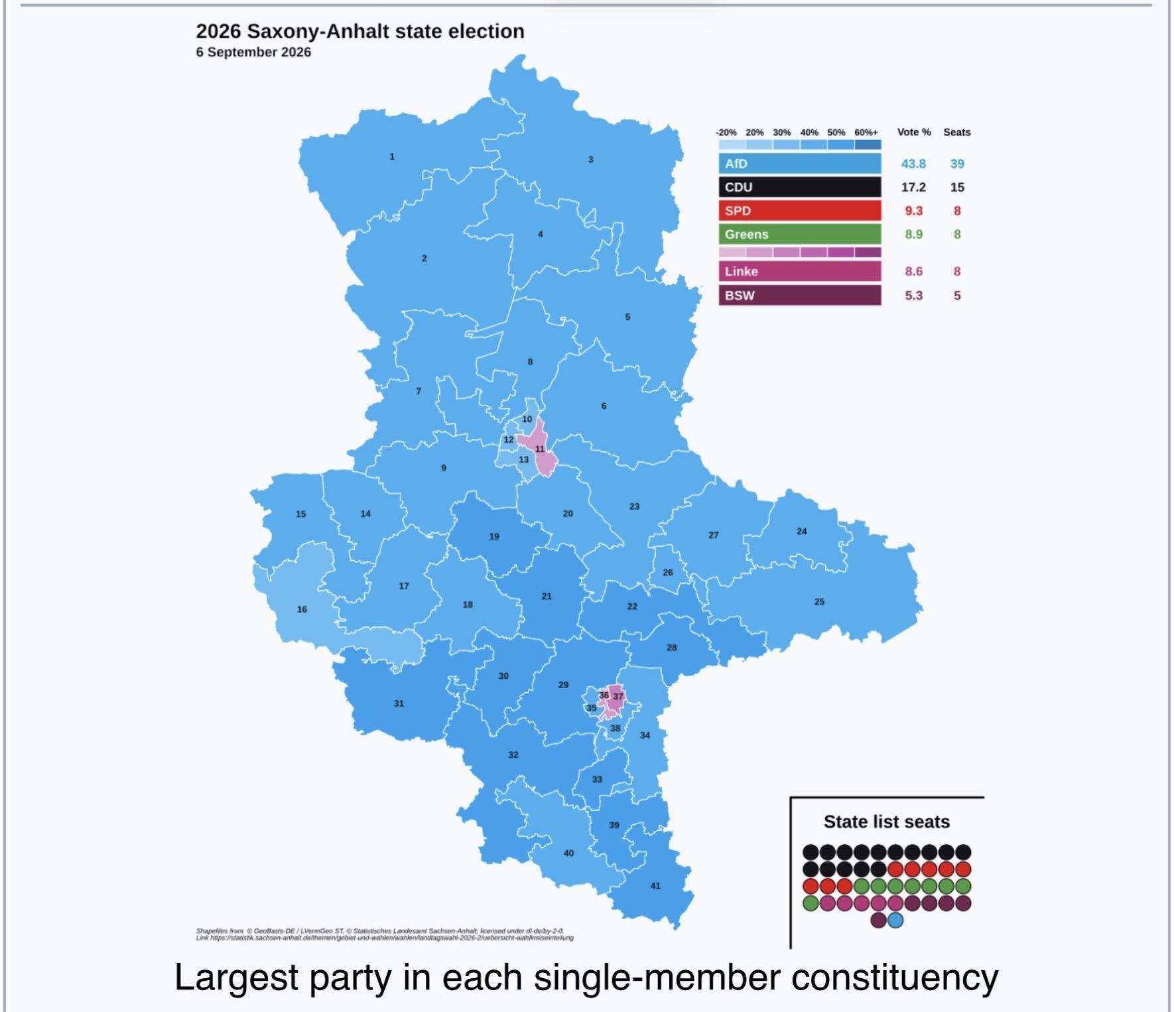
The picture shows the state of Saxony-Anhalt divided into its electoral districts. It is almost all blue because the AfD won the most votes in all but three districts but with 42% of the popular vote overall.
Had this been a province in Canada, it would have produced a legislature with just 3 opposition members, and all the rest government members. Delivering absolute majority power with no meaningful voice for any other party (likely also losing official party status and key funding for political activities) despite a significant share of the popular vote. This has happened in Canada many times, including in BC in 2001 when the NDP won just 2 seats with all 77 others going to the B.C. Liberals… it led to a referendum on PR that won over 60% of the vote but was never implemented.
Had this German state used FPTP they would have a gigantic majority of exclusively far right members and just 3 opposition.
Thanks to PR, their legislature will actually reflect the vote of the people.
42% AfD (39 seats)
17% CDU (15)
9% SPD (8)
8% GRN (8)
8% LNK (8)
5% BSW (5)83 seats: 42 needed for majority.
AfD: 39
Other parties: 44In B.C., one of the tropes the status quo campaigners constantly bring up is that PR somehow enables extreme parties more than FPTP and is thus dangerous. This has been proven false over and over including right now,
Here we are, with another example as this German state breathes a sigh of relief that PR saved them from a whollly undemocratic and extreme outcome.
Meanwhile, back in B.C., our own now far right BC Conservatives have successfully splintered the “big tent” remnants of the old slightly more centrist B.C. Liberals leading to a mish mash of independents and new parties in the B.C. Legislature that have not been elected by the people and are unable to really function as a proper opposition to the majority government. FPTP doing a great job! *sarc
Why doesn’t Canada have *any* proportional elections?
Inertia, greed, and power.
Germany 2026 state election: https://en.wikipedia.org/wiki/2026_Saxony-Anhalt_state_election
BC 2001 provincial election: https://en.wikipedia.org/wiki/2001_British_Columbia_general_election
note: This German state uses a system where people cast two votes, one for a representative and one for a party list. It is called the Hare/Niemeyer method, a form of Multi Member Proportionality. The system proposed for B.C. in 2003 by a citizen’s assembly was called BC STV, a system designed to manage the vast areas and pockets of population in our province. Indeed, another advantage of PR is you can design a system that suits the need and circumstances of a region and it’s people. It’s not just one-size-fits-all.
@chris we are not as enthousiastic, since AfD will have the majority. First because the BSW promised support, this is yet enough. Then you will see members of CDU moving to AfD, the rats are fleeing the sinking ship.
-
And just to underline the point of betrayal of democratic promises. Here is the seminal tweet from September 21, 2015 just before that year's Canadian Federal Election where the eventual winner, Justin Trudeau and the Liberal Party of Canada, promises to abolish FPTP.
He did not.
(i love that X pulled up the current Liberal Party preview card, appropriately associating both the former and current Liberal party leaders with this betrayal. Democracy denied.)
#canpoli #cdnpoli
#democracy #fptp #pr #germany #canada #bcpoli@chris was disappointed too, but GPC and NDP (from what I recall) were demanding PR. Felt like give an inch they take a mile. Without GPC and NDP agreeing not to make perfect the enemy of better I don’t see why LPC would even try. (This was the first time as a GPC member I became aware that the party was insistent on PR and not any other alternative.)
Please correct me if I am not recalling the situation correctly.
-
@chris Whatever optimism I had after Trudeau was elected died after he and Monsef fumbled that entire consultation and end result so badly and cynically.
@cjgyt and he quickly shoved her under the bus….
-
@chris we are not as enthousiastic, since AfD will have the majority. First because the BSW promised support, this is yet enough. Then you will see members of CDU moving to AfD, the rats are fleeing the sinking ship.
@Tabby_Schaf that is very bad news

-
@chris was disappointed too, but GPC and NDP (from what I recall) were demanding PR. Felt like give an inch they take a mile. Without GPC and NDP agreeing not to make perfect the enemy of better I don’t see why LPC would even try. (This was the first time as a GPC member I became aware that the party was insistent on PR and not any other alternative.)
Please correct me if I am not recalling the situation correctly.
@gordonmcdowell the main parties (including the NDP) are completely beholden to the status quo because they think it is the only way to hold majority power. The GPC is the only one to consistently advocate for PR but even they in BC acquiesced to the NDP… just doing a study instead of any kind of real change. Federally @avilewis might have the willpower to promise and move forward, but I am left cynical by past experience
-
@gordonmcdowell the main parties (including the NDP) are completely beholden to the status quo because they think it is the only way to hold majority power. The GPC is the only one to consistently advocate for PR but even they in BC acquiesced to the NDP… just doing a study instead of any kind of real change. Federally @avilewis might have the willpower to promise and move forward, but I am left cynical by past experience
@chris @gordonmcdowell @avilewis I actually think the perfect being the enemy of the good bit them here too. NDP and Greens both wanted PR, which is great, except if you can't get it passed. Ranked choice voting would be better than FPTP but neither NDP or Greens would support it in committee so it failed to make any headway.
Edit: I'm not saying the Liberals were correct to do what they did and abandon the process entirely, however they are are not solely to blame and there is an element in some progressive circles that insists upon instant perfection rather than incremental progress. There is a whole debate around incrementalism but let's not get into that now. When you have something that is better, even by a small amount, it is preferable to sticking with the status quo.
-
@cjgyt and he quickly shoved her under the bus….
@chris I wasn’t able to attend the consultation session she led here, but from what I heard it may be safe to assume that she was picked specifically because she would easily fit under the bus. From what I recall, it was clear the process was going to fail from how she was handling it. But that may have been the direction all along.
-
@chris @gordonmcdowell @avilewis I actually think the perfect being the enemy of the good bit them here too. NDP and Greens both wanted PR, which is great, except if you can't get it passed. Ranked choice voting would be better than FPTP but neither NDP or Greens would support it in committee so it failed to make any headway.
Edit: I'm not saying the Liberals were correct to do what they did and abandon the process entirely, however they are are not solely to blame and there is an element in some progressive circles that insists upon instant perfection rather than incremental progress. There is a whole debate around incrementalism but let's not get into that now. When you have something that is better, even by a small amount, it is preferable to sticking with the status quo.
@amonduin @gordonmcdowell @avilewis ranked choice voting often makes FPTP worse. PR is the solution.
-
The German state election yesterday is a perfect demonstration of why Proportional Representation (PR) is far superior for democracy than First Past the Post (FPTP).
TLDR: Thanks to Proportionality, the AfD only won a minority, not majority parliament because the state parliament always reflects the popular vote.
The picture shows the state of Saxony-Anhalt divided into its electoral districts. It is almost all blue because the AfD won the most votes in all but three districts but with 42% of the popular vote overall.
Had this been a province in Canada, it would have produced a legislature with just 3 opposition members, and all the rest government members. Delivering absolute majority power with no meaningful voice for any other party (likely also losing official party status and key funding for political activities) despite a significant share of the popular vote. This has happened in Canada many times, including in BC in 2001 when the NDP won just 2 seats with all 77 others going to the B.C. Liberals… it led to a referendum on PR that won over 60% of the vote but was never implemented.
Had this German state used FPTP they would have a gigantic majority of exclusively far right members and just 3 opposition.
Thanks to PR, their legislature will actually reflect the vote of the people.
42% AfD (39 seats)
17% CDU (15)
9% SPD (8)
8% GRN (8)
8% LNK (8)
5% BSW (5)83 seats: 42 needed for majority.
AfD: 39
Other parties: 44In B.C., one of the tropes the status quo campaigners constantly bring up is that PR somehow enables extreme parties more than FPTP and is thus dangerous. This has been proven false over and over including right now,
Here we are, with another example as this German state breathes a sigh of relief that PR saved them from a whollly undemocratic and extreme outcome.
Meanwhile, back in B.C., our own now far right BC Conservatives have successfully splintered the “big tent” remnants of the old slightly more centrist B.C. Liberals leading to a mish mash of independents and new parties in the B.C. Legislature that have not been elected by the people and are unable to really function as a proper opposition to the majority government. FPTP doing a great job! *sarc
Why doesn’t Canada have *any* proportional elections?
Inertia, greed, and power.
Germany 2026 state election: https://en.wikipedia.org/wiki/2026_Saxony-Anhalt_state_election
BC 2001 provincial election: https://en.wikipedia.org/wiki/2001_British_Columbia_general_election
note: This German state uses a system where people cast two votes, one for a representative and one for a party list. It is called the Hare/Niemeyer method, a form of Multi Member Proportionality. The system proposed for B.C. in 2003 by a citizen’s assembly was called BC STV, a system designed to manage the vast areas and pockets of population in our province. Indeed, another advantage of PR is you can design a system that suits the need and circumstances of a region and it’s people. It’s not just one-size-fits-all.
@chris RIGHT.
So in Ireland we have PR and have had for decades.
During the EU elections we had the rest of the EU pissing and moaning that our system took far too long.
Smug Germans in particular tapped their watches and made patronising remarks.
And then they go an install the Nazis again.
Germany has no credibly anymore.
-
The German state election yesterday is a perfect demonstration of why Proportional Representation (PR) is far superior for democracy than First Past the Post (FPTP).
TLDR: Thanks to Proportionality, the AfD only won a minority, not majority parliament because the state parliament always reflects the popular vote.
The picture shows the state of Saxony-Anhalt divided into its electoral districts. It is almost all blue because the AfD won the most votes in all but three districts but with 42% of the popular vote overall.
Had this been a province in Canada, it would have produced a legislature with just 3 opposition members, and all the rest government members. Delivering absolute majority power with no meaningful voice for any other party (likely also losing official party status and key funding for political activities) despite a significant share of the popular vote. This has happened in Canada many times, including in BC in 2001 when the NDP won just 2 seats with all 77 others going to the B.C. Liberals… it led to a referendum on PR that won over 60% of the vote but was never implemented.
Had this German state used FPTP they would have a gigantic majority of exclusively far right members and just 3 opposition.
Thanks to PR, their legislature will actually reflect the vote of the people.
42% AfD (39 seats)
17% CDU (15)
9% SPD (8)
8% GRN (8)
8% LNK (8)
5% BSW (5)83 seats: 42 needed for majority.
AfD: 39
Other parties: 44In B.C., one of the tropes the status quo campaigners constantly bring up is that PR somehow enables extreme parties more than FPTP and is thus dangerous. This has been proven false over and over including right now,
Here we are, with another example as this German state breathes a sigh of relief that PR saved them from a whollly undemocratic and extreme outcome.
Meanwhile, back in B.C., our own now far right BC Conservatives have successfully splintered the “big tent” remnants of the old slightly more centrist B.C. Liberals leading to a mish mash of independents and new parties in the B.C. Legislature that have not been elected by the people and are unable to really function as a proper opposition to the majority government. FPTP doing a great job! *sarc
Why doesn’t Canada have *any* proportional elections?
Inertia, greed, and power.
Germany 2026 state election: https://en.wikipedia.org/wiki/2026_Saxony-Anhalt_state_election
BC 2001 provincial election: https://en.wikipedia.org/wiki/2001_British_Columbia_general_election
note: This German state uses a system where people cast two votes, one for a representative and one for a party list. It is called the Hare/Niemeyer method, a form of Multi Member Proportionality. The system proposed for B.C. in 2003 by a citizen’s assembly was called BC STV, a system designed to manage the vast areas and pockets of population in our province. Indeed, another advantage of PR is you can design a system that suits the need and circumstances of a region and it’s people. It’s not just one-size-fits-all.
@chris Germany saw what happened to Hungary under Orban, yet, they vote in the same type of assholes. I would have really hoped humanity would have evolved beyond Hittler.
-
The German state election yesterday is a perfect demonstration of why Proportional Representation (PR) is far superior for democracy than First Past the Post (FPTP).
TLDR: Thanks to Proportionality, the AfD only won a minority, not majority parliament because the state parliament always reflects the popular vote.
The picture shows the state of Saxony-Anhalt divided into its electoral districts. It is almost all blue because the AfD won the most votes in all but three districts but with 42% of the popular vote overall.
Had this been a province in Canada, it would have produced a legislature with just 3 opposition members, and all the rest government members. Delivering absolute majority power with no meaningful voice for any other party (likely also losing official party status and key funding for political activities) despite a significant share of the popular vote. This has happened in Canada many times, including in BC in 2001 when the NDP won just 2 seats with all 77 others going to the B.C. Liberals… it led to a referendum on PR that won over 60% of the vote but was never implemented.
Had this German state used FPTP they would have a gigantic majority of exclusively far right members and just 3 opposition.
Thanks to PR, their legislature will actually reflect the vote of the people.
42% AfD (39 seats)
17% CDU (15)
9% SPD (8)
8% GRN (8)
8% LNK (8)
5% BSW (5)83 seats: 42 needed for majority.
AfD: 39
Other parties: 44In B.C., one of the tropes the status quo campaigners constantly bring up is that PR somehow enables extreme parties more than FPTP and is thus dangerous. This has been proven false over and over including right now,
Here we are, with another example as this German state breathes a sigh of relief that PR saved them from a whollly undemocratic and extreme outcome.
Meanwhile, back in B.C., our own now far right BC Conservatives have successfully splintered the “big tent” remnants of the old slightly more centrist B.C. Liberals leading to a mish mash of independents and new parties in the B.C. Legislature that have not been elected by the people and are unable to really function as a proper opposition to the majority government. FPTP doing a great job! *sarc
Why doesn’t Canada have *any* proportional elections?
Inertia, greed, and power.
Germany 2026 state election: https://en.wikipedia.org/wiki/2026_Saxony-Anhalt_state_election
BC 2001 provincial election: https://en.wikipedia.org/wiki/2001_British_Columbia_general_election
note: This German state uses a system where people cast two votes, one for a representative and one for a party list. It is called the Hare/Niemeyer method, a form of Multi Member Proportionality. The system proposed for B.C. in 2003 by a citizen’s assembly was called BC STV, a system designed to manage the vast areas and pockets of population in our province. Indeed, another advantage of PR is you can design a system that suits the need and circumstances of a region and it’s people. It’s not just one-size-fits-all.
-
The German state election yesterday is a perfect demonstration of why Proportional Representation (PR) is far superior for democracy than First Past the Post (FPTP).
TLDR: Thanks to Proportionality, the AfD only won a minority, not majority parliament because the state parliament always reflects the popular vote.
The picture shows the state of Saxony-Anhalt divided into its electoral districts. It is almost all blue because the AfD won the most votes in all but three districts but with 42% of the popular vote overall.
Had this been a province in Canada, it would have produced a legislature with just 3 opposition members, and all the rest government members. Delivering absolute majority power with no meaningful voice for any other party (likely also losing official party status and key funding for political activities) despite a significant share of the popular vote. This has happened in Canada many times, including in BC in 2001 when the NDP won just 2 seats with all 77 others going to the B.C. Liberals… it led to a referendum on PR that won over 60% of the vote but was never implemented.
Had this German state used FPTP they would have a gigantic majority of exclusively far right members and just 3 opposition.
Thanks to PR, their legislature will actually reflect the vote of the people.
42% AfD (39 seats)
17% CDU (15)
9% SPD (8)
8% GRN (8)
8% LNK (8)
5% BSW (5)83 seats: 42 needed for majority.
AfD: 39
Other parties: 44In B.C., one of the tropes the status quo campaigners constantly bring up is that PR somehow enables extreme parties more than FPTP and is thus dangerous. This has been proven false over and over including right now,
Here we are, with another example as this German state breathes a sigh of relief that PR saved them from a whollly undemocratic and extreme outcome.
Meanwhile, back in B.C., our own now far right BC Conservatives have successfully splintered the “big tent” remnants of the old slightly more centrist B.C. Liberals leading to a mish mash of independents and new parties in the B.C. Legislature that have not been elected by the people and are unable to really function as a proper opposition to the majority government. FPTP doing a great job! *sarc
Why doesn’t Canada have *any* proportional elections?
Inertia, greed, and power.
Germany 2026 state election: https://en.wikipedia.org/wiki/2026_Saxony-Anhalt_state_election
BC 2001 provincial election: https://en.wikipedia.org/wiki/2001_British_Columbia_general_election
note: This German state uses a system where people cast two votes, one for a representative and one for a party list. It is called the Hare/Niemeyer method, a form of Multi Member Proportionality. The system proposed for B.C. in 2003 by a citizen’s assembly was called BC STV, a system designed to manage the vast areas and pockets of population in our province. Indeed, another advantage of PR is you can design a system that suits the need and circumstances of a region and it’s people. It’s not just one-size-fits-all.
@chris Mind, though, that Sachsen-Anhalt still does proportionality via hangover mandates, which have the curious quirk of making the number of seats slightly unpredictable.
This technique used to be kind of common in Germany, but it's nowadays on its way out. The federal elections abolished it starting with the last cycle, IIRC.
Importantly, there's other ways to do proportionality, such as d'Hondt coefficients (and the system's modifications). By a curious history tidbit, Thomas Jefferson is known to have dabbled in something mathematically very close if not equivalent to d'Hondt's work well before him, but for some reason, seems to have never proposed it to be used in USA, giving rise to generations and generations of gerrymandering.
-
 T tofticles@helvede.net shared this topic