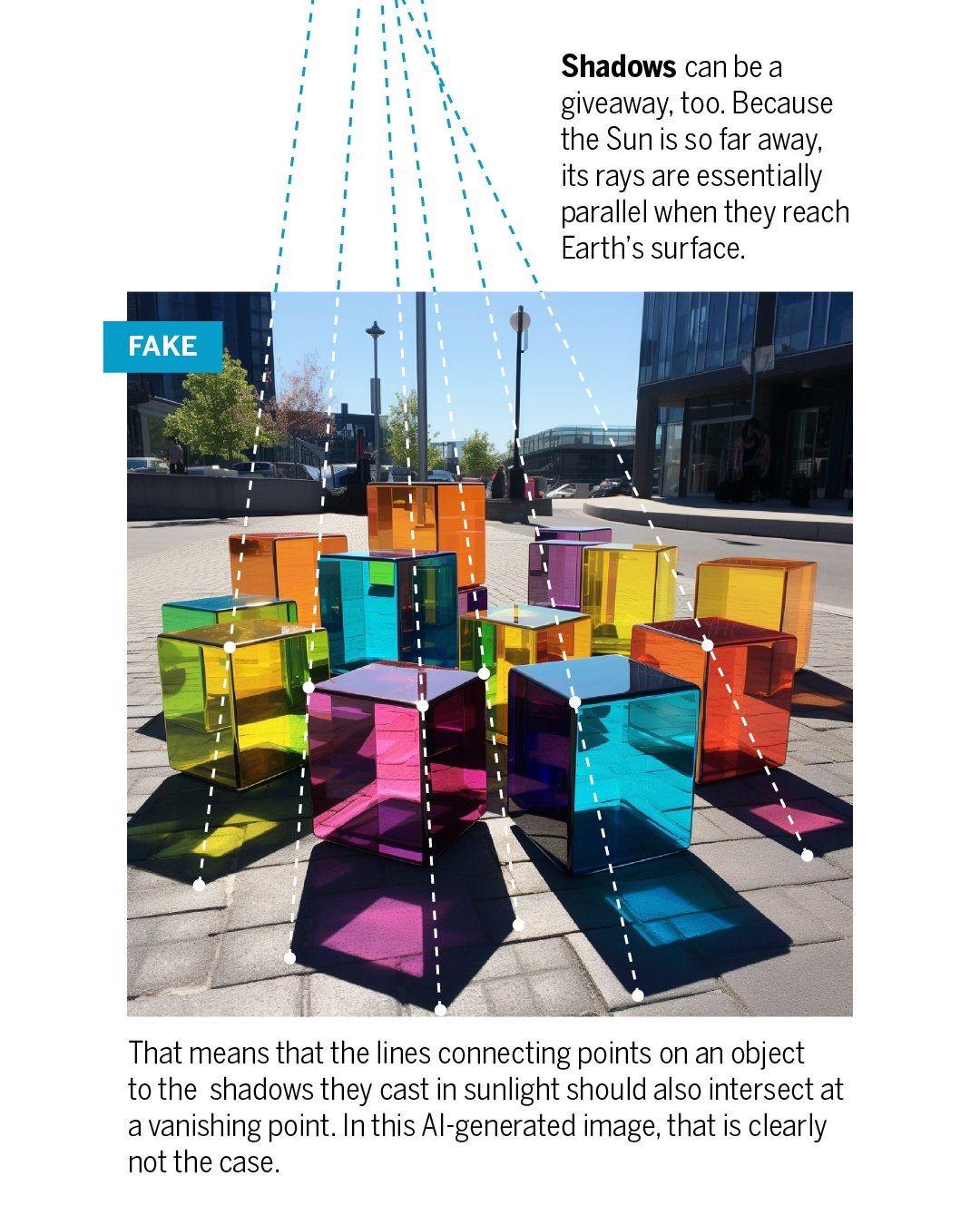
#Deepfakes are everywhere, but #DigitalForensics investigators are fighting back:
-
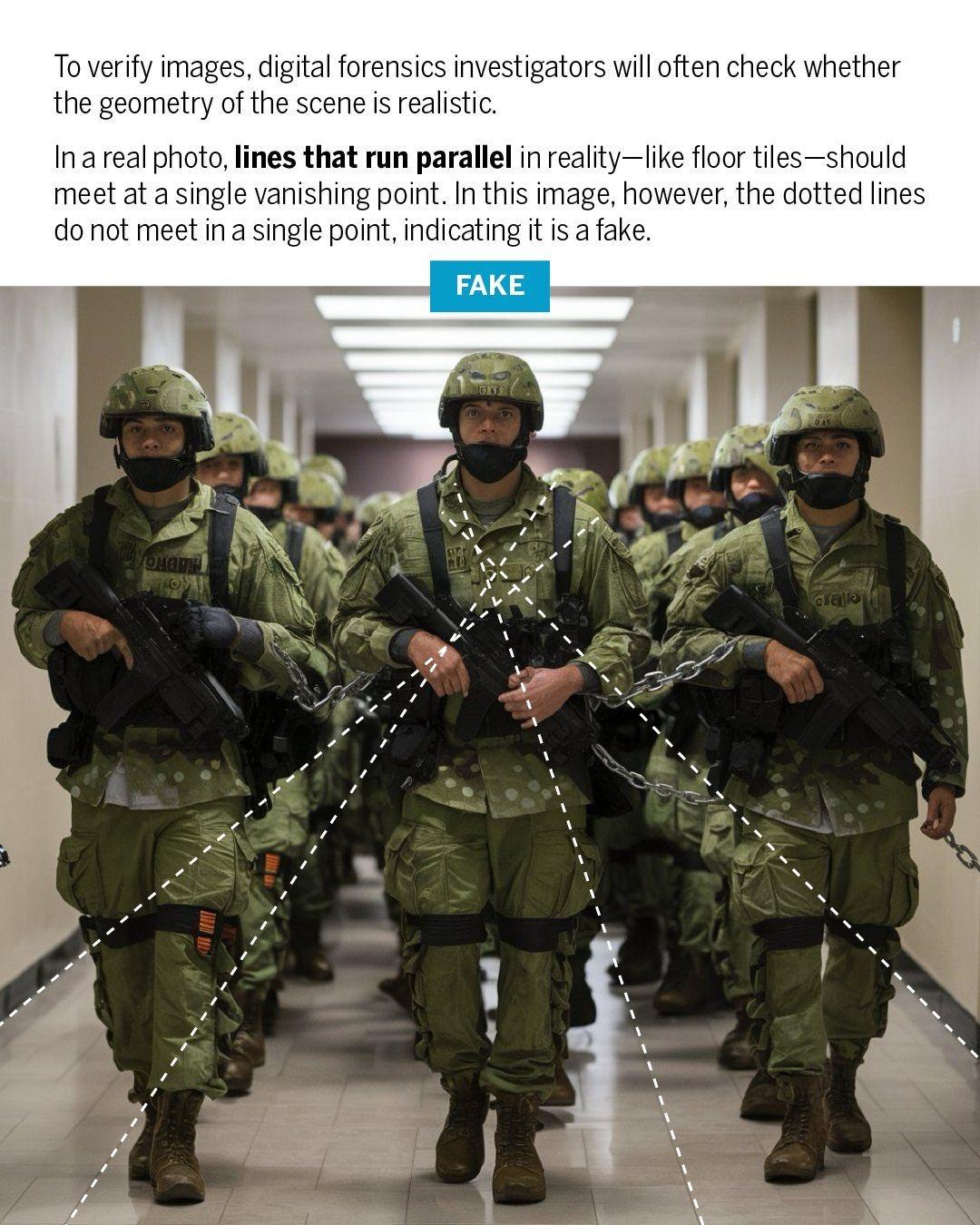
@f4grx @mansr @nCrazed @FabMusacchio I tried it on two random hallway images from Kagi Search and it worked great. I think most lens distortions are nonlinear, so the problem is rather that the lines are not straight than that they won't meet.
@leah @mansr @nCrazed @FabMusacchio How do you model the curvatures of these non straight lines so you can be sure that they all meet at the same point?

-
@leah @mansr @nCrazed @FabMusacchio How do you model the curvatures of these non straight lines so you can be sure that they all meet at the same point?
@f4grx @mansr @nCrazed @FabMusacchio I didn't need to, since the lines were straight I assumed lens correction was already done or not necessary.
-
#Deepfakes are everywhere, but #DigitalForensics investigators are fighting back:
@FabMusacchio @Jenetrix I feel like I'm in a Realism 101 illustration class

-
@leah @f4grx @FabMusacchio yeah, I think that's a fair criticism
@nCrazed @leah @f4grx @FabMusacchio Sunrays are quasi-parallel in the 3rd dimension, however they all diverge from the sun when projected on a surface such as a camera sensor or our retina. What difference does it make if the trick works with lamps too ? The sun is just a big, faraway lamp, and the rules of convergence in 2d spaces apply just the same for all 1d-ish lightsources.
The trick works if you don't mind for lens distortion, which are really minor on most smartphone cameras nowadays (do not mess lens distortion with surface distortion caused by planar projection on sensors, the latter doesn't affect convergence even though it can exxagerate surfaces on the sides of the pic).
-
@f4grx @mansr @nCrazed @FabMusacchio I didn't need to, since the lines were straight I assumed lens correction was already done or not necessary.
@leah agreed, I just wished the technique they described came with that as a warning, because the (obviously generated, "read" the uniform patches) hallway picture shown would be a *prime* candidate for taking with a fisheye lens or a similarly distorting lens; and the piece of flooring used to extrapolate the straight lines is already honestly too short in the example to be sure. I cannot, over the length of maybe 50px, draw a 1000px line with < 1° error.
-
@leah agreed, I just wished the technique they described came with that as a warning, because the (obviously generated, "read" the uniform patches) hallway picture shown would be a *prime* candidate for taking with a fisheye lens or a similarly distorting lens; and the piece of flooring used to extrapolate the straight lines is already honestly too short in the example to be sure. I cannot, over the length of maybe 50px, draw a 1000px line with < 1° error.
@leah (and of course, a photojournalist in a government building is more likely to have a "low distortion as possible" lens equipped than a fishlens, but if you're preparing for e.g. reporting from a small, crowded room and want to get as many interacting politicians into the picture as possible, you'd not go in there with a superzoom lens alone. And if a picture is claimed to be from a publicity shot, the photographer certainly will pick from a wide range)
-
@nCrazed @leah @f4grx @FabMusacchio Sunrays are quasi-parallel in the 3rd dimension, however they all diverge from the sun when projected on a surface such as a camera sensor or our retina. What difference does it make if the trick works with lamps too ? The sun is just a big, faraway lamp, and the rules of convergence in 2d spaces apply just the same for all 1d-ish lightsources.
The trick works if you don't mind for lens distortion, which are really minor on most smartphone cameras nowadays (do not mess lens distortion with surface distortion caused by planar projection on sensors, the latter doesn't affect convergence even though it can exxagerate surfaces on the sides of the pic).
@songxisto @nCrazed @f4grx @FabMusacchio Assume a solid cube on a plane, and only parallel, ambient light hits it from an angle. if you connect the cube corners with the three visible shadow-corners, the lines are parallel as well and won't intersect. am i wrong?
-
@songxisto @nCrazed @f4grx @FabMusacchio Assume a solid cube on a plane, and only parallel, ambient light hits it from an angle. if you connect the cube corners with the three visible shadow-corners, the lines are parallel as well and won't intersect. am i wrong?
@leah @nCrazed @f4grx @FabMusacchio You are right if the image is itself a parallel projection, but the images from cameras are perspectives, where parallel rays/lines in 3d always converge somewhere (except rays/lines parallel to the sensor).
-
#Deepfakes are everywhere, but #DigitalForensics investigators are fighting back:
@FabMusacchio to be fair, the first one the perspective doesn't 100% mean it's fake. It could be that some builder somewhere did a shite job of the tiling.
-
@leah agreed, I just wished the technique they described came with that as a warning, because the (obviously generated, "read" the uniform patches) hallway picture shown would be a *prime* candidate for taking with a fisheye lens or a similarly distorting lens; and the piece of flooring used to extrapolate the straight lines is already honestly too short in the example to be sure. I cannot, over the length of maybe 50px, draw a 1000px line with < 1° error.
-
Ah bah voilà une super source d'exos d'optique géométrique

@AudeCaussarieu oh wow faut que je bosse avec des profs de maths pour faire des séances maths / éducation aux médias !
-
@leah @nCrazed @f4grx @FabMusacchio You are right if the image is itself a parallel projection, but the images from cameras are perspectives, where parallel rays/lines in 3d always converge somewhere (except rays/lines parallel to the sensor).
@songxisto @leah @nCrazed @FabMusacchio Yep. you can see the difference in freecad by switching between parallel projection and perspective.
-
#Deepfakes are everywhere, but #DigitalForensics investigators are fighting back:
@FabMusacchio thanks for reposting, these are great tips to help spot fakes:) it's getting incredibly hard, if not impossible lately: (
-
#Deepfakes are everywhere, but #DigitalForensics investigators are fighting back:
Ooooh - what I like about this is, unlike a lot of "here's how you spot this stuff" advice, these seem like maybe things AI-generated images will have a *very* hard time ever getting consistently right.
-
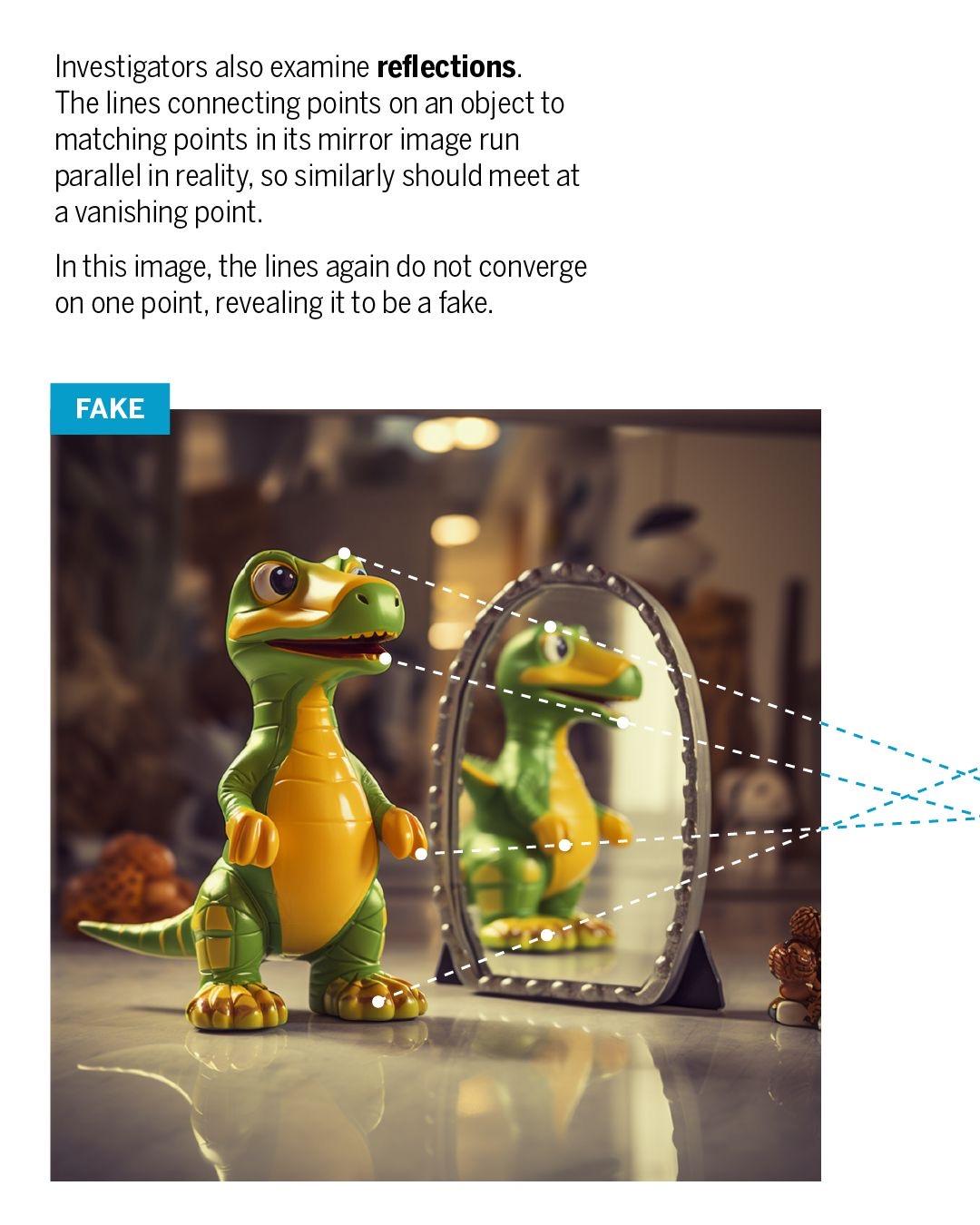
@FabMusacchio Great to have a sure way to prove things, but honestly, just zoom in on details see if they're coherent? In most if not any genai image? Not even talking about the dinausore/crocodile one because if you're under 50 you could tell in one blink
@Ragon2 @FabMusacchio I also get immediately suspicious if the image in the foreground is crystal clear, high definition, yet anything just slightly in the background is completely blurry (image 2).
Another tell is when I see people looking a little too uniform (soldier picture) and invariably all white. I'm also confused about all the chains they're wearing. Are they escorting themselves to a prison barracks? Except that one on the right with the chain trailing off screen. I assume he's taking his Labrador for a walk.
-
@AudeCaussarieu
J'aurais jamais pensé que les points de fuites pouvaient être une façon de vérifier la véracité d'une image. 🤯@mathieu_ @AudeCaussarieu
Je suis quand même un chouilla réservé sur la première photo. Ok, elle semble générée par IA, mais les lignes de fuite sur lesquelles l'analyse se base sont un peu courtes. Difficile d'extrapoler sur un petit segment qui n'est pas nécessairement représentatif ni exact.
La méthode est intéressante mais pas toujours applicable -
#Deepfakes are everywhere, but #DigitalForensics investigators are fighting back:
@FabMusacchio especially with the first image the building might be a bit crooked or the lines might just be a bit off. It's pretty close to having a vanishing point. It's even closer to having a vanishing point if you remove the wall line, that might not be perfectly parallel and look just at the tiles.
But yeah go to know about this technique anyway.
-
@FabMusacchio Great to have a sure way to prove things, but honestly, just zoom in on details see if they're coherent? In most if not any genai image? Not even talking about the dinausore/crocodile one because if you're under 50 you could tell in one blink
@Ragon2 @FabMusacchio they're just example pics. There's a lots of tells, but here they're just concentrating on the perspective lines for this part of the analysis. These are a lot more subtle and missed by folks, and can quickly reveal things in times where other tells are not available.
-
@FabMusacchio to be fair, the first one the perspective doesn't 100% mean it's fake. It could be that some builder somewhere did a shite job of the tiling.
As a photographer who is very fond of extremely wide angle lenses, I can tell you these tests will often fail on real images, as well. But the points made are valid...
-
#Deepfakes are everywhere, but #DigitalForensics investigators are fighting back:
@FabMusacchio defeated by simple trigonometry. nice.