That's no moon.
-
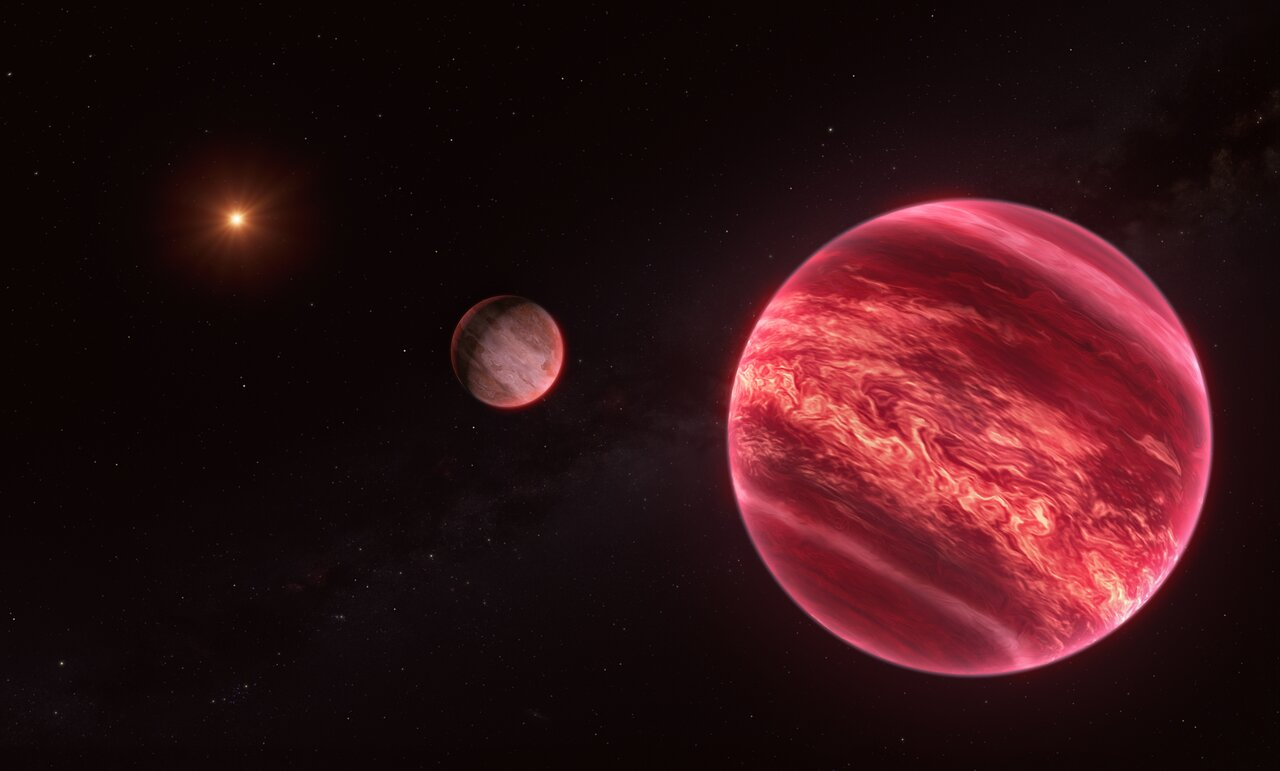
That's no moon. It's a...hang on, what should we call it?

Our VLT has revealed evidence for a moon-like object in the CD-35 2722 system. Yet this new ‘exomoon’ detection is challenging cosmic labels!
Illustration: ESO/M. Kornmesser
#astrodon #astronomy #astrophysics #space #science
1/4
-
That's no moon. It's a...hang on, what should we call it?
Our VLT has revealed evidence for a moon-like object in the CD-35 2722 system. Yet this new ‘exomoon’ detection is challenging cosmic labels!
Illustration: ESO/M. Kornmesser
#astrodon #astronomy #astrophysics #space #science
1/4
Unlike moons in our Solar System, this object — a gaseous body at least as massive as Jupiter — does not orbit a planet.
It circles a brown dwarf, that in turn orbits the CD-35 2722 star.
Regardless of what to call this object, this discovery may mark an important first.
2/4
-
Unlike moons in our Solar System, this object — a gaseous body at least as massive as Jupiter — does not orbit a planet.
It circles a brown dwarf, that in turn orbits the CD-35 2722 star.
Regardless of what to call this object, this discovery may mark an important first.
2/4
If confirmed, this could be the first ‘moon’ discovered outside our Solar System — something astronomers have been searching for years.
This animation shows how the gravitational pull of the ‘moon’ makes the brown dwarf wobble, shifting its spectrum and so enabling the detection

3/4
-
If confirmed, this could be the first ‘moon’ discovered outside our Solar System — something astronomers have been searching for years.
This animation shows how the gravitational pull of the ‘moon’ makes the brown dwarf wobble, shifting its spectrum and so enabling the detection
3/4
Read more in our press release: https://www.eso.org/public/news/eso2610/
Or if you prefer a video summary: https://www.youtube.com/watch?v=z9j_oUFddIY
4/4
-
Unlike moons in our Solar System, this object — a gaseous body at least as massive as Jupiter — does not orbit a planet.
It circles a brown dwarf, that in turn orbits the CD-35 2722 star.
Regardless of what to call this object, this discovery may mark an important first.
2/4
@esoastronomy The definition of moon feels like a wave function.
-
That's no moon. It's a...hang on, what should we call it?
Our VLT has revealed evidence for a moon-like object in the CD-35 2722 system. Yet this new ‘exomoon’ detection is challenging cosmic labels!
Illustration: ESO/M. Kornmesser
#astrodon #astronomy #astrophysics #space #science
1/4
@esoastronomy You nailed it. Death Star it is!
-
That's no moon. It's a...hang on, what should we call it?
Our VLT has revealed evidence for a moon-like object in the CD-35 2722 system. Yet this new ‘exomoon’ detection is challenging cosmic labels!
Illustration: ESO/M. Kornmesser
#astrodon #astronomy #astrophysics #space #science
1/4
@esoastronomy exosat

-
That's no moon. It's a...hang on, what should we call it?
Our VLT has revealed evidence for a moon-like object in the CD-35 2722 system. Yet this new ‘exomoon’ detection is challenging cosmic labels!
Illustration: ESO/M. Kornmesser
#astrodon #astronomy #astrophysics #space #science
1/4
@esoastronomy someone get David Kipping on the phone
-
@esoastronomy The definition of moon feels like a wave function.
@amoroso @esoastronomy . It’s a planet circling a dying star that happens to be getting pulled into another star. this feels more like a captured solar system degrading into its neighbor than a moon to me.
-
@amoroso @esoastronomy . It’s a planet circling a dying star that happens to be getting pulled into another star. this feels more like a captured solar system degrading into its neighbor than a moon to me.
@passwordsarehard4 Agreed.
-
That's no moon. It's a...hang on, what should we call it?
Our VLT has revealed evidence for a moon-like object in the CD-35 2722 system. Yet this new ‘exomoon’ detection is challenging cosmic labels!
Illustration: ESO/M. Kornmesser
#astrodon #astronomy #astrophysics #space #science
1/4
@esoastronomy satellite
-
@amoroso @esoastronomy . It’s a planet circling a dying star that happens to be getting pulled into another star. this feels more like a captured solar system degrading into its neighbor than a moon to me.
@passwordsarehard4 @amoroso Note that the intermediate object is not a dying star, it's a young brown dwarf – an object that never became a star. It's more massive than a planet but not massive enough to sustain nuclear fusion in a prolonged way.
-
@amoroso @esoastronomy . It’s a planet circling a dying star that happens to be getting pulled into another star. this feels more like a captured solar system degrading into its neighbor than a moon to me.
@passwordsarehard4 @amoroso @esoastronomy If it's pulled into another star, what's the state of that star? Sounds like a black hole or what happens when they collide?
-
That's no moon. It's a...hang on, what should we call it?
Our VLT has revealed evidence for a moon-like object in the CD-35 2722 system. Yet this new ‘exomoon’ detection is challenging cosmic labels!
Illustration: ESO/M. Kornmesser
#astrodon #astronomy #astrophysics #space #science
1/4
@esoastronomy
I wonder if this „moon“ has its own moons… -
 S simonjust@mstdn.dk shared this topic