An open letter to office suite users, just before the Euro-Office announcement
-
@karlggestd While that's true in general, do keep in mind that if you switch defaults to something that can have legal consequences, you're opening yourself up to A LOT of litigation.
For instance, you install something that changes the default to ODF, while OOXML is required to submit paperwork to an official entity like a court of law.
At this point, one of two things will happen:
1) User is tech-savvy enough to know how to change each new file to the format required, which is different than the previous default. User will then complain it's more difficult. Enough users complain, and suddenly there's an order to go back to MSOffice will come barreling down.
2) User doesn't know or care, it just knows they created the file as they always did, it got rejected by the court, and suddenly you're facing financial penalties or worse.
Don't get me wrong, ODF SHOULD be the default for official institutions. While it's not, changing the default is dangerous.
@nanianmichaels Maybe you should read the legal terms of any software out there, even the Microsoft software

Most of official entities are using PDF anyway (which adds its own set of problems) but when you have a policy of technological sovereignty things have to be part of it. How can we consider such a goal if the developers have already given up at the first hurdle?
About 2), those users will never trade their wonderful MS Office/365 for anything else.
-
@karlggestd While that's true in general, do keep in mind that if you switch defaults to something that can have legal consequences, you're opening yourself up to A LOT of litigation.
For instance, you install something that changes the default to ODF, while OOXML is required to submit paperwork to an official entity like a court of law.
At this point, one of two things will happen:
1) User is tech-savvy enough to know how to change each new file to the format required, which is different than the previous default. User will then complain it's more difficult. Enough users complain, and suddenly there's an order to go back to MSOffice will come barreling down.
2) User doesn't know or care, it just knows they created the file as they always did, it got rejected by the court, and suddenly you're facing financial penalties or worse.
Don't get me wrong, ODF SHOULD be the default for official institutions. While it's not, changing the default is dangerous.
@nanianmichaels in the other hand, I wouldn't say that OnlyOffice is dominating the market.
-
@nanianmichaels Maybe you should read the legal terms of any software out there, even the Microsoft software
Most of official entities are using PDF anyway (which adds its own set of problems) but when you have a policy of technological sovereignty things have to be part of it. How can we consider such a goal if the developers have already given up at the first hurdle?
About 2), those users will never trade their wonderful MS Office/365 for anything else.
-
The first FOSS suite was the own StarOffice, not OpenOffice.
And well, your png in that toot is horrible.
@karlggestd @libreoffice from https://en.wikipedia.org/wiki/StarOffice:
"5.2 was released 20 June 2000. Sun offered StarOffice 5.2 as a free download for personal use, and soon went through an exercise similar to Netscape's relicensing of Mozilla, by releasing most of the StarOffice source code under a free/open source license. The resultant free/open source software codebase fork continued development as older discontinued components, with contributions from both Sun and the wider OpenOffice.org community. Sun then took "snapshots" of the OpenOffice.org code base, integrated proprietary and third-party code modules, and marketed the package commercially. "
going from that info, StarOffice was not the 1st european FOSS office suite since only a part of the code/some components were open-sourced and the full suite was never released as FOSS at any point. OpenOffice.org was built from those parts, and expanded as fully FOSS to become the actual 1st european FOSS office suite.
-
An open letter to office suite users, just before the Euro-Office announcement
https://blog.documentfoundation.org/blog/2026/06/08/an-open-letter/
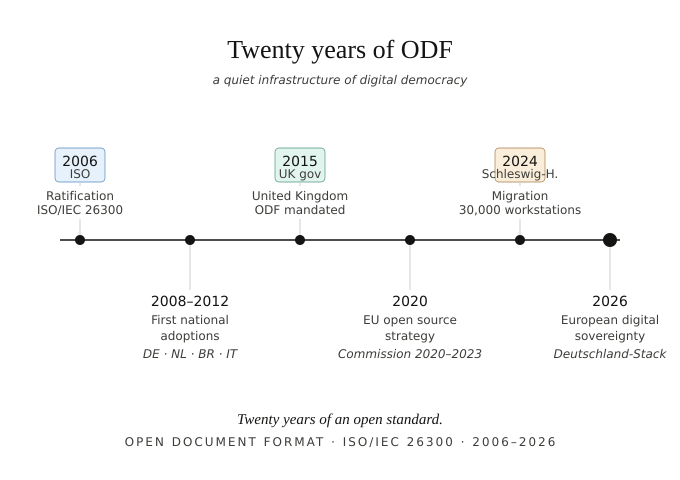
@libreoffice can you please add #AltText? I wrote one for you in the replies, here: https://gts.cairobraga.com/@cairobraga/statuses/01KTKE3QVMKBKZR7HYPTQ8TEFQ
-
@karlggestd @libreoffice from https://en.wikipedia.org/wiki/StarOffice:
"5.2 was released 20 June 2000. Sun offered StarOffice 5.2 as a free download for personal use, and soon went through an exercise similar to Netscape's relicensing of Mozilla, by releasing most of the StarOffice source code under a free/open source license. The resultant free/open source software codebase fork continued development as older discontinued components, with contributions from both Sun and the wider OpenOffice.org community. Sun then took "snapshots" of the OpenOffice.org code base, integrated proprietary and third-party code modules, and marketed the package commercially. "
going from that info, StarOffice was not the 1st european FOSS office suite since only a part of the code/some components were open-sourced and the full suite was never released as FOSS at any point. OpenOffice.org was built from those parts, and expanded as fully FOSS to become the actual 1st european FOSS office suite.
@cairobraga @libreoffice However meticulous you want to be, according to the section you linked, the suite included independent components that were not free software, but the suite itself was

You can say instead: "OpenOffice was the firs FOSS widely distributed suite".
-
@cairobraga @libreoffice However meticulous you want to be, according to the section you linked, the suite included independent components that were not free software, but the suite itself was
You can say instead: "OpenOffice was the firs FOSS widely distributed suite".
@karlggestd @libreoffice OK. have a nice week!


-
@richh @libreoffice yeah but that seems to be more of a usage policy decision which file format to use in every organization. Sure, it would be nice to recommend using odt, but that is not something you'd find in press releases regarding new products.
And it is kind of implied to use the native format to achieve best results. Also, a short web search showed that already quite a few organizations committed to it (Germany and the Netherlands,...)
@mr_harm @libreoffice Yes, ind orgs can set defaults on their local install.
It’s a human factor issue. Imagine you set ODF as default, everyone is happy with it but someone sends an OOXML file from MS Office which doesn’t render right in EO - it’s the sender’s problem. Save in ODF.
If OOXML is “standard”, then people blame EO for not opening it right, mgmt get complaints, maybe even recant and go back to MS because “EuroOffice doesn’t work”.ODF *is* the native format for most office suites. Forcing MS users to use ODF (because the rest of us are on LO/EO/OO) makes MS treat ODF compatibility as a first class format. Allowing Redmond to dictate the terms on which other office suites interoperate is a bad idea and will stymie adoption.
Obviously there are millions of old docs in MS format. EO needs to open them. Doesn’t mean new docs going forward need to make the issue worse.
-
An open letter to office suite users, just before the Euro-Office announcement
https://blog.documentfoundation.org/blog/2026/06/08/an-open-letter/
@libreoffice really sad for what you have to go through atm from all sides. As much as I root for Collabora and Euro-Office as well since the general direction is good (yes I know these are 2 topics). I would've hoped the whole debate would've been more sincere from the other parties and with you and not over the heads of you and real open document formats.
-
@libreoffice Thanks for the extra info about Euro Office. Is it known why they have chosen to default to OOXML, is there a limitation in ODF that they don't put the work in to implement? I understand that might be something only they can answer, but you seem to have done research on it.
@jmbmkn @libreoffice S'rsly? Wasted effort.
Handing MS extra influence, when they have form for abusing their own OOXML standard, and form going back to the early MS Office for Mac days, for breaking standards and breaking docs. Even earlier, remember the times when each new version of DOS broke Lotus 1-2-3? Pure coincidence, of course...
If MS can break EuroOffice compatibility, they will. They can't help themselves.
I trust MS about as far as I could spit a rat.
-
@libreoffice
I hope/predict that the unfortunate and sucky choice of OOXML default format is just a legacy of having been forked from OmlyOffice.With moves in the EU to mandate ODF as a default, I do have hopes this will be flipped to an ODF default sooner rather than later. And that would support the ecosystem favouring LibreOffice as well.
OOXML was probably chosen because Euro-Office does not currently provide full support for ODF; see https://nextcloud.com/blog/euro-office-building-momentum
"Euro-Office roadmap: Security, performance, and ODF support"
"
 Improve ODF support"
"One item we want to call out specifically: #EuroOffice will work towards full #ODF support. That is not only because it matters technically, but also reflects our priorities: a focus on open standards."
-
@jmbmkn OnlyOffice (the software Euro Office forked from) does support ODF natively.
The difference is OnlyOffice defaults to saving documents in OOXML format (and supports it better than LibreOffice, in my experience, I've had data loss from LibreOffice crashing while dealing with Word documents, and such thing has never happened with OnlyOffice).
The reason to default to OOXML instead of ODF stems, AFAIK, from OnlyOffice (and I assume also Euro Office) wanting to be a "drop-in" replacement to MSOffice, where you can be sure you'll be complying with what is the de-facto office file format used in A LOT of companies.
Also, for many governments, MSOffice is still the go-to office suite and OOXML the file format public entities MUST use.
So, while those requirements don't change, defaulting to OOXML makes sense.
Euro-Office does not currently provide full support for ODF; see https://nextcloud.com/blog/euro-office-building-momentum
"Euro-Office roadmap: Security, performance, and ODF support"
"
Improve ODF support""One item we want to call out specifically: #EuroOffice will work towards full #ODF support. That is not only because it matters technically, but also reflects our priorities: a focus on open standards."
-
An open letter to office suite users, just before the Euro-Office announcement
https://blog.documentfoundation.org/blog/2026/06/08/an-open-letter/
> Euro-Office defaults to the fully proprietary OOXML document format
Oh, that's very disappointing.
-
@luc @josch @libreoffice achievement unlocked: bespreekbaarheid
@flyingpenguin was this made with "AI"?
-
@celisej567 @libreoffice A crack of an already free product. Begone, malware bot
-
An open letter to office suite users, just before the Euro-Office announcement
https://blog.documentfoundation.org/blog/2026/06/08/an-open-letter/
@libreoffice using crappy pseudo-open Microslop format by default is a no no and is counterproductive...
-
@zandbelt @libreoffice
You can see the difference between using a native format and being able to use other formats, versus using a closed format as if it were native.ODF first, use any format, vs. OOXML first.mat.
@karlggestd @zandbelt @libreoffice OOXML isn't a closed format, even though LibreOffice's marketing keeps pretending it is.
Unfortunately, LibreOffice is choosing a fully self-defeating marketing position: The best way for open source office software to win is to loudly proclaim full compatibility with the proprietary solution everyone else is using. Businesses need software that works for them not software that sounds good.
-
@karlggestd @zandbelt @libreoffice OOXML isn't a closed format, even though LibreOffice's marketing keeps pretending it is.
Unfortunately, LibreOffice is choosing a fully self-defeating marketing position: The best way for open source office software to win is to loudly proclaim full compatibility with the proprietary solution everyone else is using. Businesses need software that works for them not software that sounds good.
@karlggestd @zandbelt @libreoffice The funny thing is LibreOffice has great Microsoft Office support, there's no reason today a business can't drop in LibreOffice. The marketing at LibreOffice however has simply chosen a completely losing strategy, to ignore their own strengths and simultaneously advertise themselves as incapable of replacing Microsoft Office in organizational use.
-
@karlggestd @zandbelt @libreoffice OOXML isn't a closed format, even though LibreOffice's marketing keeps pretending it is.
Unfortunately, LibreOffice is choosing a fully self-defeating marketing position: The best way for open source office software to win is to loudly proclaim full compatibility with the proprietary solution everyone else is using. Businesses need software that works for them not software that sounds good.
@ocdtrekkie @zandbelt @libreoffice
OOXML specifications include things as "spaceline as in Word 97". Since spaceline in Word 97 is closed, OOXML is closed.
Microsoft can spend millions paying lot of people to convince someone that OOXML is open, but, precisely, specifications are there to anyone who want to check.
-
@ocdtrekkie @zandbelt @libreoffice
OOXML specifications include things as "spaceline as in Word 97". Since spaceline in Word 97 is closed, OOXML is closed.
Microsoft can spend millions paying lot of people to convince someone that OOXML is open, but, precisely, specifications are there to anyone who want to check.
@karlggestd @zandbelt @libreoffice It doesn't have to be a good open standard to be an open standard. But that isn't really the point: Most organizations today use Microsoft Office. We can all agree that's bad, right?
The only office software that isn't *dead on arrival* is software with great compatibility with Microsoft Office. So why is LibreOffice advertising incompatibility when it works great?