An open letter to office suite users, just before the Euro-Office announcement
-
@nanianmichaels @jmbmkn the ooxml format is a breach of sovereignity. It's Microslop doing the usual EEE strategy.
@f4grx That is NOT the point I was trying to make, nor was what the person I was replying to had asked.
As it stands, OOXML is THE de-facto file format in use by most EU institutions, as well as many EU governments (fun fact, in Portugal, if you are submitting text documents to a court, you need to submit them in at best DOC or DOCX formats, if they need to be editable), and even companies.
Defaulting to ODF in those circumstances will only keep your users stuck to Microsoft, because changing the default will introduce friction most users can't or won't deal with.
Starting with moving people to FOSS and then introduce a different file format introduces MUCH less friction, and is thus easier to achieve.
That being said, I've read recently the EU wants to promote digital sovereignty even harder, so hopefully making ODF the default for governments is in the cards, which would force it to trickle down to companies and users, which IMO should be (and likely is) the end goal.
-
@flyingpenguin @josch @libreoffice that is possibly even less readable than the grey on black version ._.
-
An open letter to office suite users, just before the Euro-Office announcement
https://blog.documentfoundation.org/blog/2026/06/08/an-open-letter/
The first FOSS suite was the own StarOffice, not OpenOffice.
And well, your png in that toot is horrible.
-
@f4grx That is NOT the point I was trying to make, nor was what the person I was replying to had asked.
As it stands, OOXML is THE de-facto file format in use by most EU institutions, as well as many EU governments (fun fact, in Portugal, if you are submitting text documents to a court, you need to submit them in at best DOC or DOCX formats, if they need to be editable), and even companies.
Defaulting to ODF in those circumstances will only keep your users stuck to Microsoft, because changing the default will introduce friction most users can't or won't deal with.
Starting with moving people to FOSS and then introduce a different file format introduces MUCH less friction, and is thus easier to achieve.
That being said, I've read recently the EU wants to promote digital sovereignty even harder, so hopefully making ODF the default for governments is in the cards, which would force it to trickle down to companies and users, which IMO should be (and likely is) the end goal.
@nanianmichaels @f4grx I doesn't have to be.
If the EU says that we all need to switch to an open file format that guarantees digital sovereignty then it will (eventually) happen.
But using OOXML is a trojan horse and MicroSoft will have lobbied hard for this default setting.
As regards MS's approach to office suites, remember that MS are about to kill most functionality in Office 2019 for Mac after having originally sold it with a so-called "perpetual" licence.
https://www.pcmag.com/news/microsoft-is-killing-office-2019-for-macs-heres-how-to-keep-your-files
-
@libreoffice so LibreOffice will stop supporting OOXML format and no longer do marketing with the fact it can also handle OOXML documents to attract newcomers? The marketing argument IMO is therefore not fully fair and debatable (I do favor ODF, but there is inconsistency in the argumentation I feel). In the end the only difference is the chosen default format, but also LibreOffice supports both ODF and OOXML.
Just focus on governments prioritizing ODF format instead of focusing on OOXML? It's always stronger to advocate in favor of something then against something. LibreOffice has done A LOT to make ODF more known and the ODF (foundation) deserves credits for that! Think positive!@zandbelt @libreoffice
You can see the difference between using a native format and being able to use other formats, versus using a closed format as if it were native.ODF first, use any format, vs. OOXML first.mat.
-
@f4grx That is NOT the point I was trying to make, nor was what the person I was replying to had asked.
As it stands, OOXML is THE de-facto file format in use by most EU institutions, as well as many EU governments (fun fact, in Portugal, if you are submitting text documents to a court, you need to submit them in at best DOC or DOCX formats, if they need to be editable), and even companies.
Defaulting to ODF in those circumstances will only keep your users stuck to Microsoft, because changing the default will introduce friction most users can't or won't deal with.
Starting with moving people to FOSS and then introduce a different file format introduces MUCH less friction, and is thus easier to achieve.
That being said, I've read recently the EU wants to promote digital sovereignty even harder, so hopefully making ODF the default for governments is in the cards, which would force it to trickle down to companies and users, which IMO should be (and likely is) the end goal.
@nanianmichaels @f4grx
Users wouldn't even need to notice the format change, just as they didn't in the past (for example, during the transition from the previous format to OOXML). Users simply need their existing documents to continue working. -
An open letter to office suite users, just before the Euro-Office announcement
https://blog.documentfoundation.org/blog/2026/06/08/an-open-letter/
@libreoffice #Alt4You
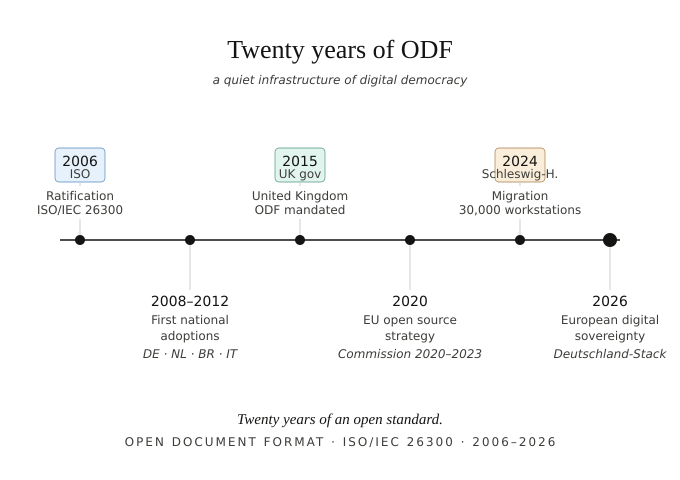
An image showing a simple horizontal timeline titled "Twenty Years of Open Document Formats", with the subtitle "a quiet infrastructure of digital democracy". It starts in 2006 with the ratification of ISO/IEC 26300; continues to 2008-2012 with the first national adoptions in Germany, the Netherlands, Brazil and Italy; goes on to 2015 when the UK government mandated the format; continues to 2020 with the EU open source strategy; comes closer to 2024 with the Schleswig-H. migration of 30 thousand workstations; and arrives in 2026 at the European digital sovereignty affairs and the Deutschland-Stack. At the bottom, the text reads: "Twenty years of an open standard.". -
@f4grx @libreoffice there's a reply in your screenshot pointing out the exact same issue maybe you didn't need to do it. Also the image is properly viewable on the linked article
@ineemio @f4grx @libreoffice it isn't, actually:
-
@the_wub @mr_harm @libreoffice
OOXML was specifically meant to frustrate and ideally block progress towards a non-Microsoft controlled standard.
And even Microsoft doesn’t know how it actually works.
None of this is hyperbole. It is all very extensively documented.
Open standards are the antidote to vendor lock-in, bar none.
@avuko @the_wub @mr_harm @libreoffice, what further helps the confusion is that the original MS OOXML, its ECMA implementation, its ISO implementation and the implementation in MS Office itself differ in important detail and are partially incompatible with one another.
-
@nanianmichaels @f4grx
Users wouldn't even need to notice the format change, just as they didn't in the past (for example, during the transition from the previous format to OOXML). Users simply need their existing documents to continue working.@karlggestd While that's true in general, do keep in mind that if you switch defaults to something that can have legal consequences, you're opening yourself up to A LOT of litigation.
For instance, you install something that changes the default to ODF, while OOXML is required to submit paperwork to an official entity like a court of law.
At this point, one of two things will happen:
1) User is tech-savvy enough to know how to change each new file to the format required, which is different than the previous default. User will then complain it's more difficult. Enough users complain, and suddenly there's an order to go back to MSOffice will come barreling down.
2) User doesn't know or care, it just knows they created the file as they always did, it got rejected by the court, and suddenly you're facing financial penalties or worse.
Don't get me wrong, ODF SHOULD be the default for official institutions. While it's not, changing the default is dangerous.
-
@flyingpenguin @josch @libreoffice that is possibly even less readable than the grey on black version ._.
@luc @josch @libreoffice achievement unlocked: bespreekbaarheid
-
@nanianmichaels @f4grx I doesn't have to be.
If the EU says that we all need to switch to an open file format that guarantees digital sovereignty then it will (eventually) happen.
But using OOXML is a trojan horse and MicroSoft will have lobbied hard for this default setting.
As regards MS's approach to office suites, remember that MS are about to kill most functionality in Office 2019 for Mac after having originally sold it with a so-called "perpetual" licence.
https://www.pcmag.com/news/microsoft-is-killing-office-2019-for-macs-heres-how-to-keep-your-files
@the_wub We're in agreement that ODF SHOULD be the default, since it's by default open, unlike OOXML.
And Microsoft has lobbied EXTENSIVELY for OOXML to be the default, and it will continue to do so.
The status quo is wrong, plain and simple.
But until the status quo changes (aka, ODF becomes the default file format for the EU and its governments), you NEED to offer proper OOXML support (and default it for new installs), otherwise your biggest chunk of the MSOffice user base (governments, and companies that deal with governments) will not even consider a piece of software as an alternative.
I very much want ODF to become the default file format ASAP, and the MSOffice dependency to end.
But that won't happen until the top deciders want to change it.
-
@karlggestd While that's true in general, do keep in mind that if you switch defaults to something that can have legal consequences, you're opening yourself up to A LOT of litigation.
For instance, you install something that changes the default to ODF, while OOXML is required to submit paperwork to an official entity like a court of law.
At this point, one of two things will happen:
1) User is tech-savvy enough to know how to change each new file to the format required, which is different than the previous default. User will then complain it's more difficult. Enough users complain, and suddenly there's an order to go back to MSOffice will come barreling down.
2) User doesn't know or care, it just knows they created the file as they always did, it got rejected by the court, and suddenly you're facing financial penalties or worse.
Don't get me wrong, ODF SHOULD be the default for official institutions. While it's not, changing the default is dangerous.
@nanianmichaels Maybe you should read the legal terms of any software out there, even the Microsoft software

Most of official entities are using PDF anyway (which adds its own set of problems) but when you have a policy of technological sovereignty things have to be part of it. How can we consider such a goal if the developers have already given up at the first hurdle?
About 2), those users will never trade their wonderful MS Office/365 for anything else.
-
@karlggestd While that's true in general, do keep in mind that if you switch defaults to something that can have legal consequences, you're opening yourself up to A LOT of litigation.
For instance, you install something that changes the default to ODF, while OOXML is required to submit paperwork to an official entity like a court of law.
At this point, one of two things will happen:
1) User is tech-savvy enough to know how to change each new file to the format required, which is different than the previous default. User will then complain it's more difficult. Enough users complain, and suddenly there's an order to go back to MSOffice will come barreling down.
2) User doesn't know or care, it just knows they created the file as they always did, it got rejected by the court, and suddenly you're facing financial penalties or worse.
Don't get me wrong, ODF SHOULD be the default for official institutions. While it's not, changing the default is dangerous.
@nanianmichaels in the other hand, I wouldn't say that OnlyOffice is dominating the market.
-
@nanianmichaels Maybe you should read the legal terms of any software out there, even the Microsoft software
Most of official entities are using PDF anyway (which adds its own set of problems) but when you have a policy of technological sovereignty things have to be part of it. How can we consider such a goal if the developers have already given up at the first hurdle?
About 2), those users will never trade their wonderful MS Office/365 for anything else.
-
The first FOSS suite was the own StarOffice, not OpenOffice.
And well, your png in that toot is horrible.
@karlggestd @libreoffice from https://en.wikipedia.org/wiki/StarOffice:
"5.2 was released 20 June 2000. Sun offered StarOffice 5.2 as a free download for personal use, and soon went through an exercise similar to Netscape's relicensing of Mozilla, by releasing most of the StarOffice source code under a free/open source license. The resultant free/open source software codebase fork continued development as older discontinued components, with contributions from both Sun and the wider OpenOffice.org community. Sun then took "snapshots" of the OpenOffice.org code base, integrated proprietary and third-party code modules, and marketed the package commercially. "
going from that info, StarOffice was not the 1st european FOSS office suite since only a part of the code/some components were open-sourced and the full suite was never released as FOSS at any point. OpenOffice.org was built from those parts, and expanded as fully FOSS to become the actual 1st european FOSS office suite.
-
An open letter to office suite users, just before the Euro-Office announcement
https://blog.documentfoundation.org/blog/2026/06/08/an-open-letter/
@libreoffice can you please add #AltText? I wrote one for you in the replies, here: https://gts.cairobraga.com/@cairobraga/statuses/01KTKE3QVMKBKZR7HYPTQ8TEFQ
-
@karlggestd @libreoffice from https://en.wikipedia.org/wiki/StarOffice:
"5.2 was released 20 June 2000. Sun offered StarOffice 5.2 as a free download for personal use, and soon went through an exercise similar to Netscape's relicensing of Mozilla, by releasing most of the StarOffice source code under a free/open source license. The resultant free/open source software codebase fork continued development as older discontinued components, with contributions from both Sun and the wider OpenOffice.org community. Sun then took "snapshots" of the OpenOffice.org code base, integrated proprietary and third-party code modules, and marketed the package commercially. "
going from that info, StarOffice was not the 1st european FOSS office suite since only a part of the code/some components were open-sourced and the full suite was never released as FOSS at any point. OpenOffice.org was built from those parts, and expanded as fully FOSS to become the actual 1st european FOSS office suite.
@cairobraga @libreoffice However meticulous you want to be, according to the section you linked, the suite included independent components that were not free software, but the suite itself was

You can say instead: "OpenOffice was the firs FOSS widely distributed suite".
-
@cairobraga @libreoffice However meticulous you want to be, according to the section you linked, the suite included independent components that were not free software, but the suite itself was
You can say instead: "OpenOffice was the firs FOSS widely distributed suite".
@karlggestd @libreoffice OK. have a nice week!


-
@richh @libreoffice yeah but that seems to be more of a usage policy decision which file format to use in every organization. Sure, it would be nice to recommend using odt, but that is not something you'd find in press releases regarding new products.
And it is kind of implied to use the native format to achieve best results. Also, a short web search showed that already quite a few organizations committed to it (Germany and the Netherlands,...)
@mr_harm @libreoffice Yes, ind orgs can set defaults on their local install.
It’s a human factor issue. Imagine you set ODF as default, everyone is happy with it but someone sends an OOXML file from MS Office which doesn’t render right in EO - it’s the sender’s problem. Save in ODF.
If OOXML is “standard”, then people blame EO for not opening it right, mgmt get complaints, maybe even recant and go back to MS because “EuroOffice doesn’t work”.ODF *is* the native format for most office suites. Forcing MS users to use ODF (because the rest of us are on LO/EO/OO) makes MS treat ODF compatibility as a first class format. Allowing Redmond to dictate the terms on which other office suites interoperate is a bad idea and will stymie adoption.
Obviously there are millions of old docs in MS format. EO needs to open them. Doesn’t mean new docs going forward need to make the issue worse.