An open letter to office suite users, just before the Euro-Office announcement
-
@mr_harm @libreoffice It puts you at the whim of MS. If MS change something in OOXML, everyone has to jump up and fix their implementation. Moreover, if MSOffice users send you a file which then doesn’t open properly in EuroOffice/OnlyOffice/LibreOffice then users will complain about “this new thing doesn’t work properly, why can’t we just use MSOffice like we always have?”.
For sure, if ODF changes, everyone needs to update. But that’s the result of a public committee decision and there will be a standards document describing the spec - not reverse-engineering whatever Redmond have done unilaterally.
If you default to a genuinely open spec like ODF, then in a couple of years when people are used to it, if an OOXML file doesn’t open, their instinct will be the at the sender is at fault, not them. And they’ll ask them to resend it in ODF.
In 2026, there’s just no reason to use proprietary formats for things like standard productivity suites.
@richh @libreoffice yeah but that seems to be more of a usage policy decision which file format to use in every organization. Sure, it would be nice to recommend using odt, but that is not something you'd find in press releases regarding new products.
And it is kind of implied to use the native format to achieve best results. Also, a short web search showed that already quite a few organizations committed to it (Germany and the Netherlands,...)
-
An open letter to office suite users, just before the Euro-Office announcement
https://blog.documentfoundation.org/blog/2026/06/08/an-open-letter/
@libreoffice
I hope/predict that the unfortunate and sucky choice of OOXML default format is just a legacy of having been forked from OmlyOffice.With moves in the EU to mandate ODF as a default, I do have hopes this will be flipped to an ODF default sooner rather than later. And that would support the ecosystem favouring LibreOffice as well.
-
An open letter to office suite users, just before the Euro-Office announcement
https://blog.documentfoundation.org/blog/2026/06/08/an-open-letter/
@libreoffice here's how your post rendered in my client btw
-
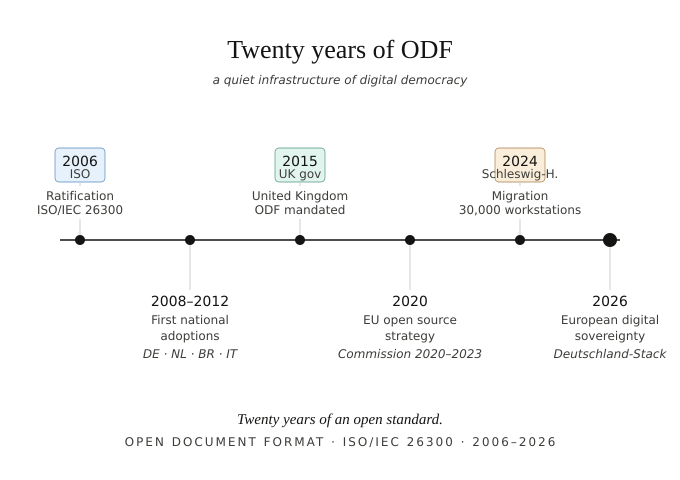
@libreoffice Hello libreoffice team! Thank you for your work! The PNG you uploaded has a transparent background. This means that when shown in interfaces with a dark background, only the white boxes (2006, 2015, 2024) will be visible because the rest is just black lines and letters on black background. In this case, an alt-text would even very much help the sighted people. Thank you!
 ️
️ -
An open letter to office suite users, just before the Euro-Office announcement
https://blog.documentfoundation.org/blog/2026/06/08/an-open-letter/
@libreoffice this is how your toot appear here: unreadable. please test your toots with some dark theme apps.
-
@libreoffice this is how your toot appear here: unreadable. please test your toots with some dark theme apps.
@libreoffice same in full screen, the background is even darker.
-
I'm not sure whether this is a problem of me using dark mode, but the text in the box is light black on a black background and impossible to read...
@ckd @libreoffice it's not just you.
-
An open letter to office suite users, just before the Euro-Office announcement
https://blog.documentfoundation.org/blog/2026/06/08/an-open-letter/
@libreoffice oh fuck this is a nightmare. These wars on file formats will NEVER end.
-
@libreoffice Thanks for the extra info about Euro Office. Is it known why they have chosen to default to OOXML, is there a limitation in ODF that they don't put the work in to implement? I understand that might be something only they can answer, but you seem to have done research on it.
@jmbmkn @libreoffice my guess is microslop lobbying.
-
@libreoffice this is how your toot appear here: unreadable. please test your toots with some dark theme apps.
@f4grx @libreoffice there's a reply in your screenshot pointing out the exact same issue maybe you didn't need to do it. Also the image is properly viewable on the linked article
-
@jmbmkn OnlyOffice (the software Euro Office forked from) does support ODF natively.
The difference is OnlyOffice defaults to saving documents in OOXML format (and supports it better than LibreOffice, in my experience, I've had data loss from LibreOffice crashing while dealing with Word documents, and such thing has never happened with OnlyOffice).
The reason to default to OOXML instead of ODF stems, AFAIK, from OnlyOffice (and I assume also Euro Office) wanting to be a "drop-in" replacement to MSOffice, where you can be sure you'll be complying with what is the de-facto office file format used in A LOT of companies.
Also, for many governments, MSOffice is still the go-to office suite and OOXML the file format public entities MUST use.
So, while those requirements don't change, defaulting to OOXML makes sense.
@nanianmichaels @jmbmkn the ooxml format is a breach of sovereignity. It's Microslop doing the usual EEE strategy.
-
An open letter to office suite users, just before the Euro-Office announcement
https://blog.documentfoundation.org/blog/2026/06/08/an-open-letter/
@libreoffice please replace the image with one that isn’t transparent and add an alt text describing the timeline shown in it.
-
@nanianmichaels @jmbmkn the ooxml format is a breach of sovereignity. It's Microslop doing the usual EEE strategy.
@f4grx That is NOT the point I was trying to make, nor was what the person I was replying to had asked.
As it stands, OOXML is THE de-facto file format in use by most EU institutions, as well as many EU governments (fun fact, in Portugal, if you are submitting text documents to a court, you need to submit them in at best DOC or DOCX formats, if they need to be editable), and even companies.
Defaulting to ODF in those circumstances will only keep your users stuck to Microsoft, because changing the default will introduce friction most users can't or won't deal with.
Starting with moving people to FOSS and then introduce a different file format introduces MUCH less friction, and is thus easier to achieve.
That being said, I've read recently the EU wants to promote digital sovereignty even harder, so hopefully making ODF the default for governments is in the cards, which would force it to trickle down to companies and users, which IMO should be (and likely is) the end goal.
-
@flyingpenguin @josch @libreoffice that is possibly even less readable than the grey on black version ._.
-
An open letter to office suite users, just before the Euro-Office announcement
https://blog.documentfoundation.org/blog/2026/06/08/an-open-letter/
The first FOSS suite was the own StarOffice, not OpenOffice.
And well, your png in that toot is horrible.
-
@f4grx That is NOT the point I was trying to make, nor was what the person I was replying to had asked.
As it stands, OOXML is THE de-facto file format in use by most EU institutions, as well as many EU governments (fun fact, in Portugal, if you are submitting text documents to a court, you need to submit them in at best DOC or DOCX formats, if they need to be editable), and even companies.
Defaulting to ODF in those circumstances will only keep your users stuck to Microsoft, because changing the default will introduce friction most users can't or won't deal with.
Starting with moving people to FOSS and then introduce a different file format introduces MUCH less friction, and is thus easier to achieve.
That being said, I've read recently the EU wants to promote digital sovereignty even harder, so hopefully making ODF the default for governments is in the cards, which would force it to trickle down to companies and users, which IMO should be (and likely is) the end goal.
@nanianmichaels @f4grx I doesn't have to be.
If the EU says that we all need to switch to an open file format that guarantees digital sovereignty then it will (eventually) happen.
But using OOXML is a trojan horse and MicroSoft will have lobbied hard for this default setting.
As regards MS's approach to office suites, remember that MS are about to kill most functionality in Office 2019 for Mac after having originally sold it with a so-called "perpetual" licence.
https://www.pcmag.com/news/microsoft-is-killing-office-2019-for-macs-heres-how-to-keep-your-files
-
@libreoffice so LibreOffice will stop supporting OOXML format and no longer do marketing with the fact it can also handle OOXML documents to attract newcomers? The marketing argument IMO is therefore not fully fair and debatable (I do favor ODF, but there is inconsistency in the argumentation I feel). In the end the only difference is the chosen default format, but also LibreOffice supports both ODF and OOXML.
Just focus on governments prioritizing ODF format instead of focusing on OOXML? It's always stronger to advocate in favor of something then against something. LibreOffice has done A LOT to make ODF more known and the ODF (foundation) deserves credits for that! Think positive!@zandbelt @libreoffice
You can see the difference between using a native format and being able to use other formats, versus using a closed format as if it were native.ODF first, use any format, vs. OOXML first.mat.
-
@f4grx That is NOT the point I was trying to make, nor was what the person I was replying to had asked.
As it stands, OOXML is THE de-facto file format in use by most EU institutions, as well as many EU governments (fun fact, in Portugal, if you are submitting text documents to a court, you need to submit them in at best DOC or DOCX formats, if they need to be editable), and even companies.
Defaulting to ODF in those circumstances will only keep your users stuck to Microsoft, because changing the default will introduce friction most users can't or won't deal with.
Starting with moving people to FOSS and then introduce a different file format introduces MUCH less friction, and is thus easier to achieve.
That being said, I've read recently the EU wants to promote digital sovereignty even harder, so hopefully making ODF the default for governments is in the cards, which would force it to trickle down to companies and users, which IMO should be (and likely is) the end goal.
@nanianmichaels @f4grx
Users wouldn't even need to notice the format change, just as they didn't in the past (for example, during the transition from the previous format to OOXML). Users simply need their existing documents to continue working. -
An open letter to office suite users, just before the Euro-Office announcement
https://blog.documentfoundation.org/blog/2026/06/08/an-open-letter/
@libreoffice #Alt4You
An image showing a simple horizontal timeline titled "Twenty Years of Open Document Formats", with the subtitle "a quiet infrastructure of digital democracy". It starts in 2006 with the ratification of ISO/IEC 26300; continues to 2008-2012 with the first national adoptions in Germany, the Netherlands, Brazil and Italy; goes on to 2015 when the UK government mandated the format; continues to 2020 with the EU open source strategy; comes closer to 2024 with the Schleswig-H. migration of 30 thousand workstations; and arrives in 2026 at the European digital sovereignty affairs and the Deutschland-Stack. At the bottom, the text reads: "Twenty years of an open standard.". -
@f4grx @libreoffice there's a reply in your screenshot pointing out the exact same issue maybe you didn't need to do it. Also the image is properly viewable on the linked article
@ineemio @f4grx @libreoffice it isn't, actually: