Good morning Mastodon!
-
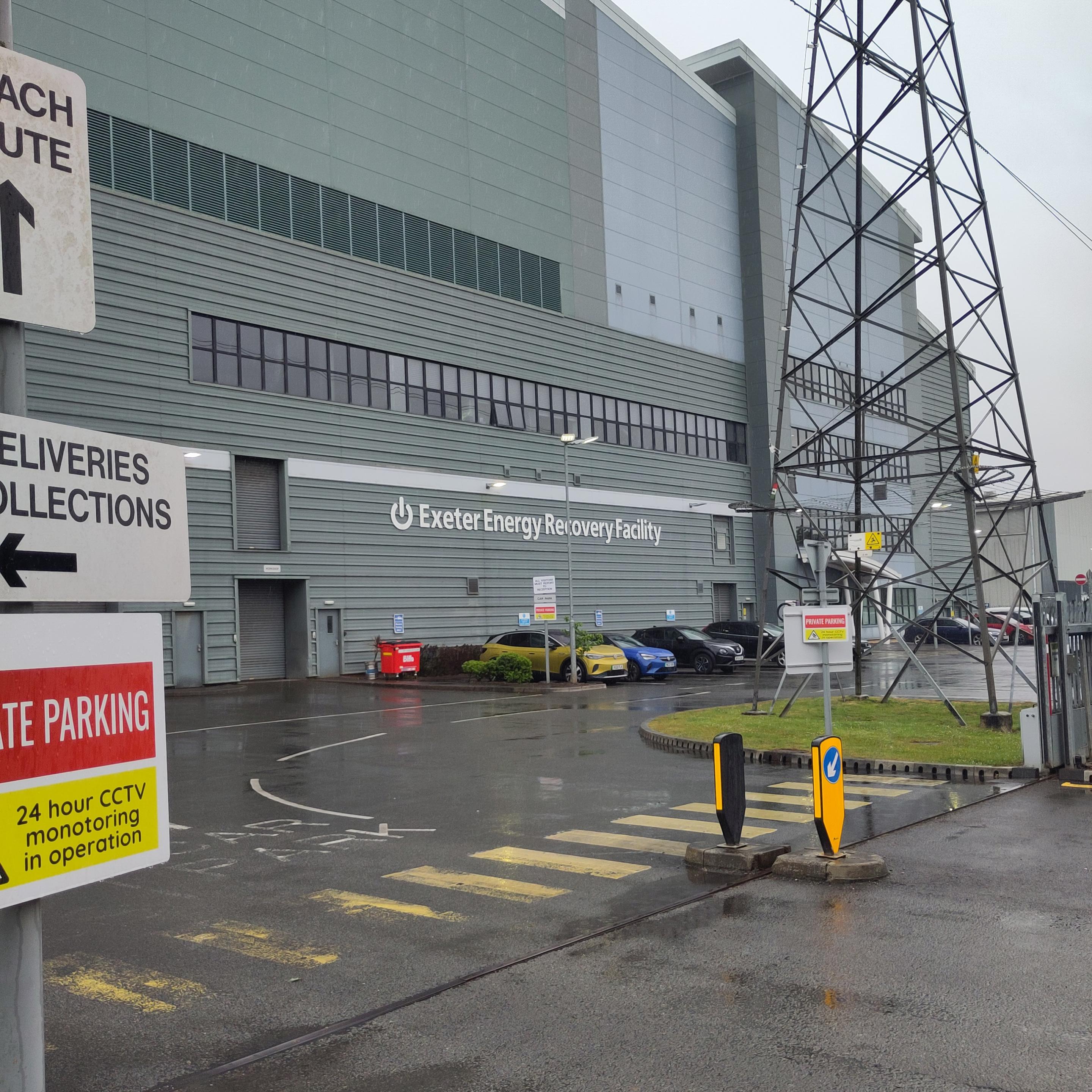
The Exeter and Plymouth plants incinerate residual waste (ie what's left over when everything recyclable or compostable has been removed) and generate electricity. There were plans to use the generated heat of the Exeter plant for a district heating system but they never came to fruition. The Plymouth plant does run a district heating system which heats the neighbouring Royal Navy barracks and dockyard, and I'm honestly not sure how I feel about the fact we can manage to implement the most sustainable solution, but apparently only in the service of waging war more efficiently
The Exeter plant produces 24,000 MWh/year. I've written down that it consumes 75 somethings for its own operation and exports the rest to the grid, but this will be amended with the correct more legible figure when I get a copy of the presentation.
-
The Exeter plant produces 24,000 MWh/year. I've written down that it consumes 75 somethings for its own operation and exports the rest to the grid, but this will be amended with the correct more legible figure when I get a copy of the presentation.
The plant takes residual waste from mid Devon where I live, so some of my illegible scrawls may have been illuminated by photons generated from my very own household's cat turds and plastic films. It doesn't take all the University's waste, which not including specialist chemical and biological waste generated by the laboratories is managed by three separate subcontractors. The student accommodation blocks are managed by two separate contractors, who contract out their waste collection to different contractors, and the non-accommodation buildings have another separate waste collection contract. Very illogically waste doesn't go to the nearest disposal facility, it could be trucked across the country to the one the cheapest contractor has a contract with.
-
The plant takes residual waste from mid Devon where I live, so some of my illegible scrawls may have been illuminated by photons generated from my very own household's cat turds and plastic films. It doesn't take all the University's waste, which not including specialist chemical and biological waste generated by the laboratories is managed by three separate subcontractors. The student accommodation blocks are managed by two separate contractors, who contract out their waste collection to different contractors, and the non-accommodation buildings have another separate waste collection contract. Very illogically waste doesn't go to the nearest disposal facility, it could be trucked across the country to the one the cheapest contractor has a contract with.
The Marsh Barton facility isn't actually owned by the council, it has a contract with company Viridor which it pays to operate it. This is all utterly insane and probably Margaret Thatcher's fault.
-
The plant takes residual waste from mid Devon where I live, so some of my illegible scrawls may have been illuminated by photons generated from my very own household's cat turds and plastic films. It doesn't take all the University's waste, which not including specialist chemical and biological waste generated by the laboratories is managed by three separate subcontractors. The student accommodation blocks are managed by two separate contractors, who contract out their waste collection to different contractors, and the non-accommodation buildings have another separate waste collection contract. Very illogically waste doesn't go to the nearest disposal facility, it could be trucked across the country to the one the cheapest contractor has a contract with.
@afewbugs what are the emissions from the plant ?
-
The Marsh Barton facility isn't actually owned by the council, it has a contract with company Viridor which it pays to operate it. This is all utterly insane and probably Margaret Thatcher's fault.
@afewbugs What isn't, really?
-
@afewbugs what are the emissions from the plant ?
@quixoticgeek I'm getting to that but there's a spoiler here if you want to skip ahead https://www.viridor.co.uk/exeter-emissions-data/
-
The Exeter plant produces 24,000 MWh/year. I've written down that it consumes 75 somethings for its own operation and exports the rest to the grid, but this will be amended with the correct more legible figure when I get a copy of the presentation.
@afewbugs that's only a ~2.7MW power plant. Less than a modern wind turbine. That's lower than I expected.
-
The Marsh Barton facility isn't actually owned by the council, it has a contract with company Viridor which it pays to operate it. This is all utterly insane and probably Margaret Thatcher's fault.
@afewbugs I suspect use of the communal heating only in RN barracks and dockyard is because military is often the only well funded and trusted public sector organisation these days, and they have the clout to impose on sailors and shipbuilders what heating solutions are used rather than let them choose their own.
There are district heating schemes in Britain but very few and ever since the govt has considered increasing regulation and demanding more customer service no private businesses want to build them..
-
The Marsh Barton facility isn't actually owned by the council, it has a contract with company Viridor which it pays to operate it. This is all utterly insane and probably Margaret Thatcher's fault.
Here's a schematic of the process.
-
@afewbugs that's only a ~2.7MW power plant. Less than a modern wind turbine. That's lower than I expected.
@quixoticgeek The primary purpose it was built for is disposing of waste, not creating energy I think. There are much more efficient ways to produce electricity, and the energy density of household waste is apparently very variable and often fairly low, depending on what's getting burnt
-
Here's a schematic of the process.
So starting at the beginning of the proccess, waste collection lorries drive in and drop residual waste into this great big pit that may or may not have a giant space octopus at the bottom
-
So starting at the beginning of the proccess, waste collection lorries drive in and drop residual waste into this great big pit that may or may not have a giant space octopus at the bottom
Waste is then collected from the pit using this giant claw and dropped into the hopper feeding the kiln
-
Waste is then collected from the pit using this giant claw and dropped into the hopper feeding the kiln
When we visited the world's biggest claw machine was operated by an extremely tolerant bloke called Ashley, who very good naturedly answered all our questions while trying to get on with his job. A couple of people told him he had the coolest job in the world, to which he replied that it had been for the first six hours or so but after that it got a bit boring.
-
When we visited the world's biggest claw machine was operated by an extremely tolerant bloke called Ashley, who very good naturedly answered all our questions while trying to get on with his job. A couple of people told him he had the coolest job in the world, to which he replied that it had been for the first six hours or so but after that it got a bit boring.
The reason waste is manually dropped into the kiln by a bloke in fancy chair, instead of just fed in automatically by gravity or something, is to make sure that nothing too big goes in that would block the hopper but also to make sure no animals or people end up falling in. As the plant runs continually apart from planned shutdowns for maintenance there is a bloke doing this 24/7, as well as support staff on site at all times. There are always at least two people in the control room.
-
The reason waste is manually dropped into the kiln by a bloke in fancy chair, instead of just fed in automatically by gravity or something, is to make sure that nothing too big goes in that would block the hopper but also to make sure no animals or people end up falling in. As the plant runs continually apart from planned shutdowns for maintenance there is a bloke doing this 24/7, as well as support staff on site at all times. There are always at least two people in the control room.
The actual incineration and heat generation takes place in a giant rotary kiln, which looks like a gigantic insulated cement mixers. The best I can do for you for a picture right now is some fire on a screen I'm afraid, there was a great photo of it being lowered in to place with a person for scale in the presentation and I assumed I'd be able to find that on the internet somewhere but I haven't been able to. I'll add it hen I get the email of the presentation.
-
The actual incineration and heat generation takes place in a giant rotary kiln, which looks like a gigantic insulated cement mixers. The best I can do for you for a picture right now is some fire on a screen I'm afraid, there was a great photo of it being lowered in to place with a person for scale in the presentation and I assumed I'd be able to find that on the internet somewhere but I haven't been able to. I'll add it hen I get the email of the presentation.
@afewbugs Literally rode past it not half an hour ago!
-
The actual incineration and heat generation takes place in a giant rotary kiln, which looks like a gigantic insulated cement mixers. The best I can do for you for a picture right now is some fire on a screen I'm afraid, there was a great photo of it being lowered in to place with a person for scale in the presentation and I assumed I'd be able to find that on the internet somewhere but I haven't been able to. I'll add it hen I get the email of the presentation.
The rotary kiln for the Exeter plant was built in France, managed to cross the whole of France on an articulated lorry, was successfully shipped across the channel and driven across most of Southern England, then got stuck on a narrow road through the Haldon Hills and had to be extracted by crane.
-
The rotary kiln for the Exeter plant was built in France, managed to cross the whole of France on an articulated lorry, was successfully shipped across the channel and driven across most of Southern England, then got stuck on a narrow road through the Haldon Hills and had to be extracted by crane.
@afewbugs Your rubbish thread today is pure 100% treasure


-
The Marsh Barton facility isn't actually owned by the council, it has a contract with company Viridor which it pays to operate it. This is all utterly insane and probably Margaret Thatcher's fault.
@afewbugs Things mostly are.
-
The rotary kiln for the Exeter plant was built in France, managed to cross the whole of France on an articulated lorry, was successfully shipped across the channel and driven across most of Southern England, then got stuck on a narrow road through the Haldon Hills and had to be extracted by crane.
Actually I can do a bit better than fire on a screen. I hope you like videos of the edge of something rotating very slowly just about visible between bits of an industrial facility Mastodon.