Shifting baseline syndrome ( #SBS ) is what happens when we forget how vibrant the natural world used to be.
-
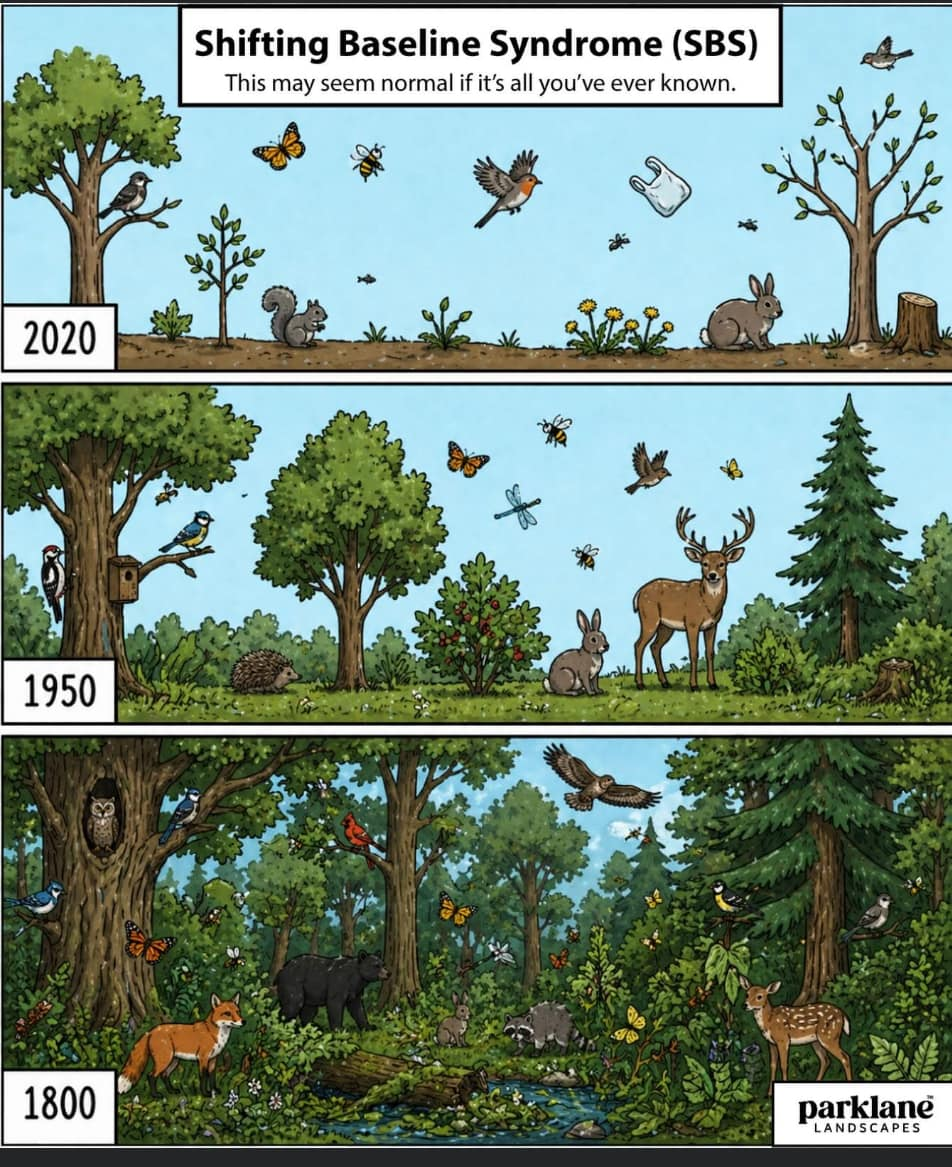
Shifting baseline syndrome ( #SBS ) is what happens when we forget how vibrant the natural world used to be. Each generation grows up with a more depleted environment and calls it “normal,” simply because it’s all they’ve ever known.
Researchers warn that this shift lowers our expectations, increases our tolerance for decline, and reduces our urgency to protect what’s left.
@Jeroen89 I miss the fireflies from my childhood.
-
Shifting baseline syndrome ( #SBS ) is what happens when we forget how vibrant the natural world used to be. Each generation grows up with a more depleted environment and calls it “normal,” simply because it’s all they’ve ever known.
Researchers warn that this shift lowers our expectations, increases our tolerance for decline, and reduces our urgency to protect what’s left.
@Jeroen89 I experienced a sort of wake up call to this visiting where I grew up for the first time in a decade. It was the first time I ever saw wild grasses there as hues of brown and yellow instead of green. Growing up, it was the greenest place I had ever seen. Even photos of other places didn't compare. It felt like the entire area, not just the people and the infrastructure, but the land itself was dying in front of me. It was horrifying.
-
Shifting baseline syndrome ( #SBS ) is what happens when we forget how vibrant the natural world used to be. Each generation grows up with a more depleted environment and calls it “normal,” simply because it’s all they’ve ever known.
Researchers warn that this shift lowers our expectations, increases our tolerance for decline, and reduces our urgency to protect what’s left.
@Jeroen89 I looked at the image without reading the text and at first understood it as "this is what regeneration can look like", with baseline at the top and what could be in a few decades at the bottom.
Join your local bushcare / bush regeneration / land care / ecological restoration group.


-
Shifting baseline syndrome ( #SBS ) is what happens when we forget how vibrant the natural world used to be. Each generation grows up with a more depleted environment and calls it “normal,” simply because it’s all they’ve ever known.
Researchers warn that this shift lowers our expectations, increases our tolerance for decline, and reduces our urgency to protect what’s left.
@Jeroen89
The ever lowering baseline. I remember when thousands and thousands of salmon came up my river to spawn in the fall. Today's people get excited by a couple hundred fish. The meadows in my home creek watershed were 98% CA native. Then in early 2020 some do gooders weed whacked 5 miles of the verge of the rd. Required by the state for a pot growing permit. They introduced 5 highly invasive species because they came with seed contaminated weedwhackers. Then they weed whacked again the next year and spread inavasive seeds far and wide, as a requirement for their stupid pot grow, when all the newly introduced invasives were setting seeds. It's unbelievable how fast those introduced invasive annual grasses, moved from the rd to ridge tops covering average, and have wiped out the incredible plant diversity that coexisted in our meadows for thousands of years. . The human new comers have no idea of the tragedy that has unfolded because of their stupid weed whacking . The road to hell is paved with good intentions. And our fire hazard has increased 1000 fold with these annual grasses that build up thick mats of bone dry tinder by May ,and our lovely diverse low growing , fire resilient , native meadows are almost gone. It's unbelievable how quickly the destruction occured. And the next generation will know that man made out of balance mess . . as normal. -
Shifting baseline syndrome ( #SBS ) is what happens when we forget how vibrant the natural world used to be. Each generation grows up with a more depleted environment and calls it “normal,” simply because it’s all they’ve ever known.
Researchers warn that this shift lowers our expectations, increases our tolerance for decline, and reduces our urgency to protect what’s left.
I've been driving interstate ( #australia) for the past 40 years...
... Early on, each time I stopped for gas, I had to scrape thick mush of dead insects off the car.
I used to have fly screen mesh on the car grill so insects wouldn't clog the radiator.
These days I travel less often, but there are only about 10-25% as many insects
-
@martaczc this appears to be the original source:
https://www.facebook.com/weareparklanelandscapes/posts/pfbid0Q5N7mYUxe12PJ4rnnFBqZW7LDU4gMGQTih54ofHo94MFJYtGhn2NvW62dTFc6oxUl -
@sarae What are some of the AI styles?
@kete @sarae This specific look of cartoon illustration is very common among AI image generators. I think it's useful to be able to recognize because you really do start seeing it all over the place.
(Someone else in the mentions pointed out that this has an odd mix of North American and European animals, which isn't what you'd expect to see in an informative illustration created by an actual human.)
-
Shifting baseline syndrome ( #SBS ) is what happens when we forget how vibrant the natural world used to be. Each generation grows up with a more depleted environment and calls it “normal,” simply because it’s all they’ve ever known.
Researchers warn that this shift lowers our expectations, increases our tolerance for decline, and reduces our urgency to protect what’s left.
@Jeroen89 I’m old enough to remember front number plates being covered in dead insects after a moderately short drive. Now I can drive thousands of miles and perhaps get just a couple of the poor unfortunates on my car. That’s an apocalyptic decrease!
-
 B bettina@mastodon.nu shared this topic
-
RE: https://mastodon-belgium.be/@Jeroen89/116493556060663013
@Jeroen89 can't remember the last time I heard bugs on a windshield
-
Shifting baseline syndrome ( #SBS ) is what happens when we forget how vibrant the natural world used to be. Each generation grows up with a more depleted environment and calls it “normal,” simply because it’s all they’ve ever known.
Researchers warn that this shift lowers our expectations, increases our tolerance for decline, and reduces our urgency to protect what’s left.
@Jeroen89 The difference between 1850 and 1950 is apocalyptic. The extermination of trees for logging, the near extinction of the American chestnut trees, and the introduction of kudzu.
We’ve been tampering with forests for far longer though: https://www.americanforests.org/article/north-american-forests-in-the-age-of-man/
-
@jrdepriest @footils @Jeroen89
I was brought up in the industrial West of Germany, but 40 years ago, even there a drive on the Autobahn at night meant you had to pull over regularly to clean all the dead insects off your windshield.
Nowadays I can drive for hours without a single bug hitting my car...
-
@jrdepriest @footils @Jeroen89
I was brought up in the industrial West of Germany, but 40 years ago, even there a drive on the Autobahn at night meant you had to pull over regularly to clean all the dead insects off your windshield.
Nowadays I can drive for hours without a single bug hitting my car...
@ckd @jrdepriest @Jeroen89
The car has won. -
@Jeroen89 If you want a jungle, you need to let it be a jungle. There's no "carefully extracting some resources" or any such thing, it will destroy the jungle. (I use jungle in a generic way to mean "nature, undisturbed" if I may.) And that's why with capitalism, you cannot have jungles. All jungles will be "extracted for profit" because growing the jungle is an externalized (to the past) cost, not having the jungle is an externalized (to the future) cost, but profit is being made NOW. Want change? Gotta go chop down some rich people instead of trees, no way around it.
 (Figuratively, of course. But chop you must.)
@phf @Jeroen89 Actually, chopping down billionaires literally could be ethically justified... As long as you are environmentally aware, and make sure you dispose of the bodies in an environmentally friendly way. The effect of one billionaire on the world is more than a great number of the world's countries.
-
@atlovato Only problem being that taking their money will not save the jungle.
@phf - Yeah; @ObsidianUrbex age has just begun and they don't care about you and I.
-
Shifting baseline syndrome ( #SBS ) is what happens when we forget how vibrant the natural world used to be. Each generation grows up with a more depleted environment and calls it “normal,” simply because it’s all they’ve ever known.
Researchers warn that this shift lowers our expectations, increases our tolerance for decline, and reduces our urgency to protect what’s left.
@Jeroen89 Wenn "Umweltschützer" einen ihrer Meinung nach "ursprünglichen" oder "natürlichen" Zustand "wieder" herstellen wollen, wird auch oft nur Schaden angerichtet.
-
@Jeroen89 is it ai generated picture? It contains a strange mixture of european and north american species, which may be typical nowadays, but not in 1800.
-
@kete @sarae This specific look of cartoon illustration is very common among AI image generators. I think it's useful to be able to recognize because you really do start seeing it all over the place.
(Someone else in the mentions pointed out that this has an odd mix of North American and European animals, which isn't what you'd expect to see in an informative illustration created by an actual human.)
-
Shifting baseline syndrome ( #SBS ) is what happens when we forget how vibrant the natural world used to be. Each generation grows up with a more depleted environment and calls it “normal,” simply because it’s all they’ve ever known.
Researchers warn that this shift lowers our expectations, increases our tolerance for decline, and reduces our urgency to protect what’s left.
@Jeroen89 I emailed this to Parklane Landscapes, "There is an interesting conversation on Mastodon social media about a graphic attributed to your organization. I have attached a link to the conversation. My question is was your graphic AI generated? It illustrates a concept we should be aware of, but using AI on a regular basis can be questionable for "nature workers" due to the negative environmental costs of implementing the technology. I would appreciate it if you were to clarify this."
-
Shifting baseline syndrome ( #SBS ) is what happens when we forget how vibrant the natural world used to be. Each generation grows up with a more depleted environment and calls it “normal,” simply because it’s all they’ve ever known.
Researchers warn that this shift lowers our expectations, increases our tolerance for decline, and reduces our urgency to protect what’s left.
@Jeroen89 Good for educational classes on the environment, notably to kids. It creates awareness.
-
@Jeroen89 I emailed this to Parklane Landscapes, "There is an interesting conversation on Mastodon social media about a graphic attributed to your organization. I have attached a link to the conversation. My question is was your graphic AI generated? It illustrates a concept we should be aware of, but using AI on a regular basis can be questionable for "nature workers" due to the negative environmental costs of implementing the technology. I would appreciate it if you were to clarify this."
@gdjp Thank you. Since the picture had their label on it, I didn't think of putting it in the reference.
Likewise I didn't think to check if it's AI made. To me, it supports the message. And in this case, it's clear (being cartoonish).
But next time I will check it and add it if I think it's AI generated