I was about to Have Opinions about the threats the US is making to Greenland, Denmark and Europe, then realised I have nothing useful to add, so I pressed Delete.
-
It upsets me that there are no umlauts in the word umlaut
@CiaraNi well, you can always create the diminutive with -chen, tweaking it to contain an umlaut:
Umläutchen
-
@CiaraNi
Omlyd, direkte oversat -
-
The one positive from the fascist's reign is that he has united the rest of the world in a way rarely seen.
As a fellow threatenee, I feel close to Denmark in a way i never have.
We have "elbows up"(a hockey reference) as our rallying cry. Do you have anything similar? -
@CiaraNi @hanscees Sorry for being boring, but just felt like writing this: (And you probably know this already, but others might not.)
Personally I use the term "umlaut" only to describe the phenomenon in German and Swedish (and possibly other Germanic languages) where the spelling of a word changes when it is inflected in plural so that to an "a" or "o" the two dots are added. Like "Apfel" (apple) (singular) -> "Äpfel" (apples) (plural), or in Swedish "man" (man) -> "män" (men).
But not all instances of ä or ö in German or Swedish are umlauts. For instance "Käse" (cheese) in German or kärna (kernel) in Swedish are not plural, and are not some other inflection either of a corresponding word without the dots. There is no corresponding word "Kase" or "karna".
And let's not forget that sometimes what looks like an umlaut is actually a diaeresis.
https://en.wikipedia.org/wiki/Diaeresis_(diacritic) -
It upsets me that there are no umlauts in the word umlaut
@CiaraNi
One of my many cheeky pleasures is to deliberately pronounce the umlauts in the band name "Mötley Crüe". -
It upsets me that there are no umlauts in the word umlaut
@CiaraNi I'm studying an 18th century German musician named Friedrich Dulon. I'm monolingual, and the U in his name has one, and I have no idea what it means for pronunciation.
-
It upsets me that there are no umlauts in the word umlaut
@CiaraNi
cedilla would like a word. -
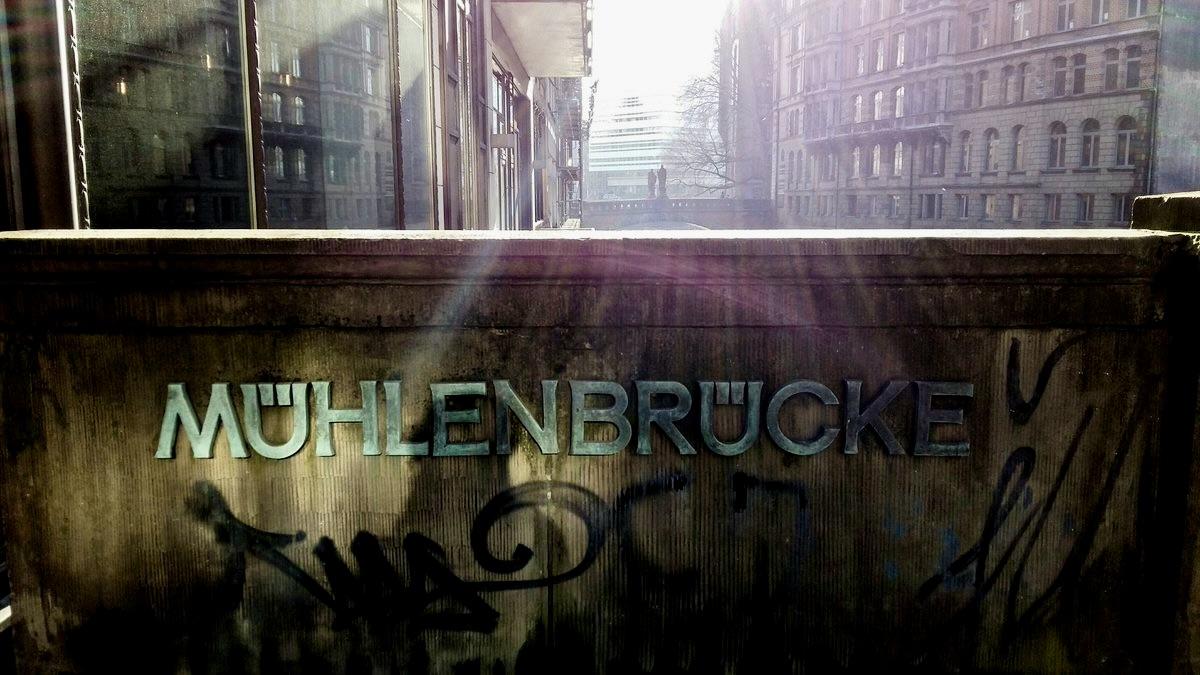
I was about to Have Opinions about the threats the US is making to Greenland, Denmark and Europe, then realised I have nothing useful to add, so I pressed Delete. Instead, here's a picture I took of a bridge because it had splendid umlauts.
@CiaraNi Me, too, regarding "nothing useful to add" — no matter how horrified I am.
Very cool umlauts!
-
It upsets me that there are no umlauts in the word umlaut
@CiaraNi Nor in the French ë/ï/ü – the trema (l’accent tréma)
-
And let's not forget that sometimes what looks like an umlaut is actually a diaeresis.
https://en.wikipedia.org/wiki/Diaeresis_(diacritic) -
It upsets me that there are no umlauts in the word umlaut
It would be impossible to type on a US keyboard, not to talk about the crime known as 7-bit ASCII.
-
-
-
@CiaraNi
cedilla would like a word.@id1om I would like to have a word with these diacriticless diacritics
-
@CiaraNi I'm studying an 18th century German musician named Friedrich Dulon. I'm monolingual, and the U in his name has one, and I have no idea what it means for pronunciation.
@ChristineMalec My school German hangs on in snippets, but the pronunciation difference with or without an umlaut is long gone from my brain, so I don't know either. Maybe somebody else can help us here.
-
And let's not forget that sometimes what looks like an umlaut is actually a diaeresis.
https://en.wikipedia.org/wiki/Diaeresis_(diacritic) -
It upsets me that there are no umlauts in the word umlaut
@CiaraNi It really does seem like a severely missed opportunity.
-
@CiaraNi
One of my many cheeky pleasures is to deliberately pronounce the umlauts in the band name "Mötley Crüe".@mlazz The kind of nice little pleasure that makes our personal worlds go around.
-
@CiaraNi I'm studying an 18th century German musician named Friedrich Dulon. I'm monolingual, and the U in his name has one, and I have no idea what it means for pronunciation.
ü is a sound we don't have in English. To make it, say a long E sound (the sound in "leek" or "wheel") but with your lips rounded as if you were saying a u sound. It's hard; you'll have to overcome programs your brain learned when you were a toddler to make the inside of your mouth try to make the 'e' sound while your lips are trying to make the 'u' sound. That combination makes the ü.